Michigan has its share of open-air museums: Greenfield Village, Crossroads Village, Mill Race Village, Charlton Park, Greenmead Village, Troy Historical Village, Port Sanilac Historical Village, and, of course, the forts and replications done up in Mackinaw City and Mackinac Island.
There is also Historic Fort Wayne in Downtown Detroit.
But this posting is going to be a different kind of history trip, and many folks don't think of my great state in this manner - - - - as a historical destination spot.
Read on....
This week's posting is about my home state of Michigan and a few (just a few!) of its historic structures. I'm the kind of guy that will stop the car while I'm driving if I see a building or a scene that I simply must take a photograph of. There are many wonderful homes and buildings from the 19th century that are still in - or very near - their original location, and I thought I'd highlight some of them.
So roll on up, for this Michigan Magical History Tour is waiting to take you away...
This first area we will stop off at in our time-travel journey is a place that is very near to my heart - the Village of Lexington. Lexington, named for the famed Revolutionary War town in Massachusetts, is a little more than an hour north of Detroit, along the banks of Lake Huron. My grandfather bought a cottage back in 1956 on a small plot of land just a few miles south of it, so heading into Lexington was always a fun treat. Still is!
And Lexington has its share of historical structures still standing in their original locations. Come with me to see a few...
The place that I'm highlighting first is not our family cottage but it is a cottage that is only a couple roads away - a ten minute walk. We always called it the Stone Castle.
 |
The Stone Castle in the subdivision of Great Lakes Shores on the outskirts of Lexington, Michigan.
|
The stone castle was built in the very early 1930's by using the rocks from the beach from nearby Lake Huron. Numerous times I've been told by various members of the family that family and friends made a line nearly an eighth of a mile long and passed the rocks from the beach up the road to the location hand-to-hand.
 |
| The stone fence surrounding the castle also has a neat European flavor, including the Tower of Pisa. |
It has become one of the sites off the beaten path that is worth checking out because of its uniqueness. I have never seen anything like it, that's for sure.
The descendents of the original builder recently sold the place to a non-family member.
Another structure in Lexington - more of a landmark actually - is the Cadillac Hotel.
The first hotel in the village was built and kept by C.L. Mills in 1840. He traded it a short time later for a farm to James Yake who in turn sold it to J.W. Buel. Buel's mother, Mrs. Mary Buel, kept the place until it had burned down in 1859. In 1860 the current Hotel Cadillac was built by John L. Woods and opened to the public with a ball on July 4 of that year.
 |
| The Cadillac Hotel before historic renovation... |
And after (as of 2018):
 |
From what I understand, this is pretty much how it originally looked back in 1860.
Pretty cool, huh? |
From what I read, the Moore Public Library was built in 1859 as "The Law Office of John Divine," who was the first attorney in Sanilac County. The three Moore sisters purchased the building in 1903 and had it remodeled for a library. It was deeded to the Village of Lexington on January 17, 1903. Mary Moore married Albert E. Sleeper, the Governor of Michigan from 1917-1920.
 |
| The Moore Public Library as it stands today |
But this building wasn't Lexington's first public library. That distinction belongs to this next structure:
 |
| The B.R. Noble building, built in 1882 features Grecian Columns made of cast iron. |
The library was started on the second floor. It is now an antique store that sells more Americana than actual antiques, but it's still a neat place to visit.
There are more Victorian structures in Lexington, but it would take numerous postings to do the village justice, so we'll take our leave and travel along the banks of Lake Huron to check out a few lighthouses.
What most Americans do not realize is that Michigan is the number one state in the union for lighthouses. No kidding! Not Maine, Florida, or California. With three of the largest Great Lakes (Huron, Michigan, and Superior - and even a bit of Erie) creating Michigan's two peninsulas - 3,288 miles of shoreline, which is the most of any state except Alaska - it's no wonder it has the most light houses.
The Fort Gratiot Lighthouse (including the Cottage keeper's house) is located in Fort Gratiot (near Port Huron), Michigan. The entrance into the St. Claire River from Lake Huron had long been deemed of strategic importance. With the surge in vessel traffic on Lake Huron in the early 1800's, the need for a lighthouse to guide vessels into the river and away from the shallows at the River entrance became a matter of increasing importance.
 |
| Fort Gratiot (pronounced Grah-shit) Lighthouse with the Cottage Keeper's house |
In response to this need, Congress appropriated $3,500 to construct a lighthouse "near Fort Gratiot, in Michigan Territory" on March 3rd of 1823. Work commenced on the structure, and with the completion of construction on August 8th 1825, Fort Gratiot Light House held the honor of becoming the first lighthouse in the State of Michigan.
On February 19, 1838 Michigan State Representative Isaac Crary entered a motion in Congress that the Committee on Commerce be instructed to investigate into the expediency of establishing a lighthouse on the nearby shore to both warn mariners of the reef and to mark the important turning point into Saginaw Bay. After investigation, the Committee concurred, and Congress responded with an appropriation of $5,000 for the Light's construction on July 7, 1838.
 |
| Pointe Aux Barques lighthouse in Port Hope |
Construction of the lighthouse was not completed until 1847, with the light not exhibited until the opening of the following season of navigation. Peter L. Shook was appointed as the station's first Keeper, and is listed in payroll records as arriving at the station on March 6, 1848, and thus it is likely he exhibited the Pointe Aux Barques light for the first time soon thereafter.
While the 1825 Fort Gratiot Light served to mark the entrance to the St. Clair River at the foot of the lake, and the 1848 Pointe Aux Barques Light guided vessels around the tip of Michigan's "Thumb," the intervening 75-mile stretch remained unlighted, with vessel masters running blind along a forty-mile stretch of coastline beyond the range of visibility of either of the two Lights.
The construction crew arrived at Port Sanilac on June 7, 1886, with a completion date of October 15, 1886.
 |
| The Port Sanilac Lighthouse |
About four miles west of Lexington is an off-the-beaten-path town called Croswell. Besides the Pioneer Sugar factory, Croswell is known for it's small-town charm and Victorian feel. But there is something that this place has that no other town has: the "Be Good To Your Mother-in-Law" Swinging Bridge.
 |
| The swinging bridge of Croswell. |
Crossing the Black River, this foot bridge was originally built in 1905 at a cost of $300 and spans 139 feet. At one time it could be swung back and forth and bounced up and down in a sort of ripple effect by those who crossed it, but now the multiple cables are tightened so it doesn't swing so much. Still, it is well worth the view off and on the bridge.
It is the longest suspension foot bridge in Michigan. I also heard it was the only suspension foot bridge in Michigan. Hmmm...
 |
| My mother-in-law wasn't very fond of this bridge. |
Mt. Clemens is a city that was founded in the early part of the 19th century, flourished well into the twentieth century, then fell into ruins in the 1960's through the 1980's. But in the 1990's a revitalization took place and the city came back strong and very community-minded. Unfortunately, many of the old structures that once stood are no more, especially in the downtown business district.
Right off the main strip, however, is a home built in 1869 by Joshua Dickinson, the city's first mayor and whose wife was the granddaughter of city founder, Christian Clemens.
 |
| The Crocker House is as beautiful on the inside as it is on the outside |
Crocker House is now a museum and welcomes visitors from March through December.
This train depot, now a railroad museum, played a very important role in American and even world history. While working as a railway newsboy on the Detroit-Port Huron line, Thomas Edison often stopped in this Mt. Clemens depot. He made friends with station agent J.U. Mackenzie, and in 1862 saved Mackenzie's three year old son from death by a train. To show his gratitude, in August 1862 Mackenzie taught young Edison railroad telegraphy. From this training, Edison became a qualified railroad telegrapher and worked during the 1860's at this occupation. He said in his later years that learning telegraphy in the Mt. Clemens depot was a very significant turning point in his life and lead him to base his early inventions on the telegraph.
 |
| The Mount Clemens Train Depot |
This building, built in 1859, stand mostly unnoticed by the heavy traffic just a few yards away.
Over in Holly there is another classic train depot that sits almost unnoticed by the masses. Built in 1886 it had a ladies waiting room that included a "handsome fireplace with a dark marble mantle and furnishings (giving) it a cozy, homelike appearance."
 |
| The Holly train depot: 17 Miles to Flint, 22 Miles to Pontiac, 39 Miles to Ann Arbor, and 45 Miles to Detroit - all major railway destinations in Michigan |
This ladies room also had a lavatory, wash bowl, glasses, and a small heater in a corner. The lap of luxury for the ladies.
The depot itself also had a telegraph office.
Holly, Michigan was (and still is) a charming little town that time seems to have forgotten. It's filled with beautiful late Victorian buildings and houses, and it's on Main Street where the visitor can still see the ghosts of Holly past.
In August of 1889, the Village of Holly voters approved the building of a town hall and by August of 1892 they had one. However, it was not only a town hall but a jail as well. The cells were located in the basement of the building.
 |
| Holly Town Hall and Jail. It also housed the fire department's equipment until a firehouse could be built. |
Here is the scene across the street from the town hall:
 |
| If the automobiles could be removed, I believe one could seemingly step right into the past here in Holly |
A series of fires destroyed all of the wood-frame buildings along Saginaw Street and new brick buildings (shown above) were erected in their place shortly after.
Holly is also filled with the beautiful Victorian homes that so many of us love.
The house shown in this next photograph was built in 1894 by a man named Moses Downing.
 |
| There are two entrances to this beautiful home: one for company and one for business |
From a description I have read it has a fireplace in the centrally located parlor along with two staircases. In the early 1900's a Dr. Felshaw practiced his medicine from this house while living there.
From Holly, our travels will now take us over to rural Ray Township where we find another historical building off the beaten path: Wolcott Mill.
The mill was built in 1847 and operated until 1967 and was both a grist and a feed mill, and the machinery used for this purpose is still viewable.
 |
| A beautiful fall setting for Wolcott Mill |
 |
| The "over-shot" water wheel at Wolcott Mill: water-power from the mill pond turned the wheel, which gave power enough to spin the giant millstones to grind the grain into flour |
Just a short carriage ride from Wolcott Mill is perhaps my favorite town in Michigan - Romeo. The entire Village of Romeo is considered historic and has an official historical marker to prove it: "
The many examples of nineteenth century architecture that remains in the village led Michigan and the federal government to list Romeo as a historic district."
How cool is that?
I don't have many photos of the downtown district - I plan to rectify that situation soon - but the picture below is one I took that shows a good part of the Gray's Block building (on the left) built in 1869. It had three rental store fronts, professional offices upstairs, and a ballroom and an auditorium, also known as Gray's Opera House.
 |
| Many operas and vaudeville shows were staged inside the building on the left, while the landmark tower/steeple of the church is on the right |
The First Congregational Church (you can see the tall steeple in the above photo), is the second oldest Congregational church in Michigan. The cornerstone was laid in 1874, the tower built in 1878, and the building was completed inside and out by 1883.
There are so many historic homes in Romeo that a person could easily get lost in the past just walking around any of its well-kept neighborhoods. In fact, we've done living history presentations here and, during breaks, will stroll up and down the streets while wearing period clothing. Now that's an awesome feeling!
The following pictures are just a few that I have taken while strolling about Romeo. A few of the houses have plaques attached stating the year it was built, but most don't.
 |
| Victorian homes in the Village of Romeo |
 |
| The good folks who live in Romeo take pride in their historic homes. |
 |
| Another Romeo home - what I wouldn't give for a home like this, with the wrap-around porch! |
 |
| Hey! This Romeo house is for sale! |
Street after street - - the 19th century comes to life in this quaint village - -rows of houses that are not all the same, and the people do seem to care...
 |
| This house has an 1844 plaque upon it |
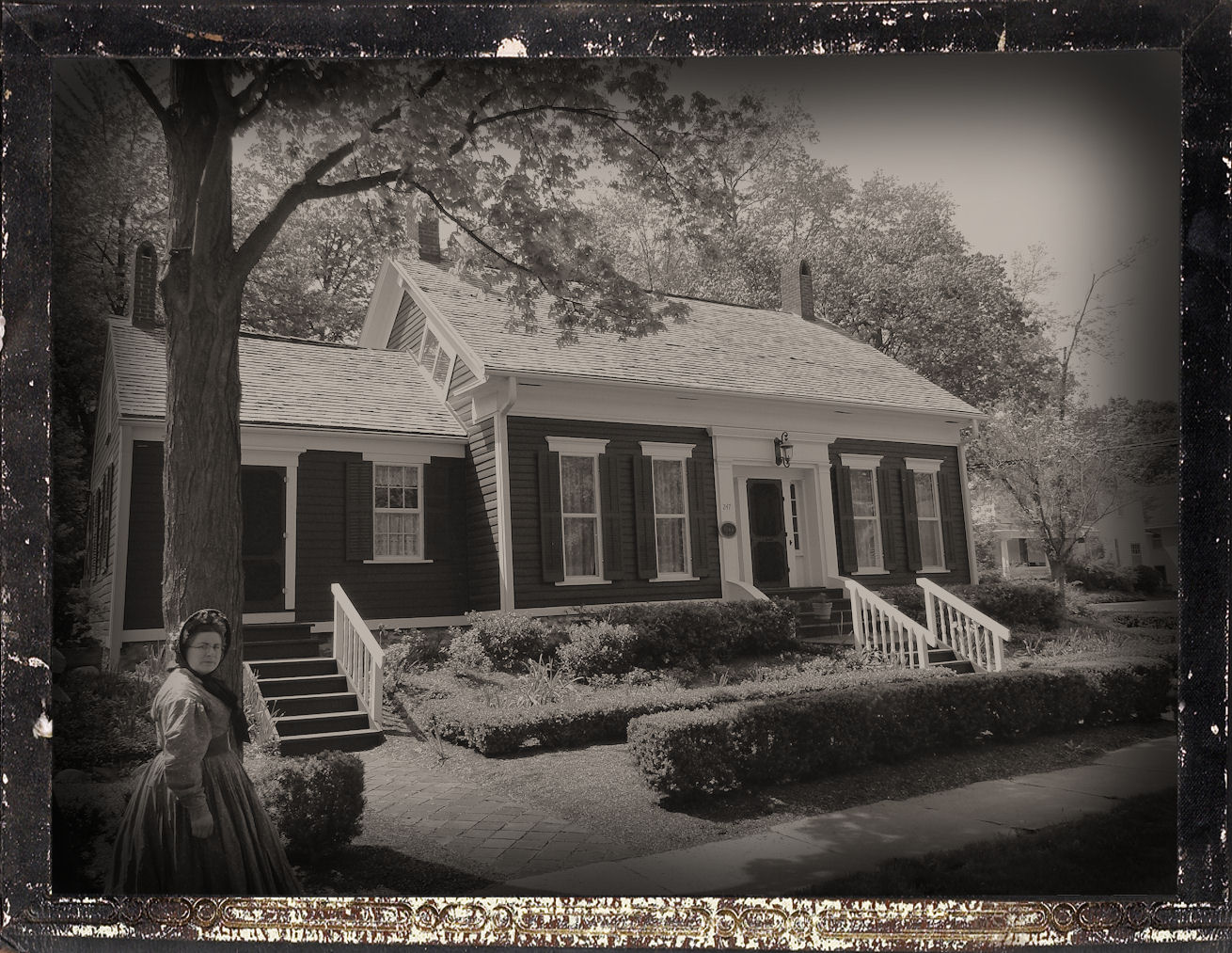
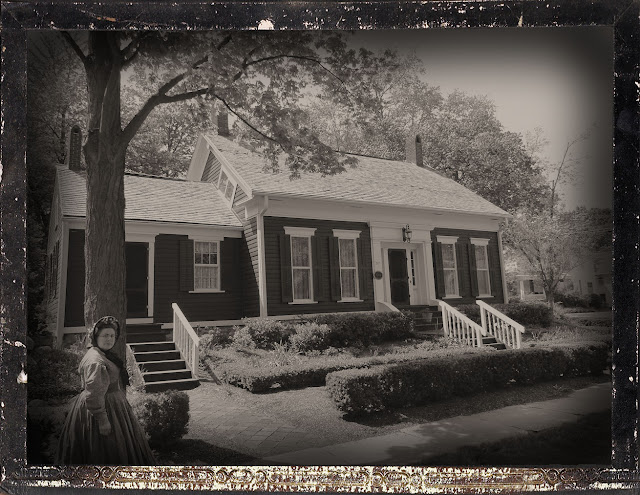 |
| The 1844 home in Romeo: My wife is dressed appropriately for the Civil War era presentation we did in 2011 |
 |
| I could fill up pages and pages of pictures of the Victorian homes found in Romeo very easily. |
 |
| This house has an 1873 plaque |
 |
| Ah...maybe one day... |
Can you imagine living in a neighborhood - an entire town - that looks like this? Many men dream of getting rich, skimpy-clad women, or racing cars. I'm the odd one out - it is my dream to one day live in Romeo and have my wife and I dress in period clothing as often as we can!
Yes, maybe one day...
Port Huron has its share of Victoriana as well. There are two parts to Port Huron (pronounced "
Portchurn" by the old-timers): the old original part of town and the new very recently built (mostly within the last 50 years) part of town.
Of course you know which area I frequent.
I have a personal historical connection to this city: when my ancestors returned to the States in 1883 after a few year respite into Canada, they came to live in Port Huron. I still have a few relatives living there to this day.
 |
| This home in Port Huron was once owned by my great great grandfather's brother during the 1880's. |
 |
| There are some very unusual looking homes in Port Huron, such as the castle on the left. Yes, this is a home! |
 |
| I stopped the car on a dime to take a picture of this house. Truly beautiful. |
 |
| And old downtown "Portchurn" (as the old-timers call Port Huron) still looks much the same as when my ancestors lived here |
Plymouth is another local city with beautiful Victorian structures abounding, dotting the neighborhoods. Summer 2011 found me roaming the streets in search of these beautiful old homes.
I found some:
 |
| Yes, I took this photo on the 4th of July - can you tell? |
 |
| This Plymouth home was built in 1894. |
This next home (photo below) is located off Sprinkle Road in Vicksburg, Michigan. I've past it numerous times while visiting my sister and it has always attracted my eye. One day I decided to stop right there on the road to take a picture. I know nothing about it but, judging by the architecture I am taking an educated guess that is was built in the 1860 - 1880's.
 |
| The mysterious Vicksburg, Michigan house is becoming less mysterious. With a little help from my sis I found out that this house was built in 1861 and was one of the infamous "underground railroad" houses we hear so much about. |
This brings us back to my own hometown of Eastpointe. To look at my city you wouldn't think it had anything remotely historical in it. But that's where you'd be wrong! There is plenty of history still standing here and I'd like to show you a few of the structures that you may or may not have seen in previous postings.
This first house, formerly known as the Ameis Home, is known now as the Leiter home, after the current owners who had put so much time and money into meticulously restoring this 1890 structure.
 |
| Before the Leiters restored it kids used to call it the Adams family Home! |
On the other side of town we find another beautiful old house - one that thousands of cars pass by daily and hardly even notice:
 |
| Once a farm house in the middle of the country, and now part of Detroit's suburbia... |
The pictures directly above and below are of the 1874 Kern Home in Eastpointe. Mr. Kern was one of the founding fathers of Eastpointe (then known as Erin Township).
We nearly lost this house - the descendants put it up for sale commercially, meaning a Rite Aid or some other unwanted drug store could've easily purchased only to tear it down and rebuild some ultra-modern monstrosity to sell their cheap Chinese made junk. Luckily, a couple of lawyers set up practice here and kept the aesthetic appearance of the place.
History was saved!
 |
| Up and down 10 Mile Rd. in Eastpointe, Warren, and St. Clair Shores there are a few house built in similar fashion, all old farm houses from the 19th century. |
And Eastpointe was also able to preserve its long past purely by accident when one of its original schoolhouses, built in 1872, was discovered being used as a warehouse. When the school closed its doors to students for one last time in 1921, Mr. Kaiser, who had recently started his own fuel and supply business with his sons, bought the building and moved it, by way of horses and skids, to the southeast corner on Nine Mile Road and Gratiot; the structure was used mainly as a warehouse for coal supplies and storage, which lasted from 1921 to 1984. To turn the old schoolhouse into a warehouse he covered the windows, walls, and flooring, thereby preserving local history. It's been said he did this purposely. We are in his debt for having the historical preservation foresight that he did.
 |
| The restored 1872 Halfway School House in Eastpointe |
In 1984 the East Detroit Historical Society (in Eastpointe) - and more specifically, John Gardiner, its then current president and superintendent of the school district - enabled the school system to purchase the building back from the Kaisers and move to have it relocated to within 20 yards of the original site. This was when restoration began on the old building. Now it stands as it once did in 1872, restored fully inside and out.
--- -- -- -- --- - ---
- -- - - ---- -- --
That concludes our journey to the past; I hope you enjoyed this little Magical History Tour around southeastern lower Michigan. I purposely did not include any structure that was moved away from its original location and put into such open-air museums as Greenfield or Crossroads Villages or any of the others in the vicinity. I wanted only the buildings that remained where they originally stood...or, in a few rare cases, very close to where they originally stood. I also didn't include the few taverns from the 19th century that still remain where they always have. I did a pretty extensive posting a while back on that subject (Michigan Taverns of the 19th Century).
And what historical gems are in your backyard...?
.




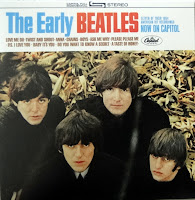

 ”Meet The Beatles!” features the same striking Robert Freeman cover photo as the British LP “With The Beatles.” However, for financial and marketing reasons, Capitol made alterations to disc's lineup. In order to save on song publishing royalties, the company limited its LP to the American standard of 12 songs rather than the British standard of 14 (in the U.K., publishing royalties are calculated on a per disc basis where each publisher shares pro-rata in the royalties paid on album sales. Thus, there is no additional cost to the record company for having extra songs. In the U.S., royalties are calculated on a per song basis. Each extra song costs the record company money. That is why the U.S. standard was a lesser number of songs).
 "The Beatles' Second Album” is admittedly a pieces-parts album, containing the five leftover songs from “With The Beatles” (“Roll Over Beethoven,” “You Really Got A Hold On Me,” “Devil In Her Heart,” “Money” and “Please Mister Postman”), three B-sides (“Thank You Girl,” “You Can't Do That” and “I'll Get You”), two freshly recorded songs that would later end up on the British “Long Tall Sally” EP (“Long Tall Sally” and “I Call Your Name”) and the hit single “She Loves You.” That said, it is an amazingly effective album full of great rock 'n' roll songs such as “Roll Over Beethoven,” “Long Tall Sally,” “Money” and “Please Mister Postman” anchored by the hit single “She Loves You.” It was number one on the Billboard Top LP's chart for five weeks and had certified sales of over two million units.
 "Something New” is arguably the weakest album of the bunch. Capitol was faced with a dilemma brought on by United Artists' film contract with The Beatles that covered "A Hard Day's Night." UA had the exclusive right to issue a soundtrack album in America, so Capitol had to come up with something new to compete with the soundtrack LP. Capitol's album mixed songs appearing on the UA disc (“I'll Cry Instead,” “Tell Me Why,” “And I Love Her,” “I'm Happy Just To Dance With You” and “If I Fell”) with a few songs from The Beatles latest British album (“Things We Said Today,” “Any Time At All” and “When I Get Home”), the two remaining rockers from the “Long Tall Sally” EP (“Slow Down” and ”Matchbox”) and a version of “I Want To Hold Your Hand” sung in German titled (”Komm, Gib Mir Deine Hand"). Although “Something New” was unable to knock the UA soundtrack album from the number one position, the Capitol album stayed at number two for nine weeks and sold over two million copies.
 ”Beatles '65” featured eight songs from the group's latest British LP, “Beatles For Sale” (namely “No Reply,” “I'm A Loser,” “Baby's In Black,” “Rock And Roll Music,” “I'll Follow The Sun,” “Mr. Moonlight,” “Honey Don't” and “Everybody's Trying To Be My Baby”), and both sides of their latest single, “I Feel Fine” and “She's A Woman,” plus “I'll Be Back,” which was on the British “A Hard Day's Night” LP but had yet to appear in America. Capitol did not completely deviate from the running order of the songs on “Beatles For Sale,” with side one bearing a strong resemblance to the British disc. So much so that the album can be described as “Beatles For Sale, Part 1.” The disc held down the number one spot on the Billboard Top LP's chart for nine straight weeks and sold over three million units.
 Those who rightfully point out that the Beatles had no part in compiling the Capitol albums often downplay or ignore the involvement of George Martin and Brian Epstein. While George Martin did not program the Capitol albums and did not approve of the practice, he and Brian Epstein were fully aware that Capitol was reconfiguring Beatles albums specifically for the American market and understood Capitol's reasons for doing so. They cooperated with Capitol's plans by supplying the label with songs to place on the American albums. When Capitol needed a few more songs to round out “The Beatles' Second Album,” George Martin, with Brian's approval, sent the company “Long Tall Sally” and “I Call Your Name.” For “Beatles VI,” George Martin sent Capitol four new songs, namely “You Like Me Too Much,” “Tell Me What You See,” “Bad Boy” and “Dizzy Miss Lizzie.”
  As for the great "Rubber Soul" album, "Capitol had recognized that the Beatles had prepared a special album, one that should not be dissected beyond recognition. The decision was made to keep the album's British title rather than create 'something new' like Beatles '66 or Beatles VIII. At the request of the Beatles, the album's striking cover, as well as the back cover's photo montage, was left intact.


