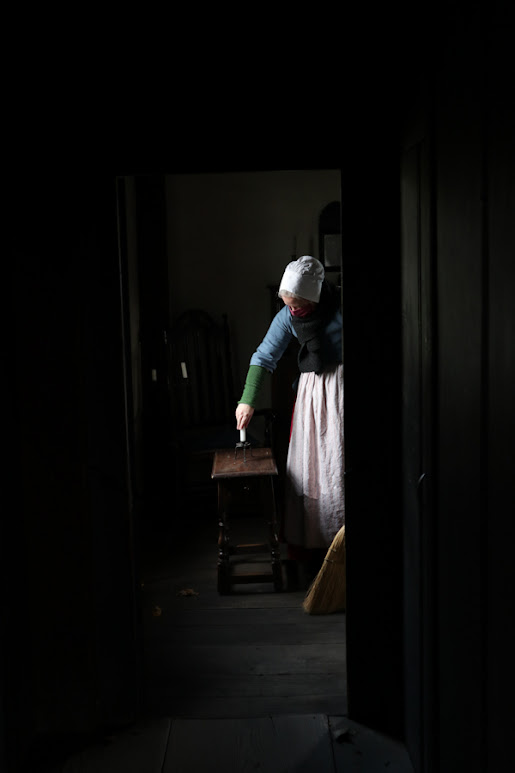
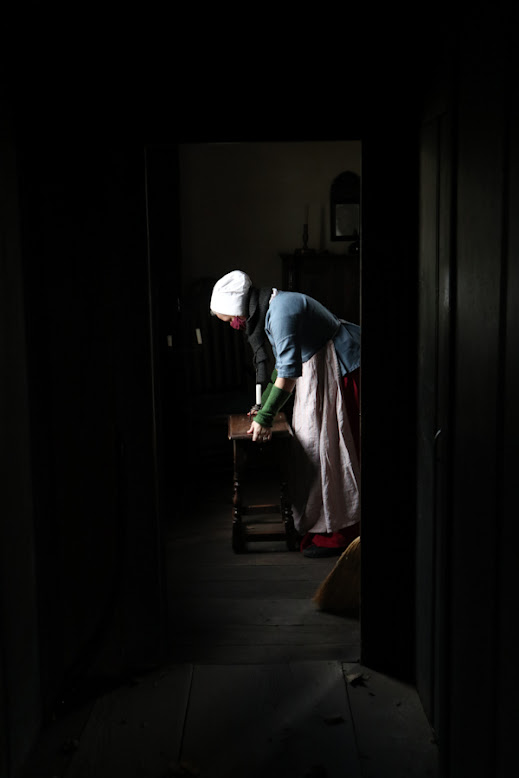
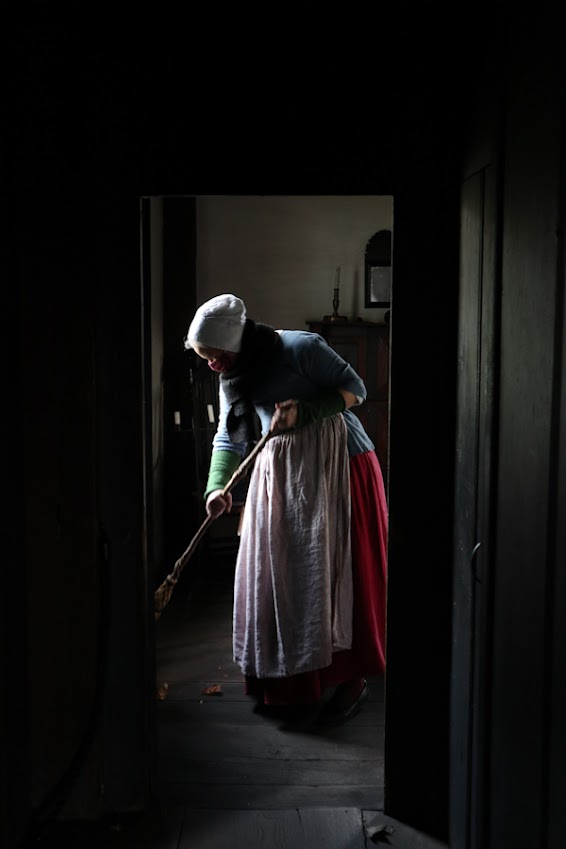
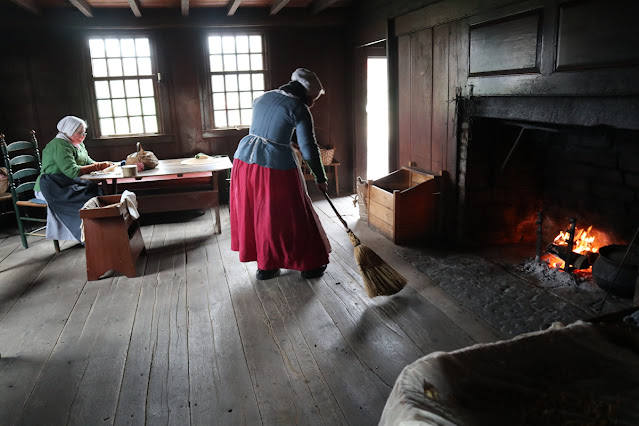
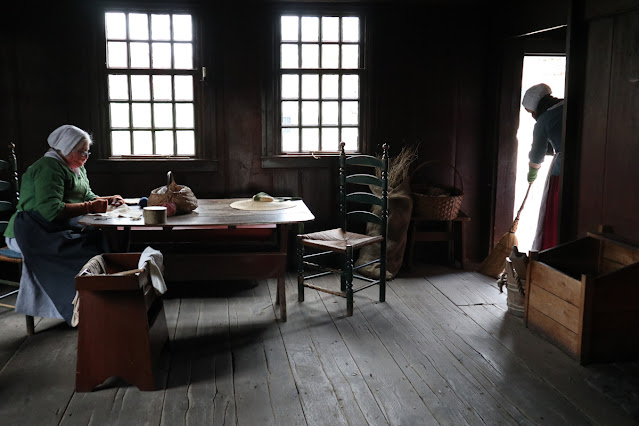
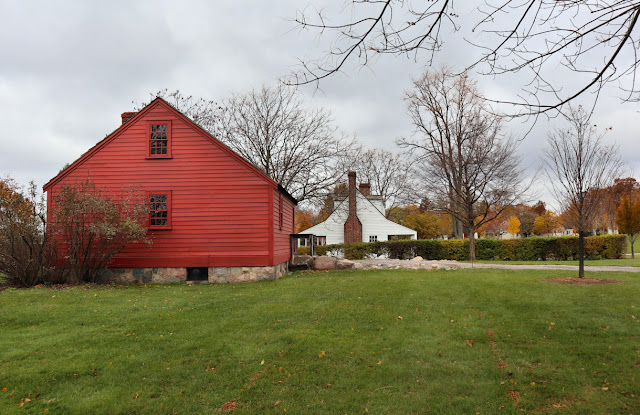
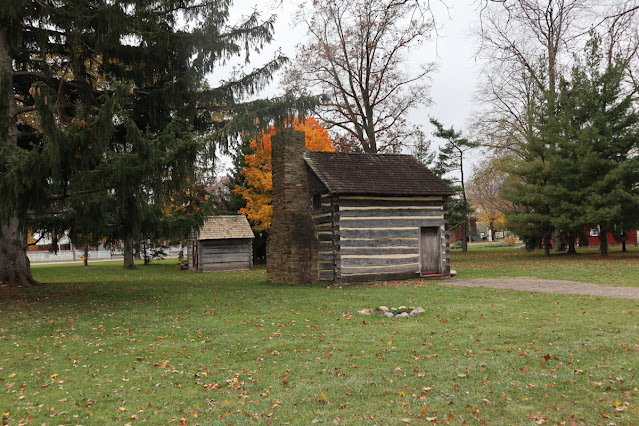
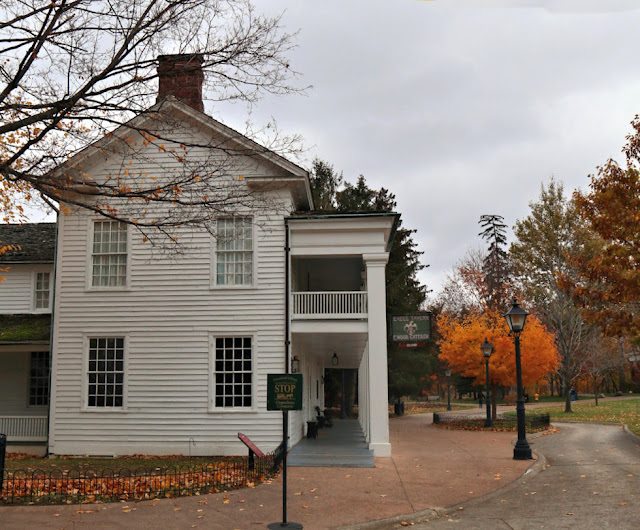
As soon as you start to think of the past as happening (as opposed to it 'having happened'), a new way of conceiving history becomes possible. Reenacting and, to an even greater extent, living history, allows us to to see the inhabitants of the past in a more sympathetic way: not as a series of graphs and charts showing data of age, race, sex, or occupations, but, rather, as investigations into the sensations of being alive in a different time. You can start to gain an inkling as to why people did this or that, and even why they believed things which we may find simply incredible. You can gain this insight because you know that these people are human, like you, and that some of the reactions are simply natural. In being able to do this sort of time-travel or, what I also call mind-travel, allows one to understand these people not only in terms of evidence through research, but also in terms of their humanity, their hopes and fears, the drama of their lives.
It is in this way we can be reminded that history is much more than a strictly educational process. Truly understanding the past is a matter of experience as well as knowledge; it is a striving to make a spiritual, emotional, poetic, dramatic, and inspirational connection with our forebears. It is about our personal reactions to the challenges of living in previous centuries and earlier cultures, and our understanding of what makes one century different from another. We know what love, fear, pain, anger, grief, sadness, and anxiety is like today. Those in the past knew as well. This is the human relation we have with our forebears.
And this is how I connect with them...
. . .
Let's begin with Thanksgiving Day itself.
It is unfortunate that we did not have our whole family together on Thanksgiving this year, for my son, Rob, an EMT, had to work that day, so neither he nor his wife made it by. But the grandkids helped to fill that void, all happy and excited to visit their Nonna & Papa, knowing that we try to make the holiday special.
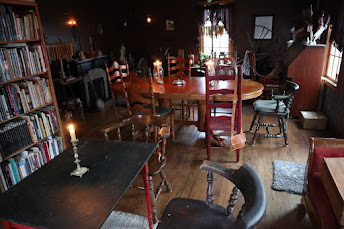 |
| A place to time-travel in my own home: period atmosphere on Thanksgiving Day. |
Atmosphere is nearly as important as the food. My wife and I try to fill our house with a sort of sensurround by way of sight (candle lit room), smell, touch, and taste (oh! the food we have! The scent and taste of turkey, stuffing with raisins & nuts, rutabaga, green bean casserole, corn, mashed potatoes, brussels sprouts, sweet potatoes, pumpkin pie, apple pie, cranberry sauce, cannoli...plus wassail to drink!), and sound (the family voices, from young to old, all joyously partaking in this wonderful American holiday).
It is an old holiday, Thanksgiving, and is celebrated in as many differing ways as there are people in our great country.
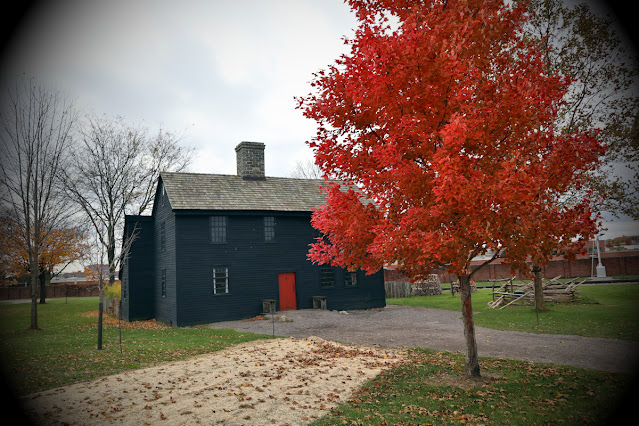
I found a particular note written on Thursday November 21, 1793 by 75 year old Samuel Lane of Stratham, New Hampshire in one of the books in my library, and it made me think of Samuel Daggett, who's 18th century Connecticut home now sits inside historic Greenfield Village. The two men were near the same age at the time.
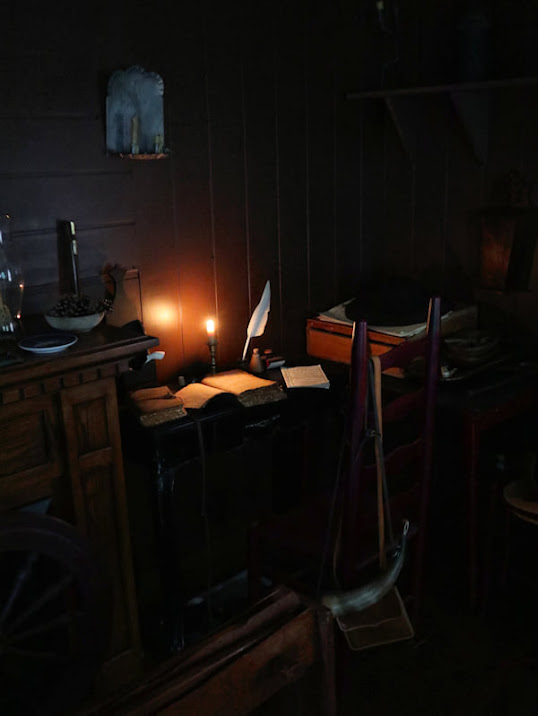 |
| The following is Mr. Lane's note, which is one of the most heartfelt I have ever seen about Thanksgiving: |
"As I was musing on my Bed being awake as Usual before Daylight;
recollecting the Many Mercies and good things I enjoy for which
I ought to be thankful this Day;
The Life & health of myself and family, and also of so many of
my Children, grand Children and great grandchildren...
for my Bible and Many other good and Useful Books,
Civil and Religious Priviledges...
for my Land, House and Barn and other Buildings, & that they are
preserv'd from fire & other accidents.
for my wearing Clothes to keep me warm, my Bed & Bedding to rest upon.
for my Cattle, Sheep & Swine & other Creatures, for my support.
for my Corn, Wheat, Rye Grass and Hay; Wool, flax, Syder, Apples, Pumpkins, Potatoes, cabages, tirnips, Carrots, Beets, peaches and other fruit.
For my Clock and Watch to measure my passing time by Day and by Night.
Wood, Water, Butter, Cheese, Milk, Pork, Beefe, & fish, &c.
for Tea, Sugar, Rum, Wine, Gin, Molasses, peper, Spice & Money for to bye other Necessaries and to pay my Debts and Taxes &c.
for my lether, Lamp oyl & Candles, Husbandry Utensils, & other tools of every sort...
Bless the Lord O my Soul and all that is within me Bless his holy Name..."
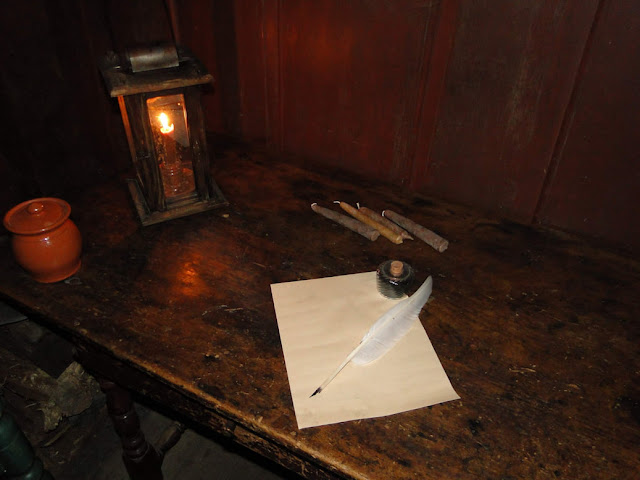 |
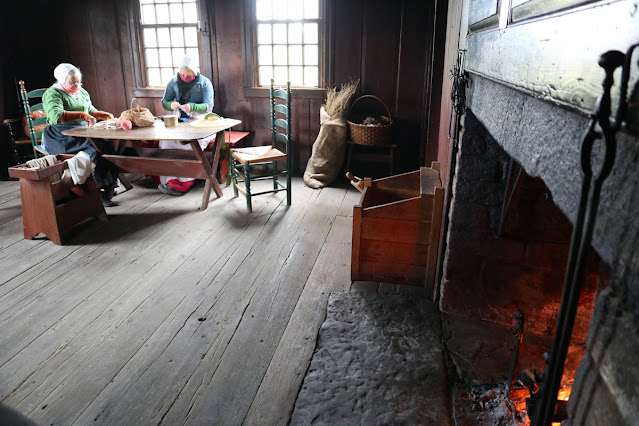
| One can imagine this man, or maybe even someone like the aforementioned Samuel Daggett, sitting at his writing desk - perhaps in his bed chamber or in the parlor...or he could be in the great hall, quill in hand - early on a cold November morning, the sun arising out of the eastern sky... Such beautiful and sincere thoughts. So glad he "shared" them with us. (This photo was taken inside Samuel Daggett's house) |
During the early 1700s, individual colonies commonly observed days of Thanksgiving throughout each year, though we might not recognize a traditional Thanksgiving Day from that period, as it was not a day marked by plentiful food and drink as is today's custom, but rather a day set aside for prayer and fasting, thanking God for His special Providence.
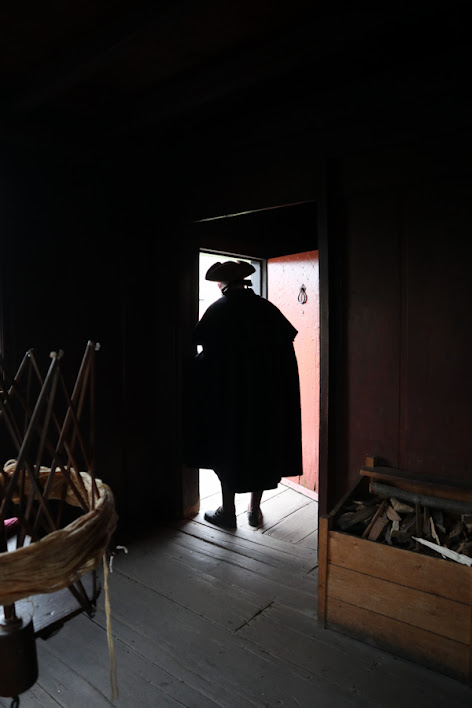 |
But, as the century wore on, it gradually turned more into a festive celebration as much as it was a holy day (or holiday). |
Men often devoted Thanksgiving morning to hunting or turkey shoots.
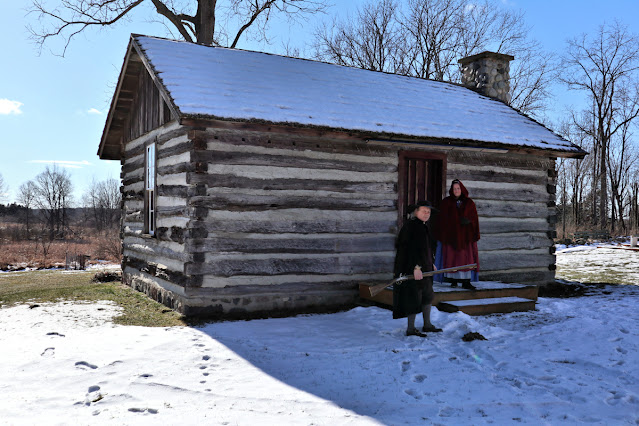 |
| At these shoots, hens and turkeys were tied to stakes and men paid four and a half pence to shoot a hen at a distance of eight rods, or nine pence to shoot a turkey from ten rods. Usually the birds were killed before being mounted on the stakes. If a man hit the bird, it was his to take home. You see Larissa & I in this picture. |
The picture below was taken inside the cabin you see above - we held our own 18th century Thanksgiving harvest feast.
 |
| In 2020 a few of us living historians gathered together inside a log cabin and celebrated an 18th century harvest - a Thanksgiving - as if it were 1770. Traditional food of the period was served. I hope to repeat this next year. |
And now we come to the point where a few of us living historians were striving to make a spiritual, emotional, poetic, dramatic, and inspirational connection with our forebears.
This year, the day after Thanksgiving - the much-hated-by-me Black Friday - was our day to cut down our family Christmas Tree. More often than not I usually will find myself at Greenfield Village on Black Friday. However, we, as a family, decided this would be the best day where most of us were available to cut down our Tree.
So it was on the next day - Saturday - that me and a few friends (grammatically incorrect, I know), visited the Village, which, as far as shopping goes, is nearly as bad as Black Friday. But it was a perfect day to visit an open-air historic village.
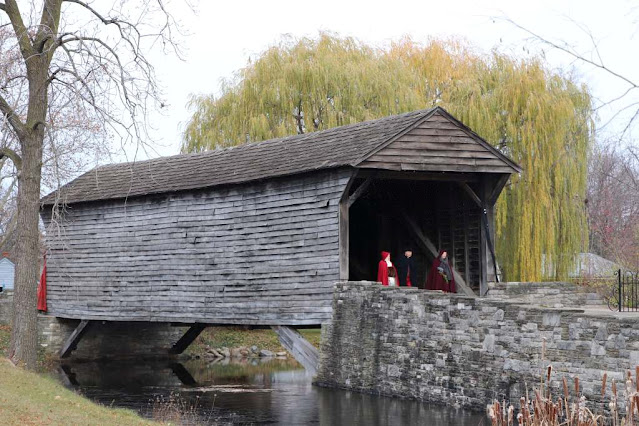 |
| Here we are making our way to the colonial part of the Village in this fine photo by Ed Davis. Being that we are representing the 1770s, walking through the 1832 Ackley Covered Bridge just is not historically accurate. It is to my understanding that erecting covered bridges in America didn't occur until early in the 19th century. The first known covered bridge constructed in the United States was the Permanent Bridge, completed in 1805 to span the Schuylkill River in Philadelphia. I didn't know this until recently. Don't you just love research? |
However, the older folks who lived during and remembered the era of the American Revolution could very possibly be still wearing their older-style fashions even as late as into the 19th century.
An interesting fact not well-known about Paul Revere, for example, is that, "As the century advance(d), small boys begin to appear---all eyes, all ears, they watch 'old Mr. Revere' in church, on the street, at his foundry. Some sixty or seventy years later, when asked, they remember him well. Rowland Ellis remembers (Paul Revere) as a 'thick-set, round faced not very tall person who always wore small clothes.' The Ellis family pew in the 'New Brick Church' was directly behind that of Revere, and there Mr. Ellis says, "I used to see him as regularly as the Sabbath came."
The oddity of 'small clothes' alone would be remembered by a small boy. The old elegance of knee-breeches, ruffled shirts, long stockings, and cocked hats had passed out of fashion years before. Others besides Paul Revere (also) clung to their picturesque costume of their youth. There were a number of these 'last leaves' about Boston. It may have been a sin for small boys 'to sit and grin...but the old three-cornered hat, and the breeches and all that, are so queer.'
Well, I suppose seeing us "last leaves" crossing the covered bridge may not seem so out of order after all.
Now, each time I go to Greenfield Village it is always great, but on this day 'twas a Best Ever Day - - and I have a load of photographs here to document our time there:
 |
| We found our way to the back of the Village first thing---before the other guests made it to that point---to the mid-18th century Daggett House, where we could spend some time chatting with the presenters who worked there about our favorite period in history. And being dressed the way we were - pretty much the same era as the house - always adds greatly to our experience. |
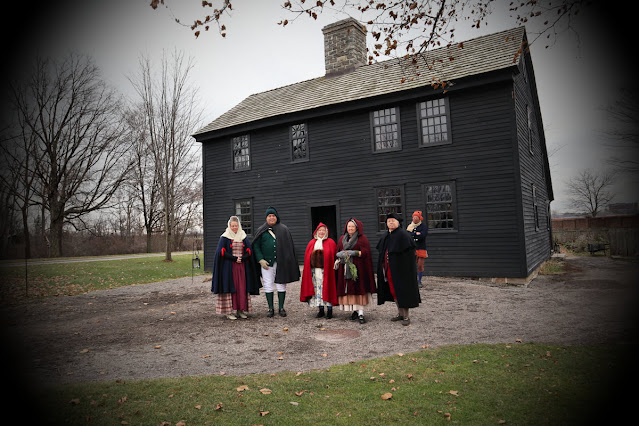 |
| There were five of us who dressed in our colonial-era clothing on this day. Being that the temperature was on the cool side - right around freezing - there weren't too many other visitors there initially. |
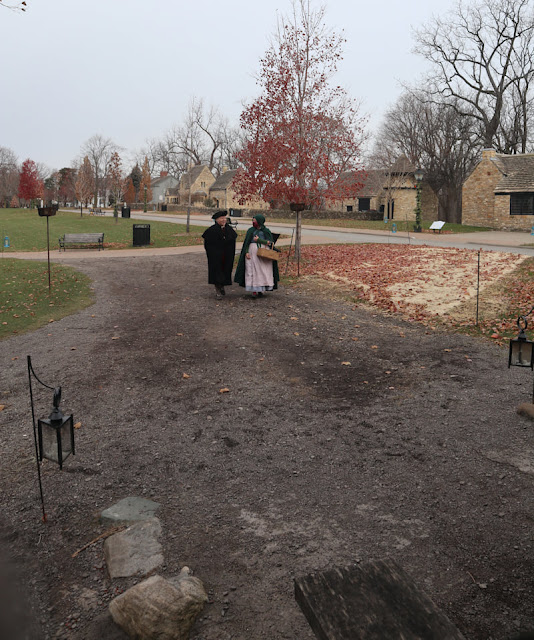 |
| Presenter Gigi and I moved up toward the house. This lady knows her stuff about 18th century living - I always enjoy our talks and the sharing of knowledge. |
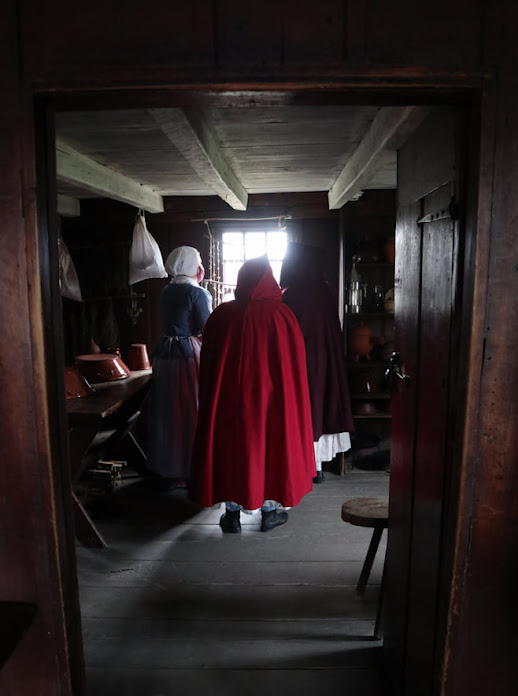 |
| Gigi, Jackie, & Charlotte enjoyed speaking about everyday colonial life, and, as they eyed the kitchen garden through the window, Gigi pointed out the vegetables that will be “over wintering" in the ground, such as onions and carrots and the like. |
"If the only light and heat comes from candles and fireplaces because of a power outage at your house, it is frustrating and annoying - but when it comes in the form of intimate tours of a historic village, it is charming and peaceful."
~A quote from Old Sturbridge Village~
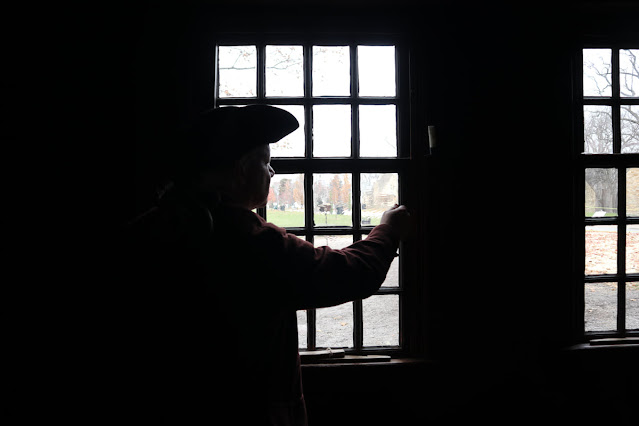 |
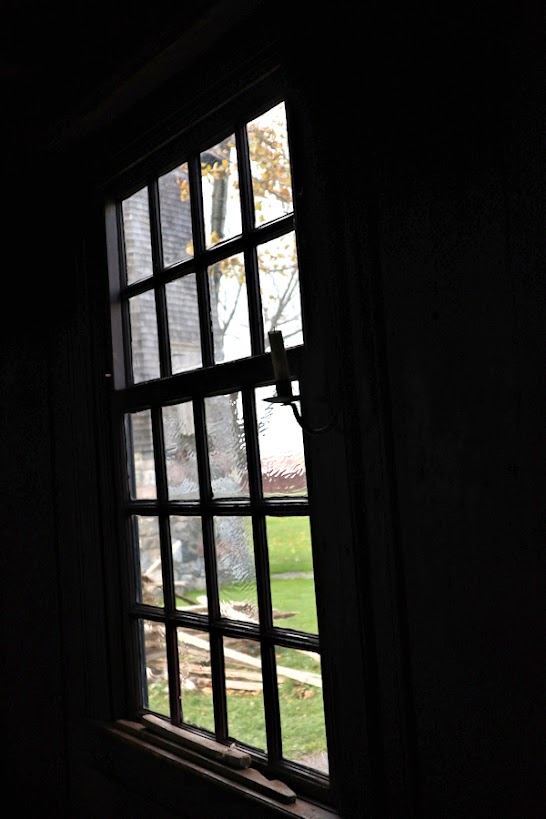
| A silhouette of me at the front window admiring the candle holder. I have a blacksmith friend (how many people can say that?) who is going to make me a replication of it. Below is a better picture of the holder: 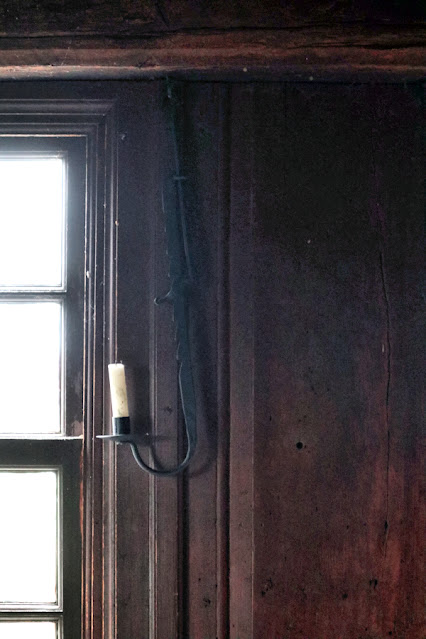 Another period accessory to help Daggett-ize my house! |
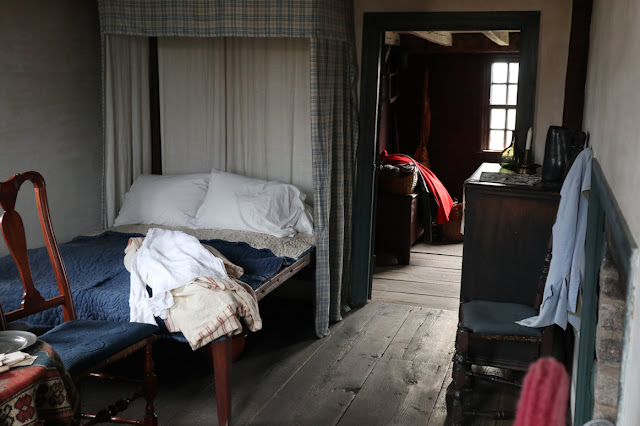 |
| Looking toward the kitchen through the parlor. Charlotte pointed out the stark-red cloak in the background. It looked just like the cloak Jackie had on. 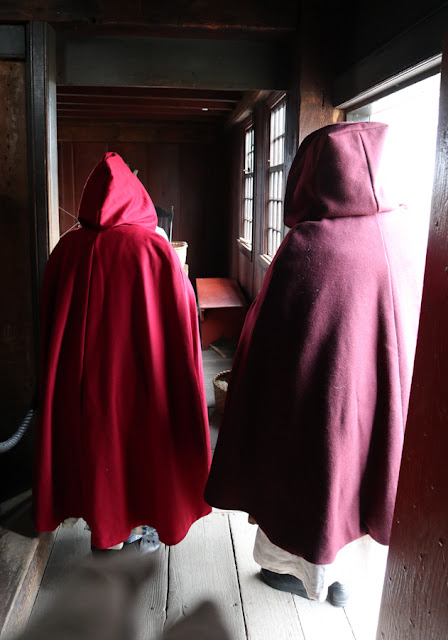 |
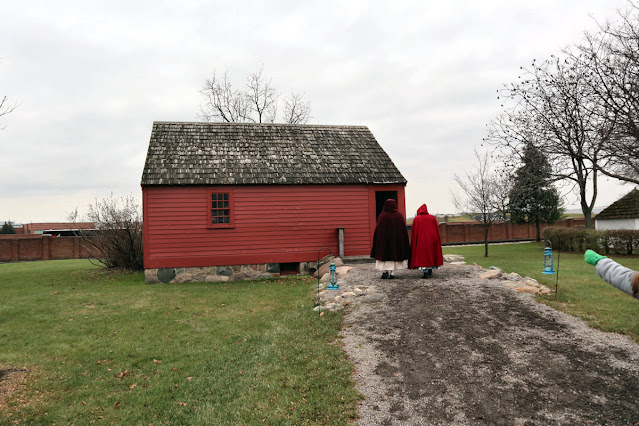 |
| From the Daggett House we stepped to the nearest neighbor, the home once belonging to Thomas Plympton. |
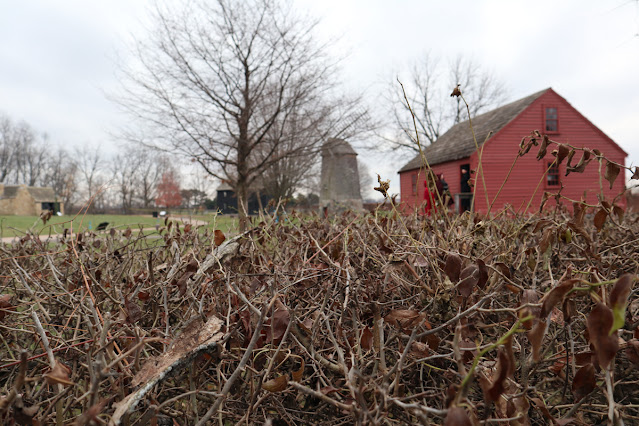 |
| Though originally built in separate New England colonies, inside Greenfield Village the Plympton House is just down the road from the Daggetts. This is another house with a long history; at the bottom of this post are links to learn the deeper history of most of the homes seen here today. |
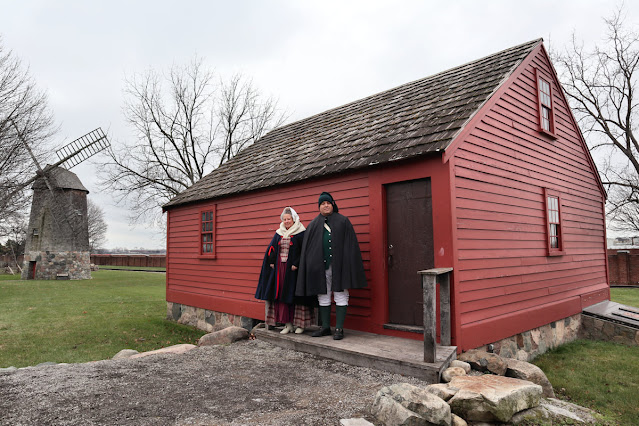 |
| Susan & David. David is a member of the Queen's Rangers reenacting group. This is his first time out as a civilian. |
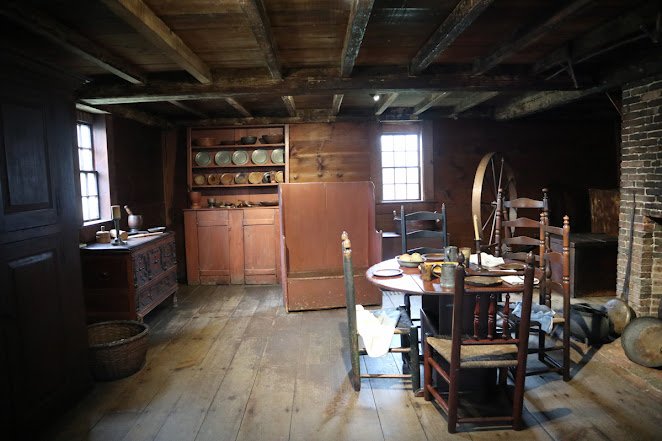 |
| Inside the one-room Plympton Home, beautiful furnishings from the early-to-mid-18th century can be seen behind plexi-glass. This is such a wonderful house that deserves to be utilized more, especially with the 250th of the American Revolution not too far away.. |
 |
| Part of the fun of working with adventurous living historians is their willingness to create scenarios, such as what we see here at the Cotswold Cottage, originally built around 1620 in England. Jump ahead about 150 years and we see 1770s neighbors chatting over the stone fence. Cotswold was not open to visitors on this day. |
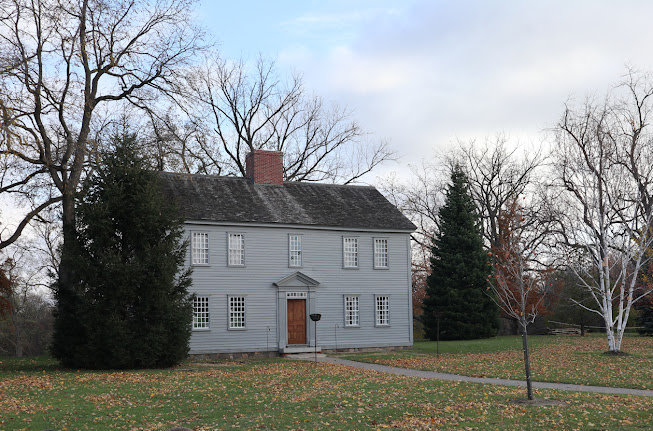 |
| We also visited the Giddings House, which was originally built in New Hampshire around the same time as the Daggett House - about 1750. It was not fully open for they were preparing it for Holiday Nights |
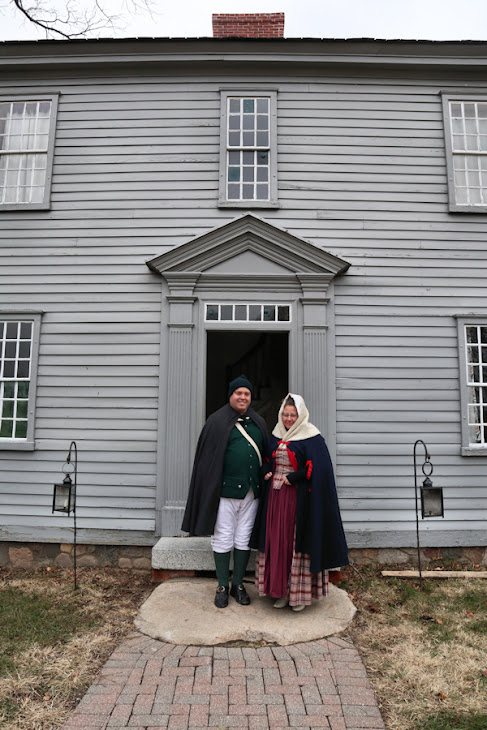 |
| I took the opportunity to snap another photo of Susan in front of this splendid 18th century house with her beau, David. The two have been courting now for a while. |
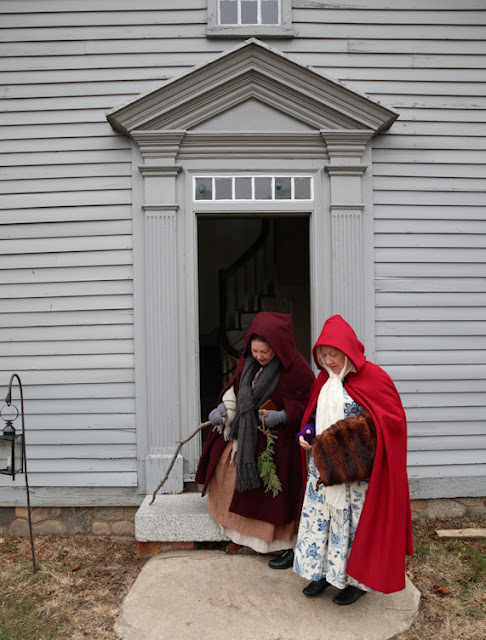 |
| Jackie & Charlotte maneuver the steep stairs. Only the very front entranceway is open to the public. The rest of the house is plexi-glassed off. |
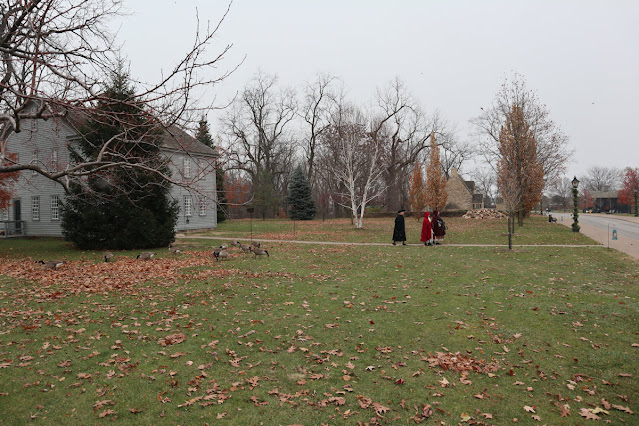 |
| Leaving the Giddings House... I do like how the structures from the 18th century (and earlier) are mostly in the same area. If you look in the background of this picture, you can easily see the Cotswold Cottage in the center and the Daggett House on the far right. Directly across the street is the Plympton House. Only the 1789 McGuffey Cabin, of which you will see shortly, has been placed further down the road. |
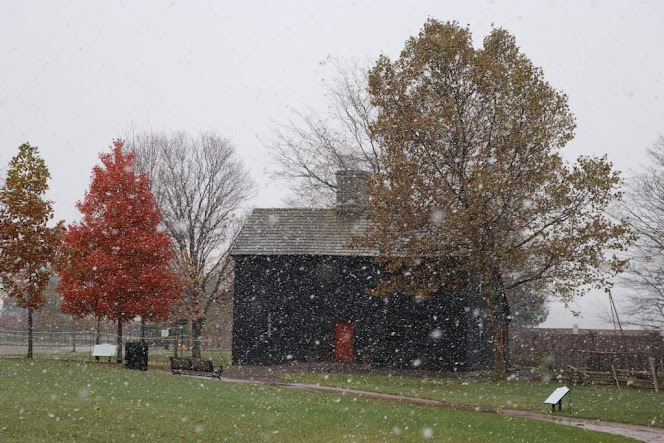
So it was about the time we left Giddings House when something happened that changed our day from great to amazingingly great: snow flurries began to fall from the sky, at first gently but with increasing intensity, and soon we were in a bonafide snow squall. Now I've been to Greenfield Village before while it flurried, but never have I been there during daytime hours where it actually stuck to the ground...it was purely magical!
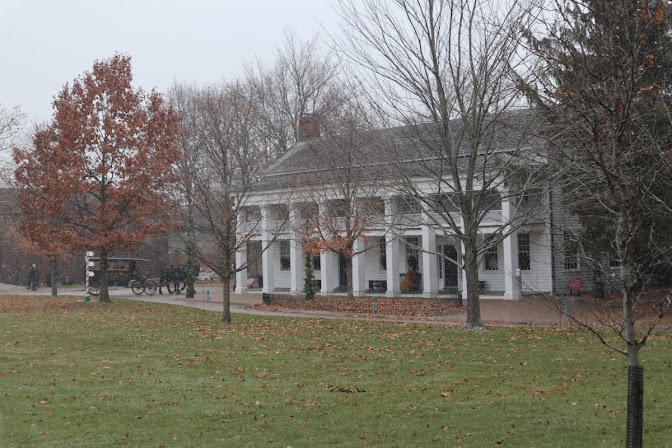 |
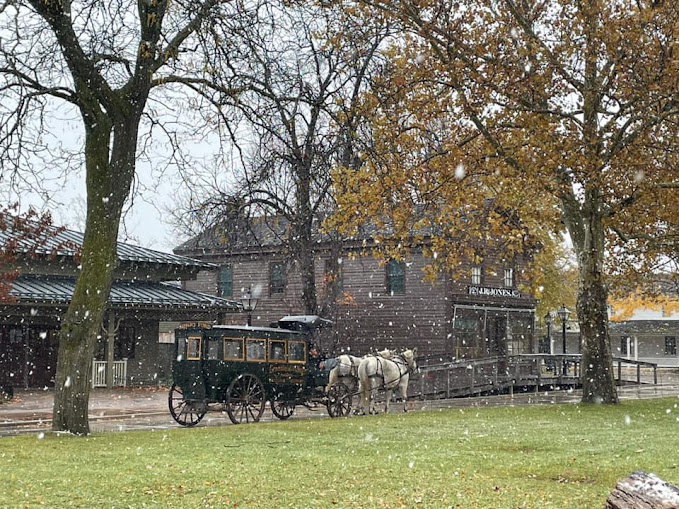
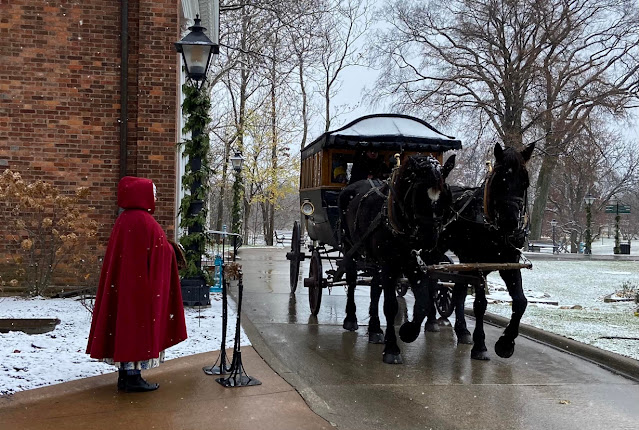
| The 1831 Eagle Tavern, along with a horse & carriage, look a bit hazy due to the light snow falling. The fury of flakes hadn't started yet. |
By the time we left the restaurant, we were in the midst of a winter wonderland.
I had plans of my own, however - - - -
Not everyone had a horse, so walking was the mode of travel for most who lived in the 18th and 19th century, as long as the snow wasn't too deep.
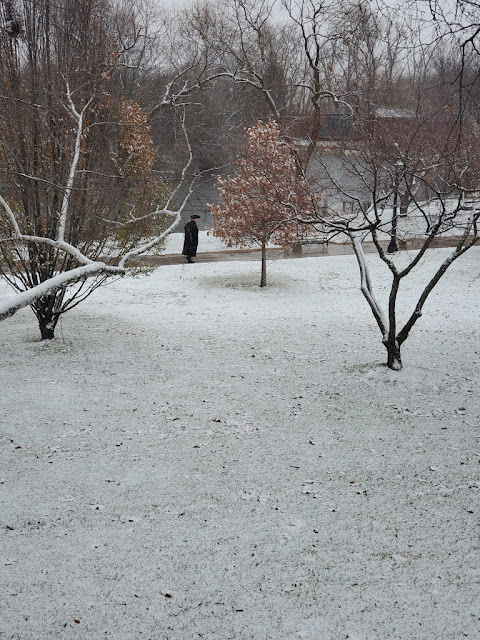 |
| I grabbed the opportunity to get some wintery shots on the other side of the Village - backtracking back to Daggett! There is a sort of short cut along the circular pond where the old steamboat used to be, and that's the route I took. In this picture by Catherine Marie Wrublewski-Kendzior I was really hoofing it - huffin' and puffin' like a 60 year old man! Wait a minute---I AM a 60 year old man! lol That's not too old, I know...but it certainly isn't 20! Also unbeknownst to me, Lee Cagle, a driver of the Model T's (and quite an amazing photographer), also took a photo of me making my way back to my favorite house. He was taking a break inside the Swiss Chalet when he snapped it: 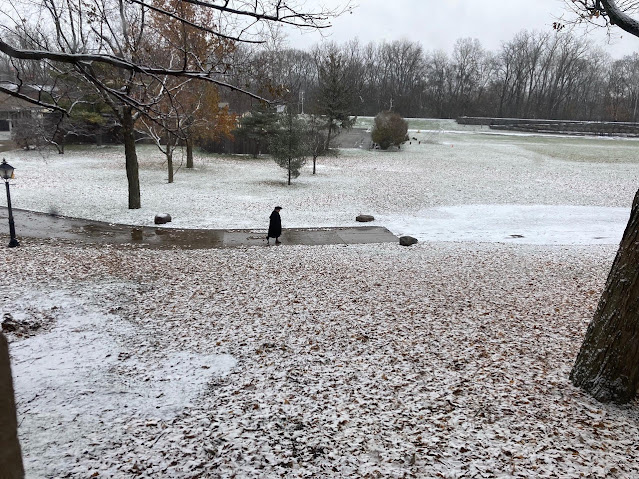 I was honored to have this picture as part of a mass e-mail, and beneath it was this quote by Ruth Stout: “There is a privacy about it which no other season gives you . . . In spring, summer, and fall people sort of have an open season on each other; only in winter, in the country, can you have longer, quiet stretches when you can savor belonging to yourself.” |
The 18th century saw the tail-end of what is now known as “The Little Ice Age,” a period lasting from the years 1300 to about 1850. It was during this time the world saw much harsher winters than the previous and following centuries, with many well-documented winter storms capable of dropping three feet of snow over a matter of hours. With these intense winters came the need to keep warm in the home.
Back I go for another visit!
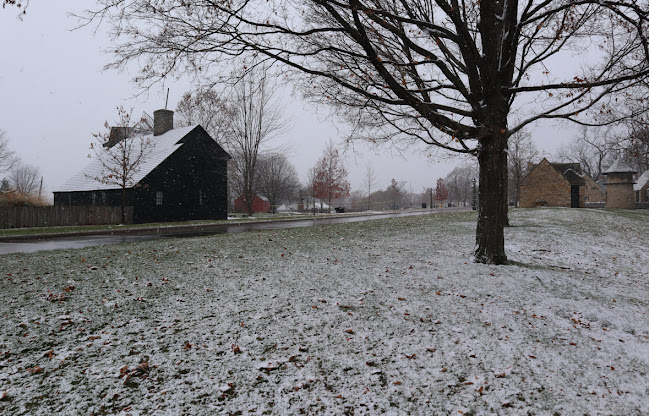 |
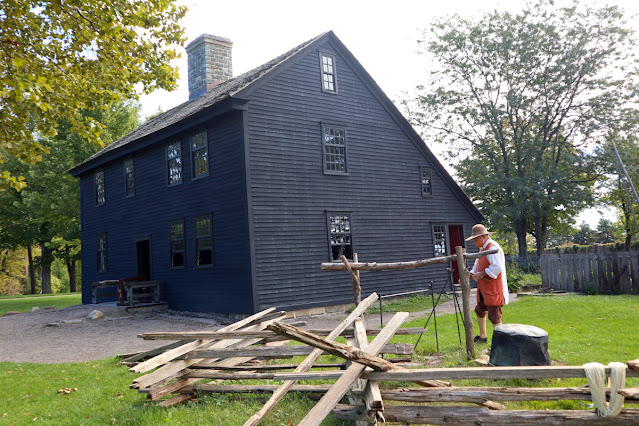
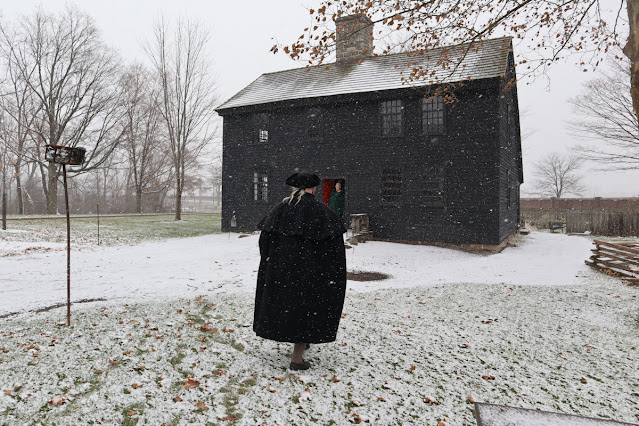
| When I saw the roof of Daggett from the bottom of the hill, I climbed up and took this photo. The snow wasn't too deep while we were there - just a light covering, but it was the first of the season, and had that natural beauty. |
 | |
|
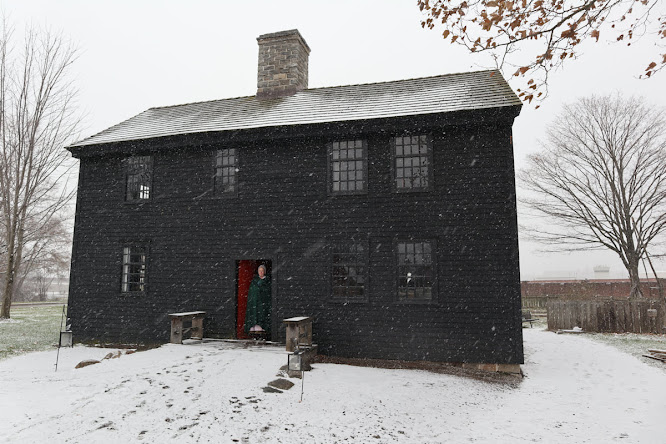 |
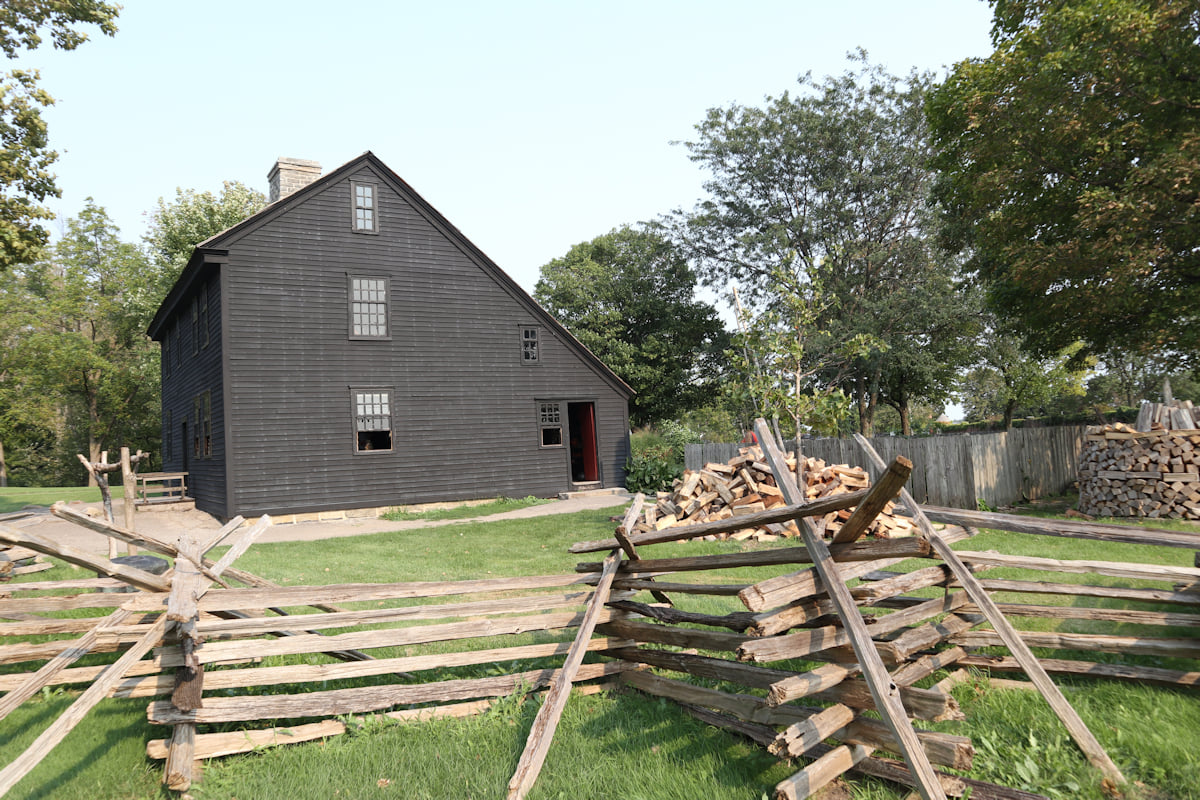
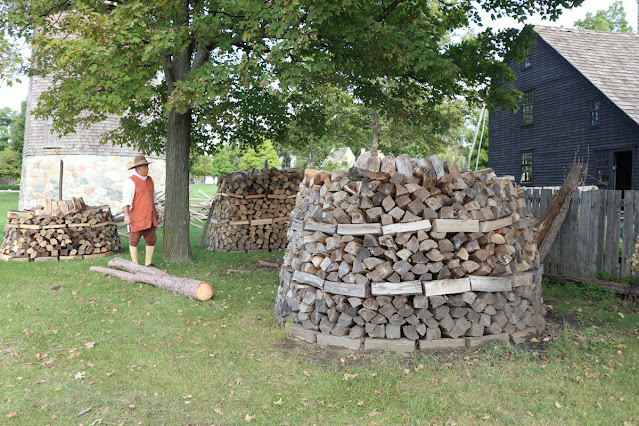
| ~Gigi in the Daggett doorway~ Wintertime in the colonial era brought in discomfort and dread to most in the United States, especially to those living in New England, the mid-west, and the plains areas. For Samuel Daggett and his wife, Anna, winter preparations would occur year 'round. Piles of firewood were cut and stacked in the warmer months for heat in cooler times and for cooking year round. Corncobs were saved for smaller fires, or for an extra touch of flavor in hams and bacon smoked over them. If the fire went out, flint and steel could spark a new one, or a child could scamper to a neighbor and bring home a hot coal in a cook pot or a tray of green bark. |
I have to say that virtually every person at the Village, whether visitor or worker, seemed to be in a wonderful and festive mood on this day.
Early snow falls can do that, you know, especially in a place such as this.
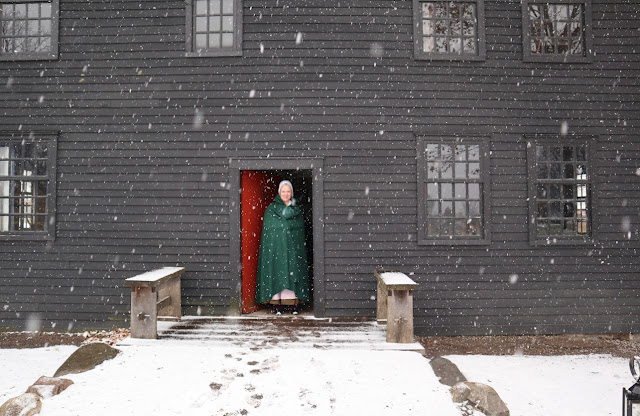 |
| I appreciate presenters such as Gigi and a few of the others at the Village for their knowledge of the period in which they work, and their willingness to go beyond the normal spiel when they see other historians, for I enjoy the wonderful conversations we have. I always enjoy the sharing of knowledge with like-minded people, which is a wonderful thing. |
I was prepared, by the way, for I wore my heavy woolen cloak, thick stockings, knit cap (sometimes worn under my hat), my mitts, and, of course, wool waistcoat & frock over my heavy linen shirt that helped to keep this man warm on such a day.
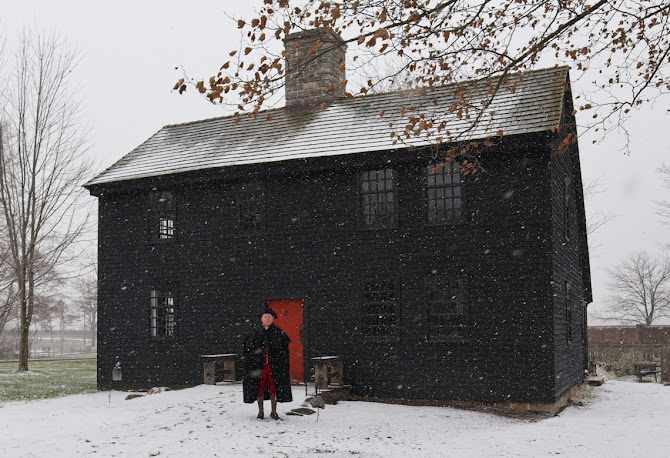 |
I suppose if I had the money to spend on whatever I'd like, building a house like this would easily be it...and then filling it with authentic or well-replicated furniture and accessories would be an extension of that dream. But, for now, I have to live vicariously through visiting moments in time. |
I am sort of doing the interior of my home in a Daggett-y style, which I call Daggetizing. Click HERE to learn (and see) how I am turning the inside of my 20th century home into the style of an 18th century home.
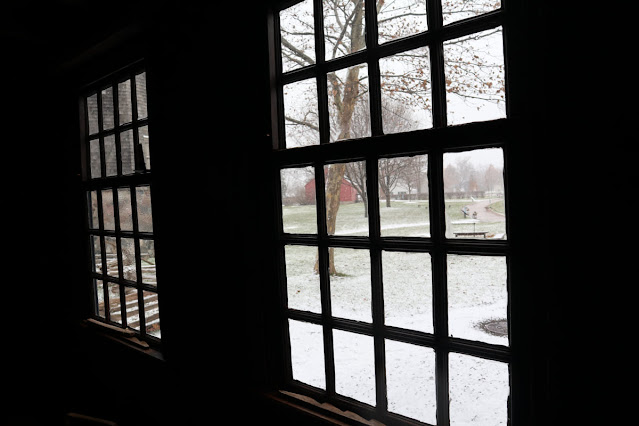 |
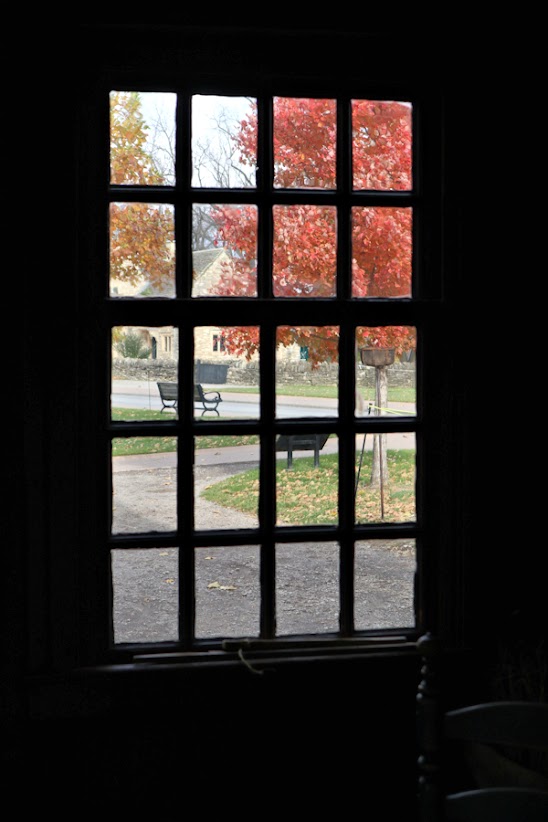
A bit of a different view looking out the Daggett window from this morning. Can you see the red Plympton House?: Seasons change with the scenery, weaving time in a tapestry... Look around - leaves are brown, and the sky is a hazy shade of winter. Look around - leaves are brown, there's a patch of snow on the ground. |
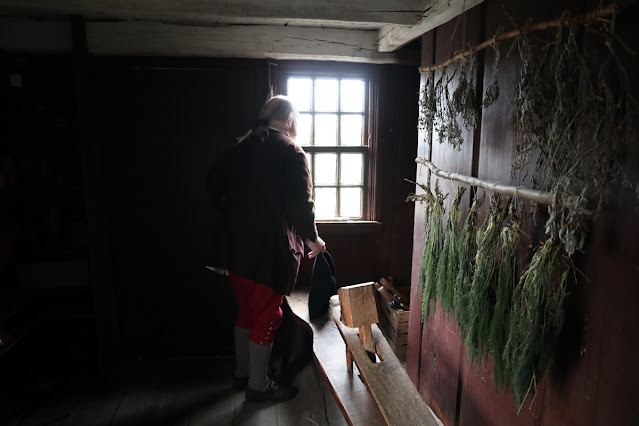 |
| "There are few things more magical than looking out the window from your house and discovering those first flurries gently falling to the ground." And this is what I saw out the back/side window and door of the Daggett House: 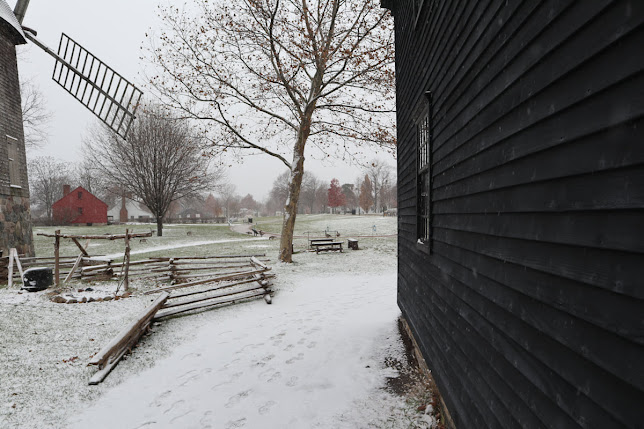 A scene from 250 years ago... |
So to not make a pest of myself, for this is twice in the same day that I was at Daggett, I bid farewell to my presenter friends and walked in the blizzard of flakes to the McGuffey Cabin, which is from 1789.
So there I go again, hoofing and huffing up the street...oh! my sciatica!
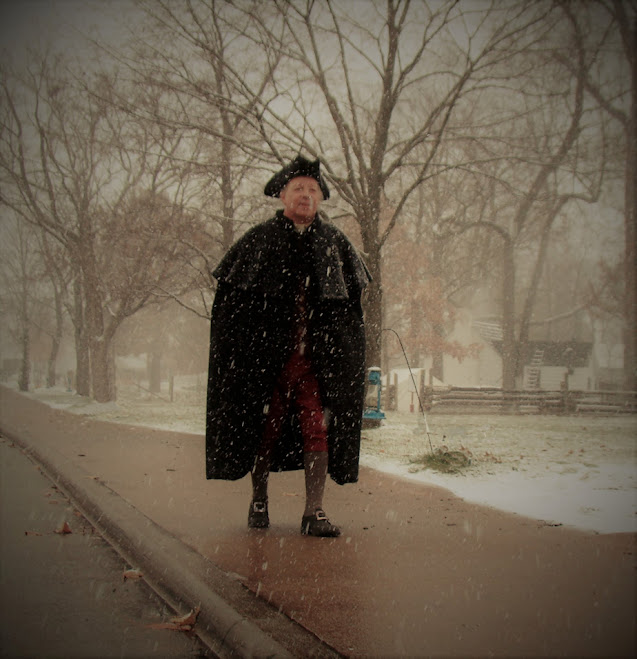 |
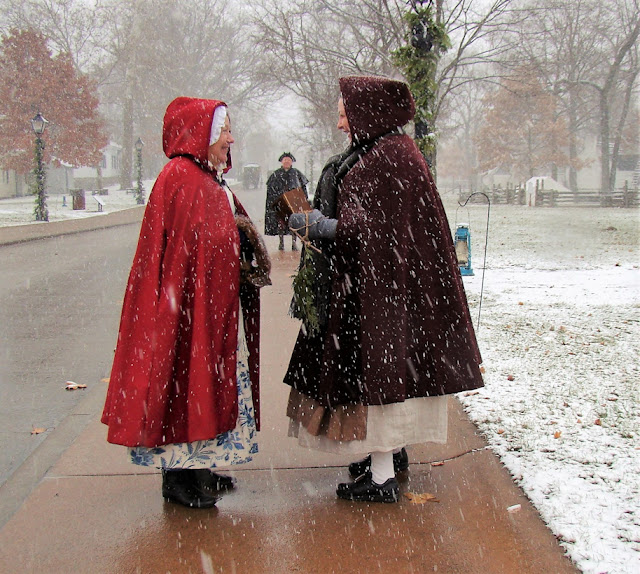
| Visitor photographer Gary Thomas caught me on my quick-step to the McGuffey Cabin. I really like the color ambience in this picture. |
 |
| I was coming upon the girls just outside the cabin when Mr. Thomas snuck a very cool picture of the three of us. |
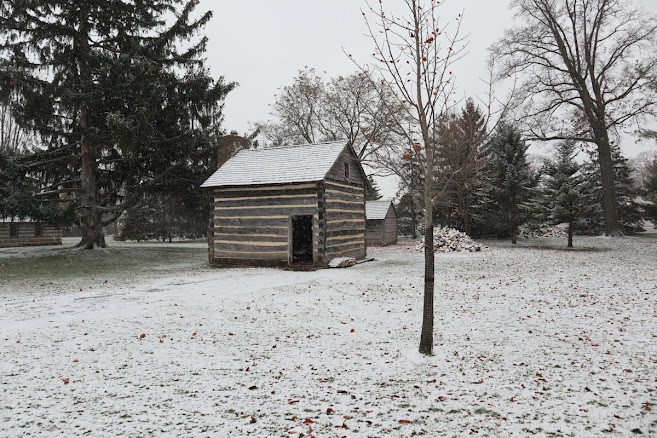 |
| This cabin was built the same year that George Washington became our 1st president. Jackie, Charlotte, and myself, along with Larissa (who was not with us on this day), have been spending some truly wonderful living history days inside a colonial log cabin preparing period-correct food and then cooking on the hearth, threshing wheat, planting and harvesting flax, dipping candles, spinning processed flax on a spinning wheel, and even chopping down a tree. And we have fine ideas for future excursions. Though this is not the cabin we've been using, we certainly have a much better idea of how those who lived in such structures actually lived. |
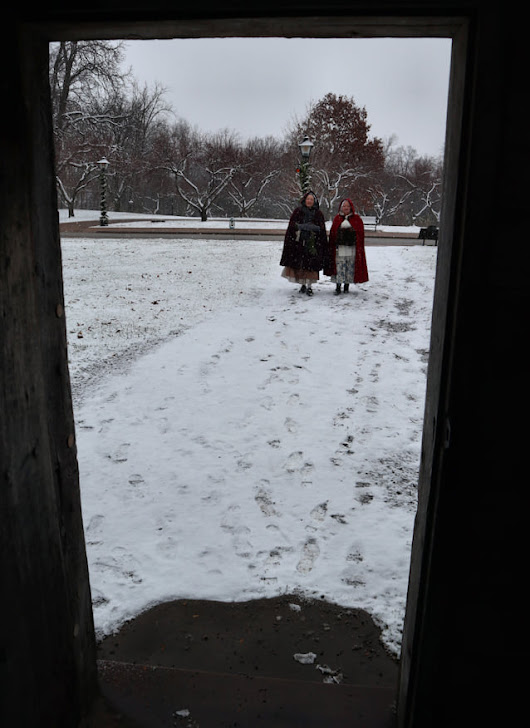 |
| Here we see Jackie & Charlotte moving up toward the door. |
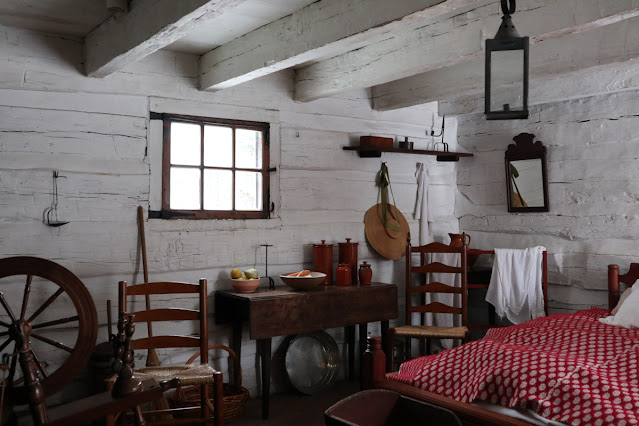 |
| Inside the McGuffey Cabin: I usually take a picture of the other end, but as we sat there on the visitor bench, we spoke about the lighting apparatus we saw, including the Betty Lamp on the left, the tinderbox and rush light on the shelf, and the lantern hanging from the center of the ceiling. Yeah...I have a thing for period lighting apparatus. |
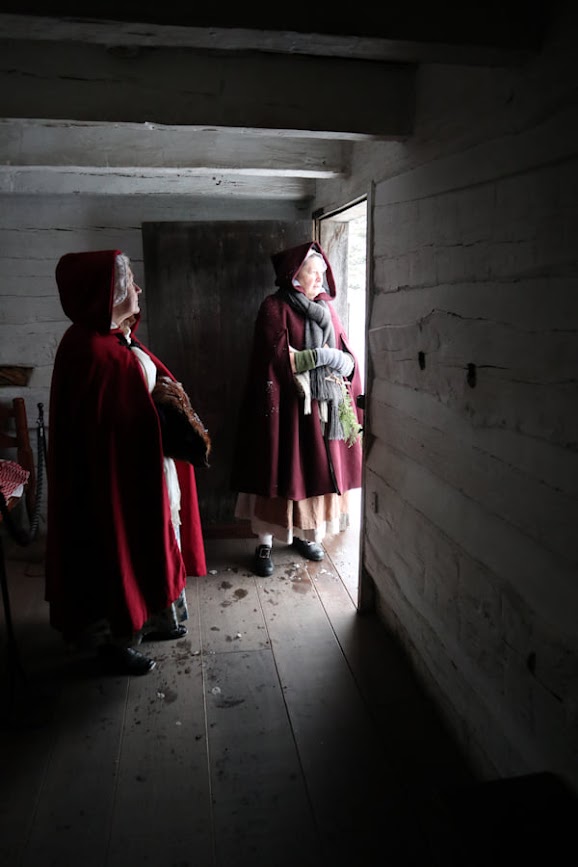 |
| When you can find good people to practice living history with, don't let go, for the wealth of knowledge that can be shared is not going to be found in most history books, but, rather, you can find the day-to-day living information in the lesser known diaries written by those who were there. And also experienced by those who practice living in the ways of our ancestors, such as the wonderful people I spend my time with. Each of us - and not forgetting Larissa - continuously dive into those diaries, journals, newspapers/broadsides, and even cookbooks written during the time we are emulating. It's there where we conceive history, which truly allows us to to see the inhabitants of the past in a more understanding and sympathetic way. |
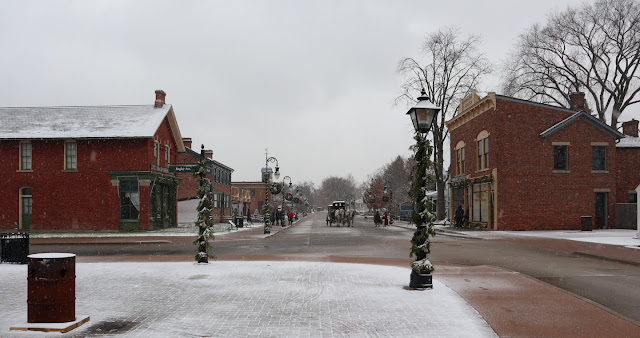 |
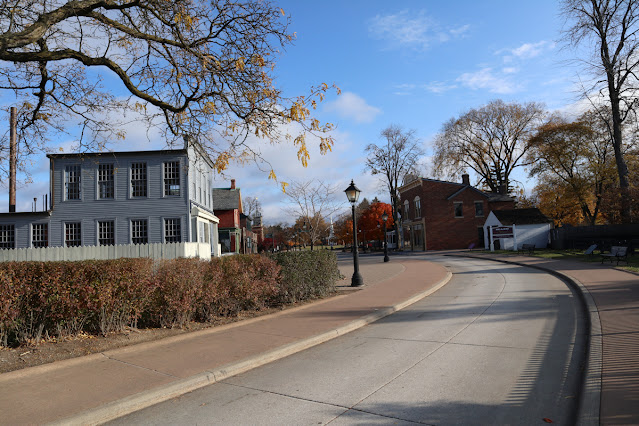
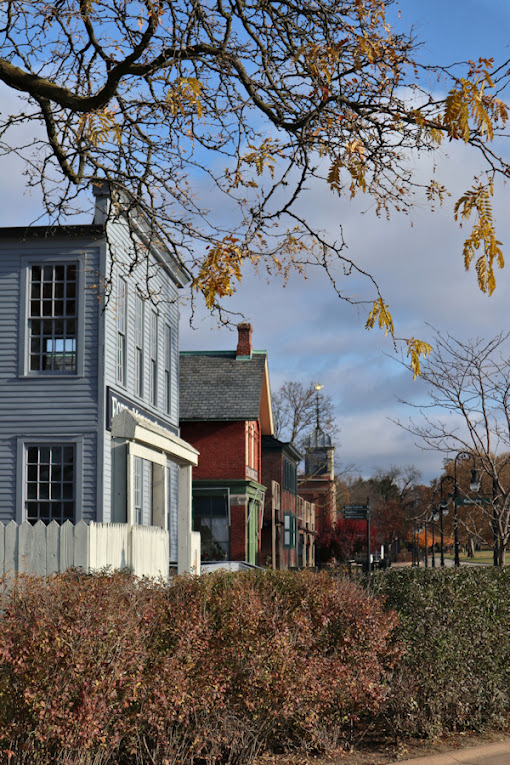
City sidewalks, busy sidewalks, dressed in holiday style, In the air there's a feeling of Christmas... And that's exactly what went through my head as I came upon the Main Street district of Greenfield Village, where one can "discover the center of community and commerce." How can one not think of such a song when they look upon a scene from a hundred and twenty years ago such as what we see before us? The first building there on the left is the Cohen Millinery Shop originally from Detroit. It was here from 1892 to 1903 that Mrs. Elizabeth Cohen made her living decorating women's hats. Next to that we can see the Heinz House. It was in the early 1860's in this Sharpsburg, Pennsylvania brick house that Henry John (H.J.) Heinz produced the first of his more than "57 Varieties" of ketchup. Directly across the street we have the Wright Cycle Shop from Dayton, Ohio, where the Wright Brothers built the first actual airplane. It was on December 17, 1903, a cold, windy day on the sand dunes at Kitty Hawk, North Carolina, that brothers Orville & Wilbur Wright had done what no man had ever done before – they had built, and Orville had flown in, a heavier-than-air machine on its own power with a safe lift off and touchdown. Next to this historic building is the Dayton house the brothers had grown up in. Now, none of these buildings are original to Greenfield Village; they came from different states and had been meticulously taken apart, piece by piece, and rebuilt/restored here in Dearborn, Michigan for all the world to see. In the late 1800s and early 1900s, no one had heard the song I quoted at the top of this post, for the carol, "Silver Bells," was actually written for the movie, The Lemon Drop Kid, starring Bob Hope and Marilyn Maxwell in 1951. Still, it fits the scene… - all brimming with American history and heritage. Yes - - it's Christmas time in the city... |
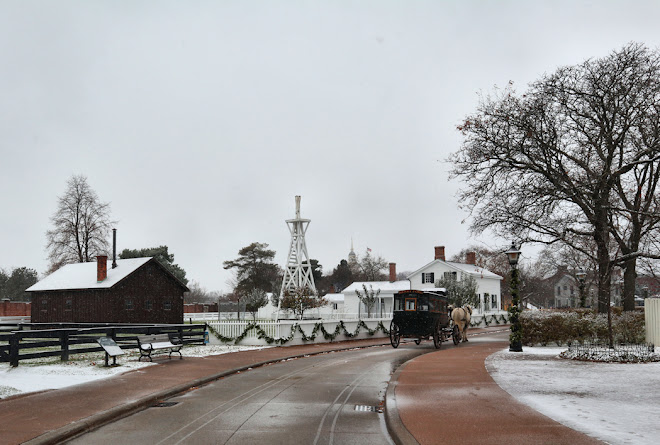 |
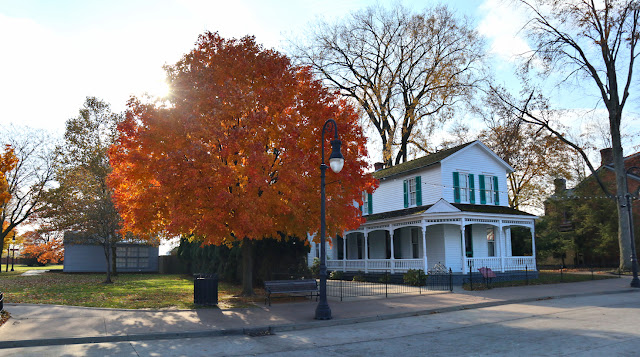
| And, on the outskirts of town, we find the Ford Farm - - the house where Henry Ford was born in July 1863. |
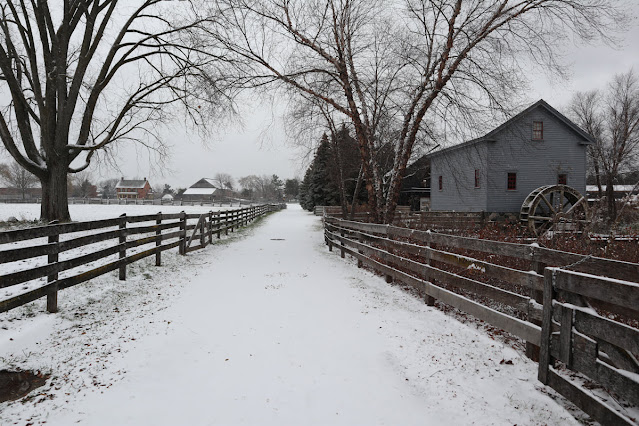 |
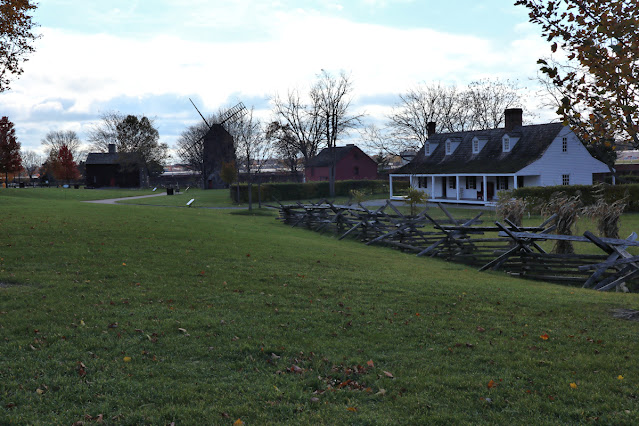
| I love this country lane that leads to Firestone Farm...walking past the Loranger Gristmill from the early 1830s, and the Weaving Shop (built in 1840) that now houses historic spinning wheels and looms dating back to the 18th century. Then, as you continue on you will pass the heirloom apple orchard that includes such ancient varieties as the Roxbury Russett, Maiden's Blush, the Rambo, and a host of others. A few more steps and you are immersed in the 1880s at Firestone Farm, a real working farm with the field work, cooking, and chores done as they were about 140 years ago. |
Though we did not visit Firestone this time, I still thought of how the family could have possibly spent their days following their Thanksgiving celebration back in the 19th century, showing that instead of shopping, farm chores in preparation for winter still had to be done, including hog butchering, which could take place right around this time of year - in late November or, more often, in December.
“We hired nine or ten men who did all the hogs down in the shed. (We) cut up with our own hands 226 pounds of sausage, while Aunt Kitty and Harriet did the lard. Fortunately, Charlie Fisher is the expert with the sausage chopper and he turned and fed the machine himself. We sold 100 pounds and have it all packed away. After that the worst was over. Harriet still had lard to dry up. She had been wonderful to manage it all and to cook for so many extra men. We also canned rounds of sausages in glass jars over which boiling lard was poured.
The women gathered at long tables in the shed, slicing, chopping, rendering lard, which meant boiling the fat down in an enormous kettle until it became liquid. When it cooled it became cool and white, almost as fine as the cream city ladies put on their faces at night.
Hams were rubbed with saltpeter, smoked over hickory fires several times to cure them. Encased in cloth bags, they hung from the ceiling in the smokehouse, sometimes for years, until an occasion warranted taking one down and preparing it for the table, a process that took days. Other sides of meat were salted down in barrels.
It is dirty, greasy work, but somehow there was always a holiday air about hog killing. Perhaps it was the knowledge that Christmas was not too far away or perhaps the thought that for the next few nights everyone would feast on fresh delicacies – pork chops! Brains scrambled with eggs was one of Harriet’s specialties.
We’d sing as we sat at the long table set up in the shed, joining our voices first in Lizzie’s sweet sad spirituals, ‘Look Down That Lonesome Road,’ followed by (the) lively ‘Frere Jaques’ which (we were) taught to sing in a round. Our hands flew, knives chopped, and the piles of meat, the flesh pink, the fat white grew.
The days following hog killing, there’d be a spell of baking – cakes, pies, and cookies – while the lard was fresh. Apple, cherry, peach...all from our own trees. For Christmas, mince meat. The pies were stacked in a pie safe on the back porch and we prayed for a long spell of cold to keep them from spoiling before they were eaten up."
Remembrances of Alice Grey Emory Wilmer
(so much for Black Friday or Cyber Monday shopping!)
The farmer would also work very hard on banking up his home and farm by insulating the north sides of each structure against the coming winter, and preparing his sleigh and its runners to ensure its readiness for travel over hill and dale.
And that’s what I thought of when I saw this scene above that lay our before me.
 |
| Soon, however, it was time to take our leave, for we were concerned at the possibility of some snow-covered roads. I didn't want to be slip-sliding away. |
This was one of my favorite Greenfield Village visits this year! Everything just felt right, you know?
Being in my period colonial clothing with friends to visit such a historic place...well, it really is difficult to explain...you see, to me it's like having the spirits within the walls of the historic houses immersing me - not in a ghostly eerie evil way...just in an...immersive way; one can almost feel the past.
I often hear the term if these walls could talk...and yet, they do - - - the connection is there. And researching the past beyond the schoolbooks, common history books, and the horrible Facebook memes that some people actually believe as fact, will connect you to the past in ways you'd never thought you'd experience.
"Opening a diary for the first time is like walking into a room full of strangers," so writes Laurel Thatcher Ulrich, social historian and author of numerous books including -
A Midwife's Tale: The Life of Martha Ballard Based on Her Diary 1785 - 1812.
I love reading the journals and diaries written by those who lived so long ago. I have numerous of these books that can tell us more about lives once lived than any school history book can ever hope to. And if the reader researches the finer details of everyday activities of the period, as Ms. Ulrich has, a complete new world of the past can open up, allowing the reader to almost seemingly travel through time from the written word.
A Midwife's Tale: The Life of Martha Ballard Based on Her Diary 1785 - 1812.
I love reading the journals and diaries written by those who lived so long ago. I have numerous of these books that can tell us more about lives once lived than any school history book can ever hope to. And if the reader researches the finer details of everyday activities of the period, as Ms. Ulrich has, a complete new world of the past can open up, allowing the reader to almost seemingly travel through time from the written word.
In fact, HERE is a link to a book post I wrote that includes links to other book postings I wrote.
Until next time, see you in time.
But before you take your leave:
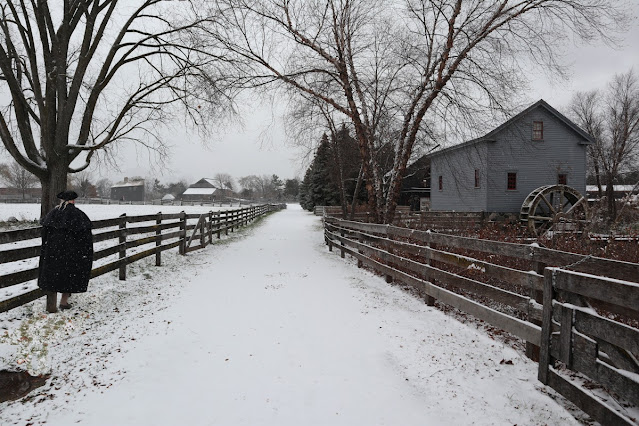 |
| A little computer magic to liven up this picture and give it more of an 18th century feel. |
And please check out the following:
For a more in depth look at each of the four seasons and of how our ancestors lived in each, please check out the following postings:
1880s Firestone Farm through each season of the year in pictures, click HERE
Winter
A 2nd Colonial Winter
Spring
Summer
1880s Firestone Farm through each season of the year in pictures, click HERE
Winter
A 2nd Colonial Winter
Spring
Summer
Colonial Harvest
Also, you might enjoy these postings as well:
Lighting in Colonial Times
In the Good Old Colony Days
Cooking on the Hearth
Also, you might enjoy these postings as well:
Lighting in Colonial Times
In the Good Old Colony Days
Cooking on the Hearth
~And if you are interested in some of my other postings on the structures at Greenfield Village, check out these links:
Ackley Covered Bridge 1832
At one time, in the 19th century, covered bridges were commonplace. Not so much anymore. But Greenfield Village has one from 1832.
Ackley Covered Bridge 1832
At one time, in the 19th century, covered bridges were commonplace. Not so much anymore. But Greenfield Village has one from 1832.
and
Daggett House & Farm: part II
Perhaps the most extensive look at not only the Daggett family, but of their lives as they lived inside this beautiful home that Samuel himself built. Diary notations and tons of photos are included.
Doc Howard's Office - The World of a 19th century Doctor
It's 1850 and your sick. Who are you going to call on? Why, good ol' Doc Howard, of course!
Eagle Tavern
Learn about the Eagle Tavern and 19th century travel & dining
Eagle Tavern: Eating Historically
Taste history while being immersed in the 1850s
Firestone Farm at Greenfield Village
Learn about the boyhood home of Harvey Firestone, the tire magnate.
The Giddings House
Revolutionary War and possible George Washington ties are within the hallowed walls of this beautiful stately colonial home.
Noah Webster House
A quick overview of the life of this fascinating Founding Father whose home, which was nearly razed for a parking lot, is now located in Greenfield Village.
The Plympton House
This house, with its long history (including American Indians) has close ties to Paul Revere himself!
Preserving History
Henry Ford did more for preserving everyday life of the 18th and 19th centuries than anyone else! Here's proof.
Tales of Everyday Life in Menlo Park (or Francis Jehl: A Young Boy's Experience Working at Menlo Park)
Menlo Park is brought to life by one who was there. First-hand accounts.
Richart Carriage Shop
This building was much more than a carriage shop in the 19th century!
And for some haunted fun,
Ghosts of Greenfield Village
Yep - real hauntings take place in this historic Village.
Unfortunately, the Village closes for daytime hours at the end of November and will now only be open for the Christmas Holiday Nights event, which is pretty amazing in itself, so I will be back at least one more time before it closes for good at the end of December...and reopen in mid-April.
Perhaps the most extensive look at not only the Daggett family, but of their lives as they lived inside this beautiful home that Samuel himself built. Diary notations and tons of photos are included.
Doc Howard's Office - The World of a 19th century Doctor
It's 1850 and your sick. Who are you going to call on? Why, good ol' Doc Howard, of course!
Eagle Tavern
Learn about the Eagle Tavern and 19th century travel & dining
Eagle Tavern: Eating Historically
Taste history while being immersed in the 1850s
Firestone Farm at Greenfield Village
Learn about the boyhood home of Harvey Firestone, the tire magnate.
The Giddings House
Revolutionary War and possible George Washington ties are within the hallowed walls of this beautiful stately colonial home.
Noah Webster House
A quick overview of the life of this fascinating Founding Father whose home, which was nearly razed for a parking lot, is now located in Greenfield Village.
The Plympton House
This house, with its long history (including American Indians) has close ties to Paul Revere himself!
Preserving History
Henry Ford did more for preserving everyday life of the 18th and 19th centuries than anyone else! Here's proof.
Tales of Everyday Life in Menlo Park (or Francis Jehl: A Young Boy's Experience Working at Menlo Park)
Menlo Park is brought to life by one who was there. First-hand accounts.
Richart Carriage Shop
This building was much more than a carriage shop in the 19th century!
And for some haunted fun,
Ghosts of Greenfield Village
Yep - real hauntings take place in this historic Village.
Unfortunately, the Village closes for daytime hours at the end of November and will now only be open for the Christmas Holiday Nights event, which is pretty amazing in itself, so I will be back at least one more time before it closes for good at the end of December...and reopen in mid-April.
Happy history.
~ ~ ~