Monday, August 1, 2022

Lammas Day - The Beginning of the Harvest

~A little known mostly forgotten holiday and some interesting seasonal information,  
all rolled up in one,  for they do go together~

....................................

Lammas Day...or Loaf Mass Day
August begins with Lammas Day  (or Loaf Mass Day),  the day when a bread loaf baked with flour from July-harvested wheat or corn would be brought into church and blessed.  It's one of the oldest points of contact between the agricultural world and the Church.
Many colonial farmers celebrated the holiday  (or holyday,  as these special days of celebration or worshiping were called)  on August 1st,  which marked the first major harvest festivity of the beginning fall season.  
Even though it is still technically summer,  August was once considered one of the months of harvest time.  As such,  Lammas Day was a sort of  Thanksgiving,  and so it remained for many colonial families not only here in America,  but in many parts of the world,  especially the British Isles.  
On a colonial-era Lammas Day,  it was customary for the head of the household to bring to church for a blessing the first loaf of bread made from the new crop,  which began to be harvested at Lammastide,  falling at the halfway point between the summer solstice and the autumn September equinox.  That loaf was then used as the center of the family’s Lammas Thanksgiving feast.  
Well,  at least the good ol'  Farmer's Almanac
recognizes the old holyday!
It was by religious festivals such as CandlemasRogation Sunday,  and Lammas  (Loaf Mass)  Day that villagers told the passing of time,  especially in the Middle Ages  (click HERE for historical Candlemas).  Events in the recent past or near future would be dated by their coincidence with - or proximity to - a particular saint's day or festival.  Few in the Medieval period knew the exact year according to the Christian chronology,  and even literate men & women living in the manor houses looked at the passing of time in terms of the monarch's reign.  The hours of the day were calculated by the position of the sun or sundial on the church tower.  In fact,  not too long ago I read an excellent novel,  The Outcasts of Time  by Ian Mortimer,  about two time-traveling Englishmen - John & William - who were originally from the year 1348 but travel into the future at 99 year intervals,  witnessing the changes made in each near century.  And since we are speaking of  marking time,  I thought the following passage and exchange in the book was well-suited at this point,  for it speaks of  the ultimate man-made time-keeper:  clocks.  You see, mechanical clocks,  as we know them to be,  did not exist in John & William's starting point time.  However,  a major breakthrough occurred around 1360 when a device designed and built by Henry de Vick established basic clock design for the next 300 years.  Of course,  ideas and inventions took much longer to spread in those long ago days,  and minor developments were added over the decades and centuries,  such as the invention of the mainspring in the early 15th century,  which allowed small clocks to be built for the first time,  but the basics were there early on and remain to this day.
So,  as the Outcasts of Time story continues on,  at one point the two men find themselves in the year 1546 - 198 years past their own time - and in meeting a man named Tom,  the following occurs  (written in 1st person from John's perspective p. 134):
St.  Michael the Archangel's Church,  Chagford
The church bell in Chagford  rings out nine times. 
"Nine of the clock,"  remarks Tom.
"What is  'the clock'?"  I ask.
He looks at me.  "How can you not know what a clock is?  It is a machine for telling the time.  With weights and cogs and things like that.  Surely you've heard one?  They're proud of their clock in Chagford.  All the folks there live by its chimes.  But those from the town are constantly saying  'sorry,  sorry'  for their lateness - and why?  Because their clock tells them so.  If they didn't have a clock,  they would never be late.  No one would know."
I am still mystified.  How do you get a machine to tell the hour?  Time is reckoned by the motion of the sun around the Earth,  which is down to the Will of God,  so how do you make a machine that tells the Will of God?
You see,  because the seasonal tasks were the same every year,  and because only a major public or private event,  such as a plague epidemic,  a drought,  or the death of a monarch or a family member,  for example,  would distinguish any one year from all the others,  the perception in the passing of time meant little to most people,  and only few were even aware of any differences in the physical conditions of their lives compared with those of their grandparents  (even though such differences may have been minimal). 
So Lammas  (or Loaf Mass)  Day was one such religious festival or celebration to help the marking and passing of time.
It is still somewhat celebrated in England and throughout the British Isles and elsewhere throughout the world,  though it is a forgotten holyday by most here in America.  However,  a variety of Pagan religions also still celebrate,  I am told.
To coincide with Lammas Day,  the harvest fly,  more commonly referred to today as the cicada,  was thought to make its first appearance of the year on that day.
On August 3,  1805,  Noah Blake wrote:
"Very warm.  The harvest fly was two days late."
The year of Blake's diary,  cicadas seem to have decided to come a bit later.
Here in my neck of the woods,  the metro Detroit area,  it tends to come a day or two early.
This 1st Lammas Day picture shows the wheat - could be winter wheat planted last fall or an early summer wheat crop planted in the spring - ready for harvest.  Winter grain harvest is ready around early July,  while a spring sown crop is ready late in July to early August  (these harvest dates are just generalities,  as many conditions can change the ripening date). 

"Bringing in the sheaves..."
My friend,  Theresa,  harvesting wheat.
Then the use of a flail to separate the wheat from the chaff.  This is called threshing.
In the context of agriculture,  wheat refers to the edible grain,  while chaff is the inedible outer husk that surrounds it.  The phrase  "separating the wheat from the chaff"  means to distinguish between what is valuable and what is not,  often used in a metaphorical sense to discern between truth and falsehood or good and bad. 
In this photo we see the gristmill where the grain will be ground into flour
to make the bread after it has been threshed.
Though the Loranger Gristmill seen in this photo was built in 1832 - decades after
the colonial period in America's history - the architectural style of such buildings 
(like taverns and blacksmith shops),   generally did not change much from the
18th century through much of the 19th century.


In this 3rd picture you see an 18th century scene with me standing near my
presenter friend Rebecca  (along with a few others)  in the kitchen garden of the
18th century Daggett Farm House in Greenfield Village, perhaps gathering
summer harvest vegetables to add to the Lammas Day Thanksgiving feast.
The house was built in the early 1750s but is presented as being in the 1760s.

And the 4th photo is of  "Mama"  Jean Dillard,  a former
Greenfield Village employee holding fresh-baked bread that
my wife Patty made especially for her for Lammas Day.
Mama Jean was one of the best presenters I've ever met, 
and is one of the kindest of people.
She is greatly missed at the Village,  but she is now
enjoying her time with her family.
God Bless her.
The living history group I am involved - those who I affectionately call The Cabin Crew,  for we celebrate 18th century life in a very real and researched manner,  celebrate Lammas Day:
Our loaves to be blessed for our celebration of Lammas Day.

Our summer harvest Thanksgiving meal,  including
the vegetables grown in our own kitchen garden.

Pastor Gerring performs a Lammas Day prayer and ritual of the colonial times.

Now,  early August is usually also the time for harvesting / pulling flax,  the plant used in the textile industry that is planted in late April or May.  Almost exactly three months later the plant is ready for harvesting,  though,  just like wheat and other crops,  these harvest dates are just generalities.
American Gothic?  Green Acres?   
Tales From The Green Valley?
Mayhaps  Jonathan and Suzanna Heacock,  my 5th great grandparents 
who were 18th century Quaker farmers? 
Or how about Samuel and Anna Daggett,  whose house now sits 
inside Greenfield Village?
We'll take 'em all,  but really,  we're just Ken & Patty~
And we're ready to harvest flax!

From the diary of Martha Ballard:
August 3,  1786,  Thursday
the Girls Pulld Flax.

August 4,  1786,  Friday
Clear & Hott.  we pulld flax.
In August of 2021,  my wife and I pulled flax that was grown from seed.
 
Once pulled,  there is a process that is done to prepare the flax for spinning.  This includes rippling  (removing the seeds),  retting,  drying,   breaking,  scutching,  hackling,  then,  finally,  spinning it.
Here you see me breaking the flax with a flax break.
This is only just one part of a multi-part process to prepare the flax for spinning,
of which you see in the picture below.

Yes,  Rebecca is spinning the flax that was broken,  scutched, 
and hackled
  earlier that same day.
So,  though most of us do not think of the month of August as anything but the month before school begins - the final month of the summer season - its importance in the farming season was,  and to some extent,  still is,  important in the harvest season. 
Well then,  just what season of the year is August considered to be in?
And what's the difference between autumn or fall?
We'll tackle that second question first:
of the names autumn and fall,  are both commonly used,  though  Autumn  is thought to be slightly older,  appearing in the 1300s,  with the word Fall  first appearing around the 1500s in reference to leaves falling off trees.  
We're not quite there yet.  But...
An even earlier name for the season is Harvest.  It comes from the Old English word hærfest,  of Germanic origin,  perhaps with an underlying,  ancient sense of   “picking,  plucking”  (as in,  picking fruits to harvest them).
Now that makes sense!
Perhaps we should change the name back to harvest rather than autumn or fall!
I don't know...it's all psychological anyhow,  right?
Lol
But to get technical:
based on the intensity of  the sun as well as duration of daytime,  mid-August marks the start of autumn.  The solar season of fall is centered on the September equinox  (approximately the 21st of September),  so the season comprises the second-half of August,  the complete months of September and October,  and first-half of November.
Now,  before allayall start coming down on me with your  "it's still summer - stop rushing it!"  
I'm not rushing anything.  
This is the earth and nature's natural cycle.  And it's okay,  for there is plenty of summer weather still to be had,  especially in August!  
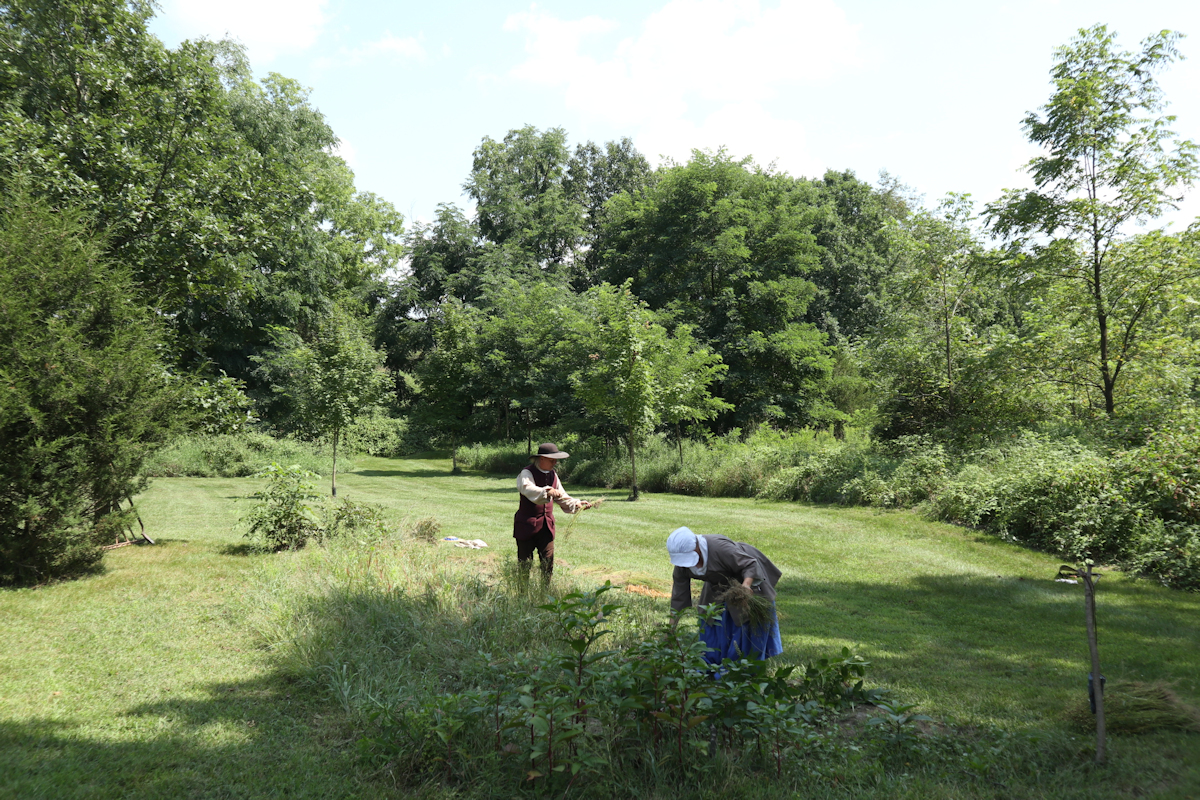
Pulling flax in the hot August sun:  90 degrees and humid.
We were drenched in summer sweat,  just like our colonial ancestors.

All of this because of a forgotten holiday known as Lammas Day.
I find this sort of thing very interesting. I mean,  most of us here in 21st century America do not live by the seasons.  We can get fruits and vegetables virtually any day,  any month,  any season of the year,  where in centuries past we would have eaten seasonally.  March,  April,  and most of May,  for example,  could have been fruits-and-vegetables-free,  for in your cellar you would probably have the last of the potatoes,  winter squash,  soft old carrots,  onions,  dried beans,  and perhaps dried fruit,  if there were any left.
Celebrating Lammas Day and understanding our seasonal - and monthly - earth weather/solar cycles was of utmost importance to our ancestors.
So to you all reading this I say Happy Lammas Day!
Perhaps,  if you are able,  you can bake bread today in celebration.  Or,  if you are not a baker,  maybe a visit to your local bakery to purchase some freshly baked bread may be in order as a second choice.
Celebrations are always fun,  and freshly baked bread is always good!

Until next time,  see you in time.


If you are interested in daily life on a colonial farm,  click HERE

Celebrating another religious festival - Candlemas
And also celebrating yet another 18th century religious festival - Rogation Sunday


~   ~   ~


Friday, July 29, 2022

Presenting Colonial Times in Frankenmuth and for High School Kids

July 9,  10,  and 11 were busy days in the past for me.
Saturday,  July 9 found me in 1862 at Charlton Park  (read all about that event HERE).
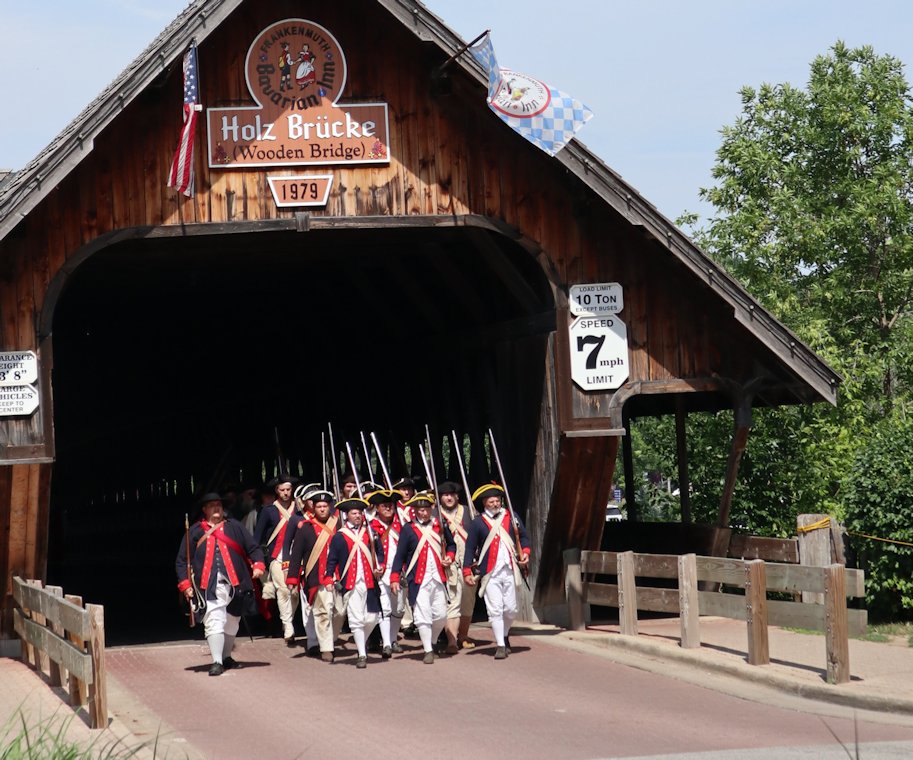
July 10 had me in Frankenmuth,  Michigan for the Rev/War - French & Indian War event,  and on July 11 - a Monday - I was back in my 18th century clothing for a school presentation.
It wasn't just any school presentation;  it took place at my summer employment job.
But more on that shortly.  Let's begin this week's posting in Colonial Frankenmuth,  where the temperature was hot...and muggy.  It started off pretty nice but as the day went on,  the temps and humidity climbed.
A sort of panoramic view of  American and British soldiers.

One of the battles took place at the bridge,  where the Continentals were crossing.

But the British seemed to have the high ground - a better position...

...as you can see.
My good friend Ben Franklin was there with his daughter,  Sarah.
Okay,  actually this is Bob Stark with his daughter Abby.
Bob,  of course,  portrays Benjamin Franklin.
Though Abby does not  portray Sarah Franklin,  she does do presentations
on historic teas,  including the tea that was thrown into Boston Harbor
during the Boston Tea Party in December of 1773. 
Now,  I'm not a tea drinker,  but its place in world history - and in America's Revolutionary War history -  is solidified.  
According to researcher and historian Benjamin Woods Labaree, the tea that was tossed into Boston Harbor nearly 250 years ago was all loose tea because the colonists had no taste for tea bricks,  and tea bags were still 150 years in the future.
In Labaree’s well-researched book,  The Boston Tea Party  it says the three tea ships contained 240 chests of Bohea,  10 of Souchong,  15 of Congou,  (all black teas),  60 of Singlo,  and 15 of Hyson  (both green teas),  all produced in China.  The teas mentioned here can be seen in the photo below in the same order as written.
Bob,  or should I say,  Bob's daughter,  Abby,  was selling this very cool collection
of  Boston Tea Party tea at her father's Salty Lantern sutlery
.  Naturally,  I had to
get it to add 
to my American history collection of cool stuff.
So,  I did.
I love collecting Americana and American history almost as much as I enjoy "living" it!

Susan has her Carrot Patch Sutlery,  where she sells all things wool.
Yes,  she also spins yarn on her spinning wheel.

She has been teaching her boyfriend's daughter how to knit.
I love when I see talents being passed on to the next generation;  too many of our
young people have little-to-no knowledge of  the traditional crafts.

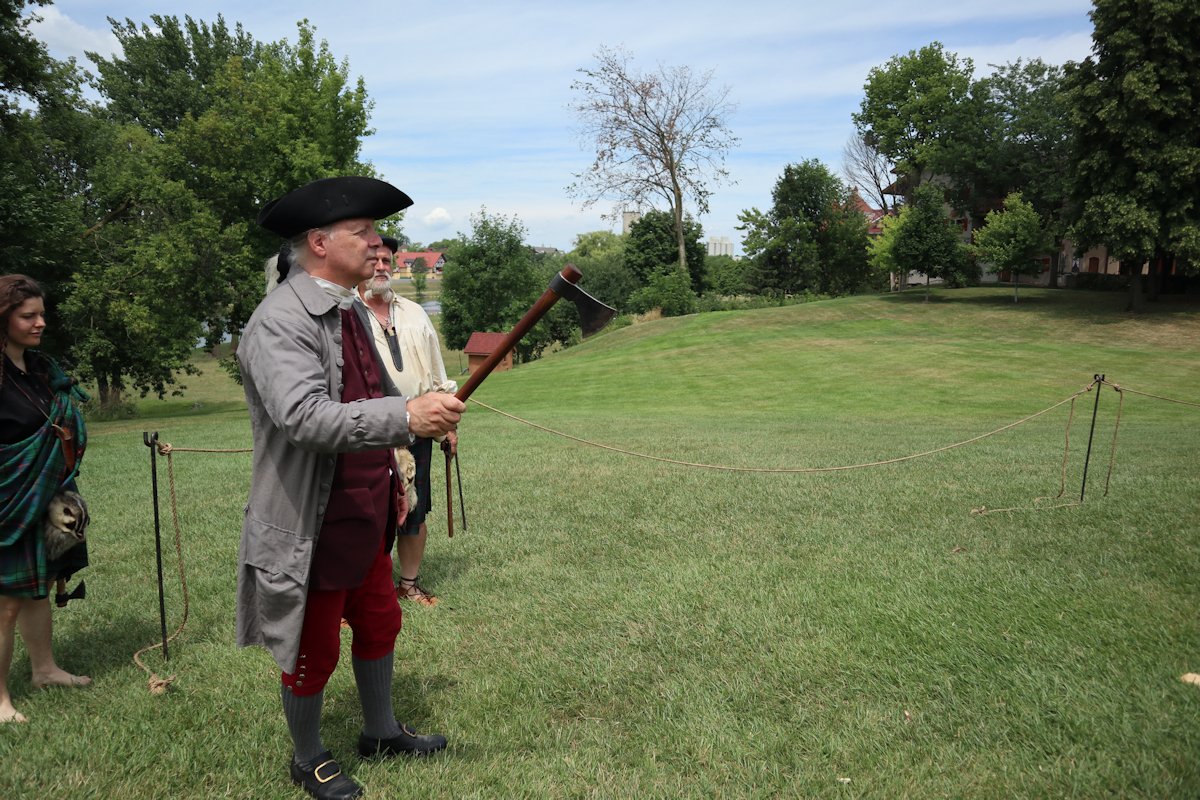
And there was axe tossing.
I did absolutely horrible this time around.
I need to practice...and practice some more.
I will be totally honest here:  it was miserably hot for me.  I've tolerated worse heat before,  but this time - this day -  it was intolerable for some reason.  At one point I felt like I was going to pass out,  but Abby saved me from that embarrassment by getting me some cold water.  It was at that point when I decided I'd best head back home.  It was unfortunate because I do really enjoy this event.  But,  yeah,  it was one of those rare moments where I felt I had to leave...and I didn't take nearly as many pictures as I normally do.  For this I apologize to all involved.
On the way home,  with the wind helping me to remain cooler,  we  (my son Robbie and I)  stopped at a local Frankenmuth air-conditioned diner on the outskirts of town - yes,  dressed in our period clothing - where I was immediately called George Washington.  I responded with,  "I appreciate the high compliment,  he being such a great man and all,  but..."  (I bowed)  "...Paul Revere at your service."  They loved it,  and showed us to our booth where Rob and I both proceeded to order the  "All-American Burger"  (as it was titled on the menu).
"Of course that's what you'd order!"  the waitress laughed.
It was very good. 

The following day was Monday,  and though school is out for the summer,  for three weeks in July I work for the Building Bridges Camp for autistic kids.  This is my fifth year doing this and really enjoy it quite a bit.  I work with high school-age kids,  and we have areas where they can do arts and crafts,  play in the gym,  cook,  work on pictures - drawing and painting and coloring - and go on field trips,  including to a horse farm,  the cider mill,  canoeing,  and numerous other places.  In other words,  this camp gives the kids experiences they might not otherwise have the opportunity to try.
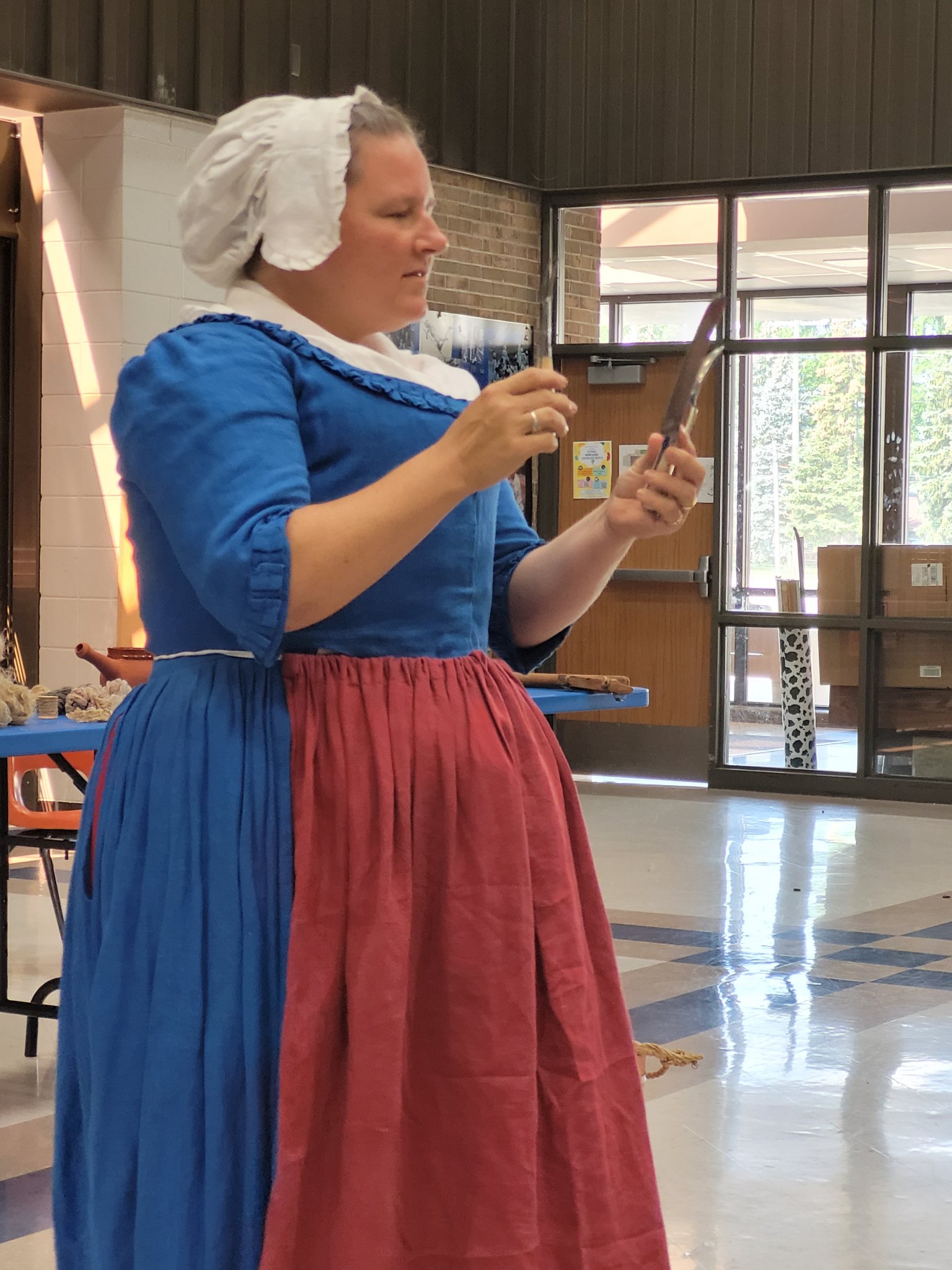
Well,  it just so happens that this year Larissa & I were part of their experiences:  we did our Year in the Life on a Colonial Farm program for them.  We brought along many items in our combined historic collection,  including yoke with water buckets,  candles at various dipping stages,  scythe  &  sickle,  dinner ware,  flail,  flax,  cotton at various stages,  and other period items,  most of which we passed around.
I explained about writing by way of  quill and ink, 
and explained how oftentimes they would have to
even make their own ink.

Larissa explained the use of carding paddles after showing
the different stages of  processing wool.
Note the yoke & water buckets.

While we were in textiles,  I spoke on flax and showed
what it was - raw and after being processed. 
Now I did not bring my flax break - it would have made
quite a mess!  But they did notice the difference between the
hard raw flax and the softness once it was processed. 
We also had some flax thread that was spun at the cabin a while back.

Colonial dinner ware - what do you mean  'eat with the knife?'
Yep,  Larissa explained the differences in eating and table
manners from colonial times to modern times.

Larissa and I with our collection of period accessories.
Besides what I listed earlier,  I also see a butter churn,  a wrapped sugar cone,  
lanterns,  a hat for men and one for women...
quite a caboodle of colonial collectibles.
Though I was  "warned"  that the kids would be bored and difficult to keep attentive,  we most certainly held their attention!  Of course we did---we've been doing this for nearly a decade to such a variety of people,  from pre-schoolers on up to senior citizens.
In fact,  for the rest of the day the kids continued coming up to me and telling me how much they liked it and how much they learned.  One young man even brought in a feather he found while he was outside and gave it to me to  "dip into the ink and write with!"
Another told me I looked like I  "should live back then!"
My heart is full.
Well,  it just so happened that a couple days later our group went to the cider mill,  which is also a farm and grows a variety of fruits and vegetables.  While there,  the kids were able to pick summer apples,  raspberries,  and,  as seen in the picture below,  beans.
I was out there picking beans with the kids.  One of the teachers I was with
asked me,  "Did you hear that?"
"Hear what?"
I guess a student responded to another's comment about picking beans in the
summer by stating,  'weren't you listening to Mr.  Ken the other day?' 
How cool is that,  that they recalled when I spoke on summer harvest while
picking beans on this hot summer day?  You bet that made me feel great!
I like to think at least some of what we teach the kids during our presentations sticks with them.  It's us bringing a sort of museum to them,  and they do show their appreciation.  But to hear it in action,  well,  that just made my day.
And then we received this!
I absolutely love doing historic presenting.  If I could make my living doing this,  I most certainly would.  The past cries out to those who will listen.
And,  as you have just seen,  some truly are  listening.

Until next time,  see you in time.


 ~   ~   ~

Friday, July 22, 2022

Living History at Historic Charlton Park - Summer 2022

We've been through a lot,  we who comprise the 1860s Logan family.  We have been portraying this scenario for so many years;  I personally have been reenacting inside the Sixberry House since 2008,  only missing two years between then and now - 2019 due to illness,  and 2020 due to the covid pandemic shutting everything down.  It was in 2010 while at Charlton Park that I came up with the idea of creating an 1860s family,  where a few of us who work so well together in this capacity - oftentimes falling into immersion and 1st person - mostly as a Maryland family during the Civil War.  Our only time portraying southerners.  
It was in 2014 where I found my,  shall we say,  permanent  1860s family:  my friend,  Larissa,  reenacts as my wife,  Jackie my sister,  and Candy  (as well as Carrie/Agnes)  as our servants.  And over the years we've had various young ladies portray our daughters.
Here  'tis,  the 1858 Sixberry House,  which a few of us have called  "home" 
at least one day a year for over a decade.
It really does feel like our home.
We all returned once again this year to bring the past to life in our own living history way,  though we did not have  "our"  daughter along this time  (I suppose we could say she got married).
So here we are,  back as the Logan family,  and very much enjoying spending our time together once again.
That's Jackie on the left and Larissa on the right.

And in the top row in the back we have our two servants who have been
with us for years,  Agnes behind Jackie and Candace behind Larissa.
And these two ladies truly do act as our servants - they are amazing.
~Living History~
The definition for Living History is:  an activity that incorporates historical tools,  activities and dress into an interactive presentation that seeks to give observers and participants a sense of stepping back in time.  Although it does not necessarily seek to reenact a specific event in history,  living history is similar to,  and sometimes incorporates,  historical reenactment.  Living history is an educational medium used by living history museums,  historic sites,  heritage interpreters,  schools and historical reenactment groups to educate the public or their own members in particular areas of history,  such as clothing styles,  pastimes,  and crafts,  or to simply convey a sense of the everyday life of a certain period in history.
That last line there -  to simply convey a sense of the everyday life of a certain period in history...this is what we do.  In order to do this we work to bring back the visual,  the feel,  and the correct historical information  (as best in our knowledge).  
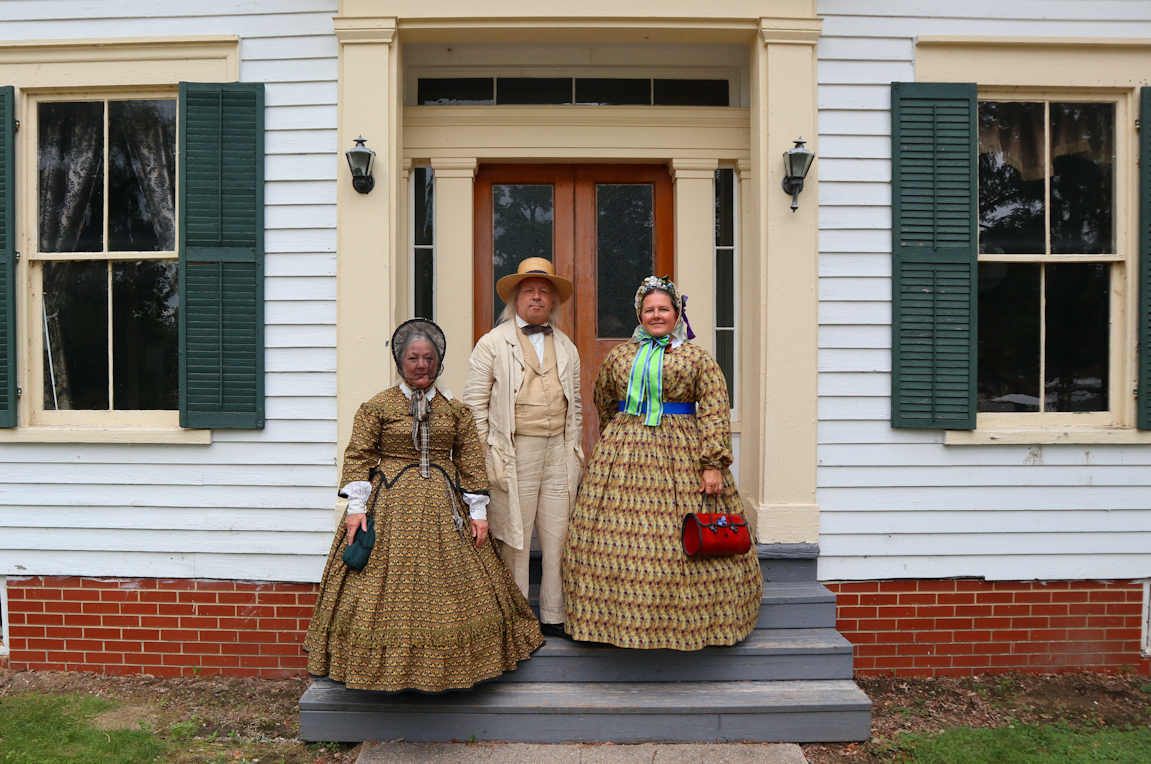
This just may be the most  "textbook Victorian"  picture I've taken yet.
Yep---bringing this mid-19th century house alive once again.
We spend countless hours researching every minute detail of actual history,  including clothing,  accessories,  hair,  lifestyles,  furniture,  and to a lesser extent,  language  (it's hard to do language properly without sounding Hollywood or silly/stupid).... 
Now,  to some this may seem like pretending...kinda sorta,  yeah...but in all honesty we are so much more than that.
We blur time...and we teach,  which is why we must be diligent in how we go about this whole concept.
I suppose the years of experience between all of us helps - we have learned what works and what doesn't. What fits and what doesn't.  What sounds silly and what doesn't.
And we continue to strive for what works,  and realize what doesn't.
One of the things we enjoy most of all while reenacting inside the Sixberry House
is that we'll get visitors,  such as Mrs.  Cummings and her daughter.  and fine
conversations will ensue.

We also went visiting,  too:
Larissa getting ready for our walk through town.

Strolling along the walk,  we came across Mr.  &  Mrs.  Carlson.
Mrs.  Carlson did a wonderful job portraying the Head Mistress of a
finishing school we sent our daughter to a few years ago,  if you recall.
(click HERE)

We also stopped by to see Mr.  and Mrs.  Assenmacher.
They had a new tintype taken of themselves in their home.

And Mr.  Beech,  photographer,  was the man who captured their image taken
with an authentic 19th century camera.

On the top we see another tintype taken by Mr.  Robert Beech.
This is of Mrs.  Frederick,  Miss Schimenti,  and friends.
I took the bottom picture here...

Word was getting around that there was to be a battle in our little town...
I think the double loaded powder - man!  was it loud!

The booming of the cannon sent folks a-scurrying,  including our own family members.

I don't believe I've seen better battle scenarios than what they do at Charlton Park.


The Union Cavalry showed as well.
I really like this photo - - we came out to watch the battle from a safe distance.
Now,  if we were truly watching an actual battle,  we'da been hiding in the cellar.

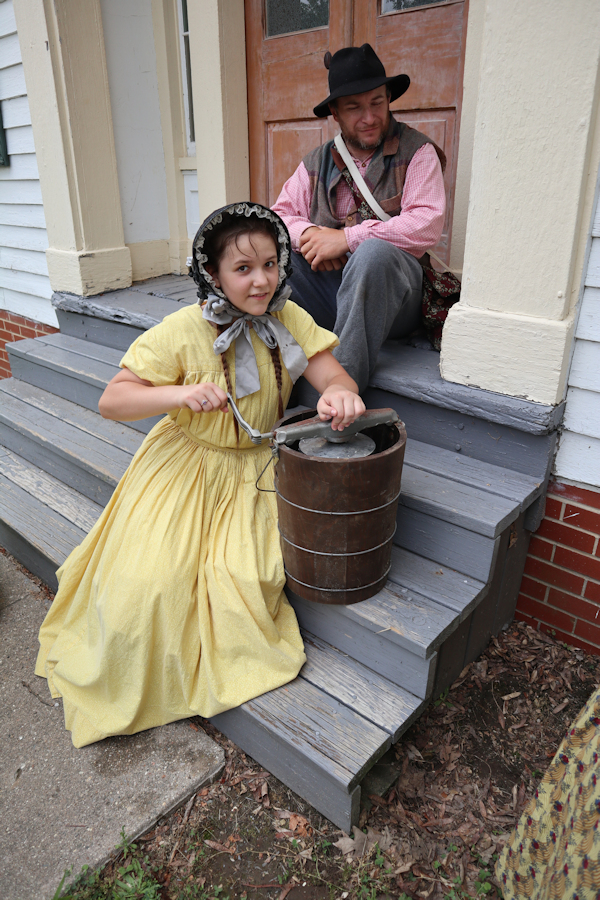
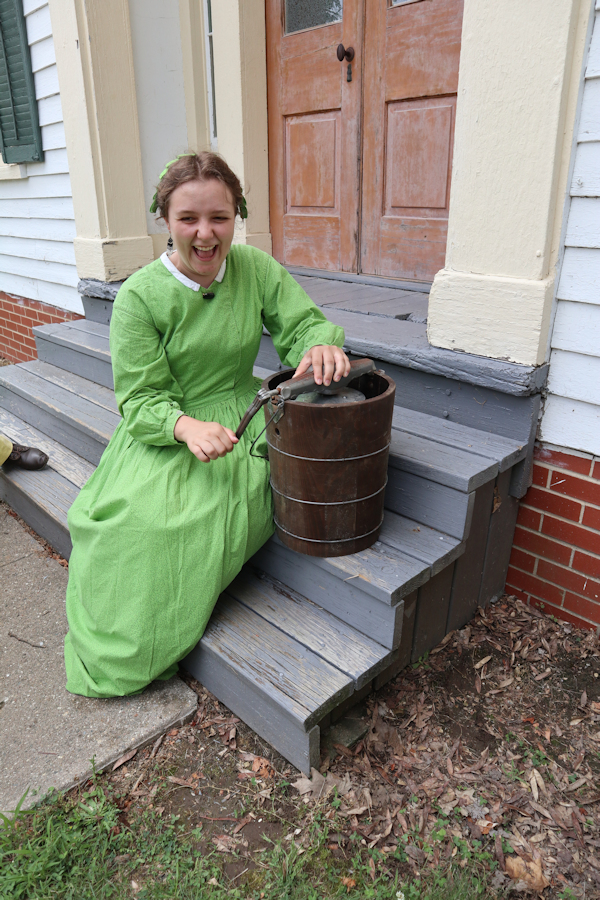
One of the best purchases I've made as a living historian,  besides my clothing  (obviously),  is a hand-cranked ice cream maker.  After years of watching the historical presenters at the 1880s Firestone Farm make ice cream every 4th of July - and wanting to taste some but,  of course,  not being allowed to - I found one on an on-line search and,  naturally,  bought it.  Lucky for me,  I was also able to procure a period recipe as well  (actually,  it's a combination of the same one that the folks at Firestone use as well as one taken directly from the Buckeye Cookbook,  printed in 1883)!  So now it's become an annual late Saturday afternoon activity to make ice cream while at the Charlton Park event.
This period activity has become a mainstay with my reenacting family,  and we make a pretty big deal out of it,  including inviting other reenactors to enjoy the period treat.  
The bucket is prepared with the ice,  rock salt,  and the cream.
Then we all take a turn to churn.
Jackie.

The youngest of the Schroeder children.

Another Schroder child is having a blast!

Mrs.  St.  John took a turn.

Peter helped out as well.

As you can see,  neighbors and friends from all over stopped by.

Freshly picked raspberries added flavor.
It looks like it's ready to serve...don't you think?

Visitors brought their own cups and bowls.

As Larissa put it,  we had a regular ice cram social!
This was a fine mid-summer's eve period tradition that we plan to continue as we did in years past. Even modern visitors still wandering inside historic Charlton Park Village enjoyed watching,  some hoping for a taste.  We were all being drawn into the world of long ago...through sight, sound, smell,  touch,  and taste.
Yeah...I believe we were there,  back in that summer of 1862.
Four of the Schroeder children...all growing up!
I am so glad they joined in our little party.

It had been since 2018 that we'd made ice cream at Charlton Park,  and, 
in my opinion,  as wonderful as our day was,  this was the hit: 
the toppermost of the poppermost.

Another group shot.
I would like to thank the kind folks at Charlton Park who allow us such opportunities in bringing the past to life in our own unique way.  I do hope they are pleased with our actions.
With all my heart I thank them for their trust in us.

Until next time,  see you in time.


I was not the only one taking photographs - 
Peter Miceal Kent and Ian Kushnir also took a few that I borrowed for this post.

To see a history of our bringing history to life at the Sixberry House,  please click HERE


~   ~   ~