Friday, September 9, 2022

Jackson 2022: The Triumphant Return of a Great Event!

The lock down for covid really did a number in the reenacting hobby,  especially for the era of the American Civil War.  The slowdown actually began a couple years earlier - right after the 150th activities died down - and the numbers of participants seemed to drop.  Yet the number of spectators continued to be strong.
Then covid struck and the bottom dropped out.
Was it covid that convinced/scared reenactors away?
Was it that reenactors  "aged out"?
Was it that younger people were not/are not interested and would rather play video games?
Was it because of the woke/cancel culture protests and too many reenactors bowing down to them out of senseless fear of being  "canceled"?
Or maybe it was a bit of everything,  all put into a mixing bowl...
Jackson Civil War Muster is BACK!
Here in the Great Lake State we lost a few events during this pandemic time:  Greenfield Village put their Civil War Remembrance on a  "pause"  (whatever that means),  Detroit's Historic Fort Wayne has stopped all reenactments there as of 2022  (their last event being the ever-popular Christmas at the Fort  last December),  and Port Sanilac had its final  "Civil War Days"  in 2022 due to lack of participation from reenactors  (and not  due to lack of visitors,  as some have claimed).  It was also during this time that the previously very well attended Jackson  (Michigan)  Civil War Muster had also cancelled their event after over three decades.  First it was moved out of its long-time Cascades Park location,  which turned many people off,  including spectators.  Then,  again,  covid struck and the event was simply cancelled.  Earlier this year it was rumored that Jackson would be back.
Okay...not a big deal.  Just a rumor.  We've heard it before.
But then we heard that not only was it truly coming back after its hiatus,  but it would be back at Cascades Park!
Okay,  now our ears are perked up.
Then rumor became truth - - - and interest rose...and continued to rise.
But what was going to actually happen?  
All good,  that's what.  And we can thank Muster President Maurice Imhoff for everything.  This young man worked his butt off  to make it all happen.  Maurice is also the founder and President of the Jackson County Michigan Historical Society as well as a long-time member of the 102nd United States Colored Troops Company B.    As he stated,  "The community has long wanted it back;  it’s an important event to Jackson as well as the reenacting community."
Yeah...Jackson's back...
Ready to see how well it turned out?
Well,  away we go!
This is the sight that greeted me Saturday morning:  smoke arising from the campfires
of  the area known as Jacksonburg,  the reenactor tent city,  just like days of old. 
Could it look any better?

The first thing I came upon as I moved into the  "town"  was the church,  which only makes sense because,  historically,  a church was usually the first structure to be built in any new town or village.  Possibly,  perhaps,  only a lumber mill or gristmill may had been erected before.
The church building would have also been used as a schoolhouse and
a sort of town hall.
Here we see Charlotte and Faith reading the latest news from the war front.

Mr.  Purdue and Mr.  Walker.
Preacher Purdue is a real bonafide preacher,  though he does not evangelize at
the church in the previous photo.
And Dave Walker always does a wonderful job portraying
Confederate President Jefferson Davis.

This coffee wagon is a 7/8 size replication modeled after an 1863 original. 
This one was built by the Chase and Sunburn Coffee Company in 1970.
The idea for a coffee wagon came in 1861 when delegates of the northern YMCA  (Young Men's Christian Association)  came up with the idea to help out with the soldier's spiritual and temporal needs of the Union Army as well as to help alleviate some of the suffering from wounds and illness.
In March of 1863,  Jacob Dunton of Philadelphia built and presented to the US Christian Commission a wagon made from an artillery caisson that could brew 108 gallons of coffee,  hot tea,  or cocoa an hour.
No records have been found to show how many of these coffee wagons had been built,  but documentation shows there was one at the Appomattox Courthouse in April of 1865.

There were many tents set up in Jacksonburg,  including numerous people I did not know,  so for today's posting I will concentrate on those who I do know.
Welcome to the home of  Mrs.  St.  John  (on the right).
Vickie has been reenacting the Civil War longer than nearly anyone I know -
and she's not very old!  But she still finds such joy in this hobby.

At the campsite of  Mrs.  St. John we have an artist named Anna doing a sketch of  her friend, Amelia.  I don't have a photo or copy of the actual sketch,  but I can tell you that
Anna is a wonderful artist!

Next to the St.  John tent was the home of Mr.  and Mrs.  Assenmacher:  Andy  &  Sue.
The Assenmacher tent was filled with activity.
It seemed to be the  "go-to"  tent.  They didn't seem to mind.

In fact,  Andy was teaching his grandson how to use an axe.
What an awesome skill to learn at such a young age!

Cooking and doing dishes.
All the comforts of a 19th century home.

Next to the Assenmachers we have Jackie Schubert's 19th century home.
Patrick,  and I visiting with Jackie.

And on the far end we had the Cary tent where we see Mrs.  Cary,  as Mary Gardner,  tell her story  of what occurred on September 17,  1862,  which was one of the darkest days in Pittsburgh history: 
Mary Gardner,  survivor of the Allegheny Arsenal explosion,  speaks with the public.
It was not considered proper for women to work outside the home,  but this work was allowed because it supported the war effort.
Around 2pm,  Joseph Frick was delivering wooden barrels of DuPont black powder in a horse-drawn wagon up the new stone road.  Rachel Dunlap,  an employee in the lab watched as Frick maneuvered his wagon into position to offload the barrels.  Just then she saw a spark flash near the horse’s hooves  (with iron horseshoes)  and the iron-clad wagon wheels.  Then she saw a sheet of flame.  All it took was one tiny spark.
Many of the victims died in horrific ways.  Witnesses reported bodies bursting in mid-air.  A body does not survive 125,000 rounds of exploding ammunition,  not to mention a couple hundred parrot-gun projectiles.  Where the heat was most intense,  there was nothing left but white bones in a heap.
Just as Antietam would prove the costliest day in military dead,  the Arsenal explosion would produce the largest civilian death tally in the Civil War.  The 34-acre complex became a grim public morgue with bodies laid out on wooden planks.

It was good to see so many friends that we have not seen in such a long time, 
including Amy  (with her kids).  Amy also portrays a Citizen of the American
Colonies,  but she loves the Civil War period most of all.

Mrs.  Alto was also enjoying her time at Jackson,  a-working on her sewing.

When reenactors pose for photographs,  we usually attempt to make valiant efforts to emulate the people from the 1860s and try not to smile.  There are numerous reasons that people have given for the more serious poses,  but the one that makes the most sense to me is early custom dictated wide-mouthed,  toothy grins were considered inappropriate for portraiture. Even in other kinds of old paintings, a person's wide smiles were often associated with madness,  drunkenness,  or otherwise informal,  immature behavior. 
Now some may disagree with me,  others may agree.  But it was basically the custom and fashion of the times - same with the painted portraits before photography.
So...how do we get Miriam to not smile...
How about I tell her that her dog died?
I can just imagine the conversation at her  (modern)  home afterward:
"Mom,  Mr.  G said our dog died!"
"Dear,  we don't have a dog."
"Well,  not anymore!!"
I guess my little scenario didn't work!

Mr.  and Mrs.  Lynch.

Jackie,  myself,  and Larissa~
The three of  us seems to jump back and forth between the 1770s and the 1860s
quite often this year.  And Larissa also time-travels back to the 1940s as well, 
as you will see in a photo coming up.

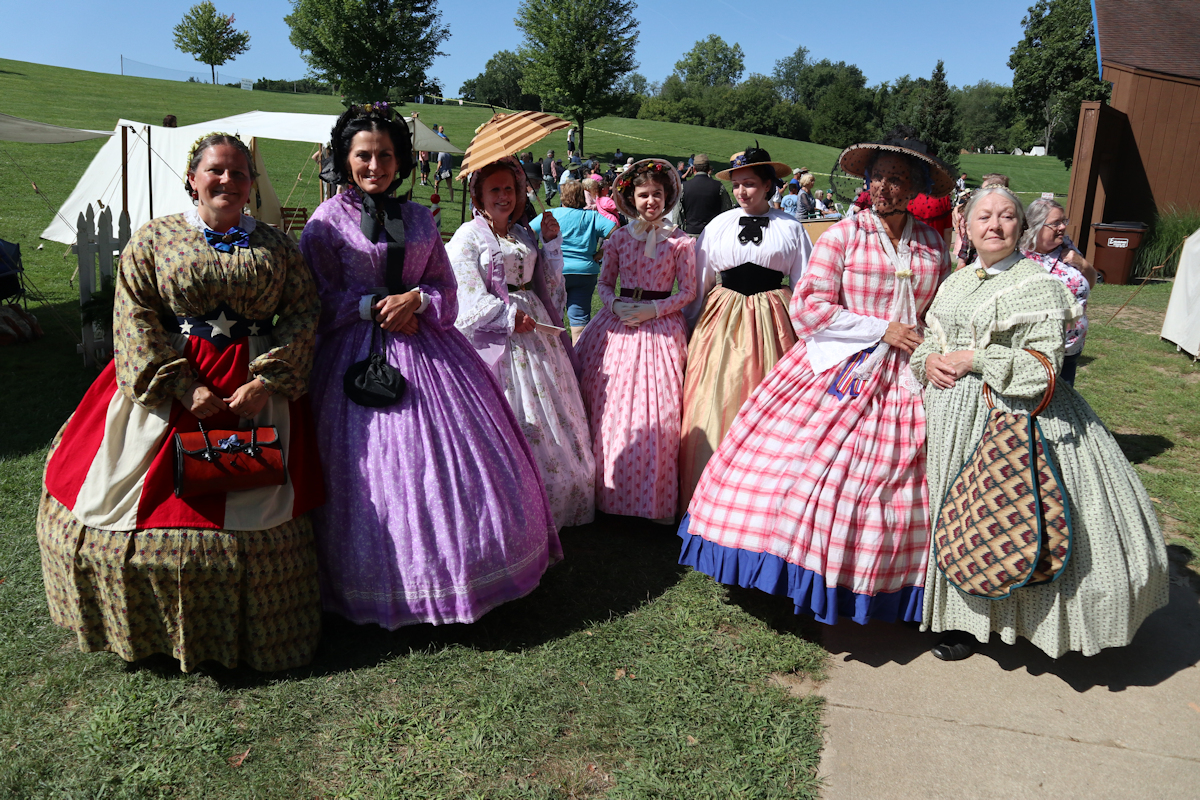
Some of the loveliest of ladies are right here in this picture.
Now I said  "some of,"  for there are more lovely ladies who were not
with us for this photograph.

Susan Hansen,  who can oftentimes be found with her Carrot Patch Farm
woolen sutlery in the Revolutionary War period,  was here in the 1860s as well.  

Dr.  Mary Walker  (who you know and met at Port Sanilac)  had her medicine
 and medical supplies here at Jackson,  and she kept quite busy teaching
the public about medicine and health issues of the 1860s.

Such a wonderful mother-and-daughter picture,  don't you think?
The same manner of picture of the same mother and daughter...taken at Jackson
back in 2013!
Ysabeau is growing up!


Dr.  Trippe,  another 1770s reenactor,  also found himself in the midst of
the 1860s Civil War,  field doctor for the southern army.

A small part of military camp,  which seemed to stretch on quite a ways.

What's weird is this was like nostalgia for reenactments the way they used to
be...reenacting a time before any of us were born...
But it was great to see the Jackson muster as it once was---back where it belonged. 

The camps...

...the cooking...

The cavalry were there as well.
Larissa with her boys Zane and Titus.  She makes history fun for them, 
so naturally they want to come.
Larissa was ecstatic to have her two sons there,  all dressed up in 19th century fashion.

The beauty of the sun gleaming through the branches.

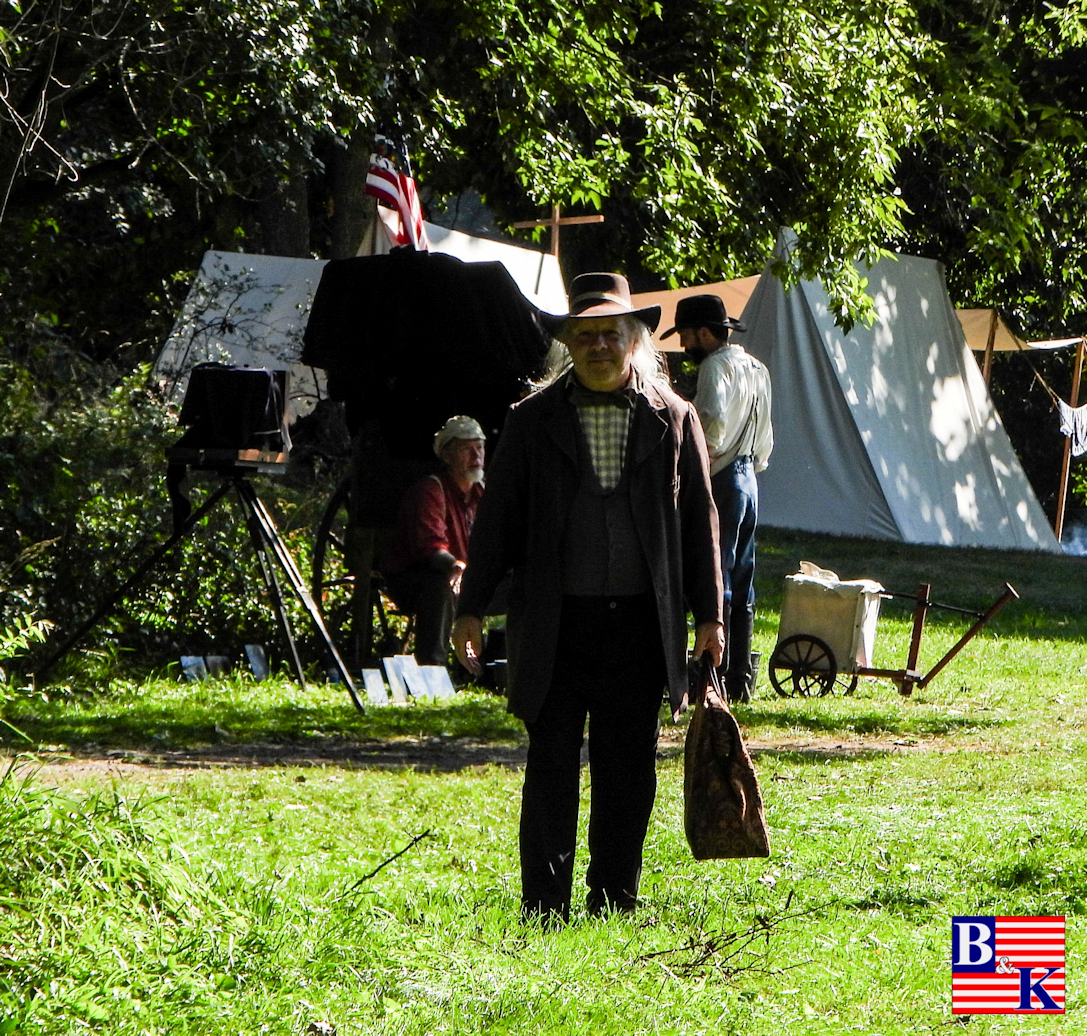
I visited "W.C. Badgley"  the tintype photographer.  I half thought of having
my likeness taken,  but then,  I didn't want another of  just me by myself. 
 
Next time I'll plan something out for a few of us.

I did not see the battle take place,  therefore I took no pictures of it.
But Beth & Kevin from B&K Photography did.  And they got some pretty nice shots.
The battle was not showing any particular historic battle but,  rather,  more of
a tactical,  showing the art of organizing and employing fighting forces
in a more natural way rather than scripted.

In other words,  the military had to react to the enemy without fully knowing their
plans as history shows,  which made it actually more interesting,  from what I was told.

As you can partially see in this phot,  there was a good amount of spectators who showed.

The cavalry is always my favorite part of any battle.
I must admit,  I've longed to see someone on a horse  "take a hit."
I know...it's dangerous...but just imagine...

Medics on the battlefield.

Though some folks have condemned battle reenactments due to the violence and
what some have deemed the  "glorification of war,"  I - and the greater majority
of people - enjoy the history of it...seeing and hearing what it was like,  even to
a small extent.  the sound of musketry and cannonading brings this time in our
history to life for all those interested.  So I tell those people who do not like it
to be on their way.
There is little that can compare to the sound and feel of an actual cannon being fired.
Nothing.
Of course,  to the victors go the spoils and celebrations,  such as a tintype:
We often see the outcome of original pictures like this,  but, 
because we weren't there,  we do not see the set up
beforehand,  so I would imagine it would not had been too
different from what we see here.
And below is the color version of what the tintype will look like.
Unfortunately,  I have not seen how this particular tintype turned out.
"Gentleman,  get ready for the pose."

Here is Larissa and friend,  Cyndi.
Friends in the 1860s.
Both ladies also reenact the
18th century as well.
Here is Cyndi and Larissa,
friends in the 1940s.
Larissa is the chaperone for
the girls on the baseball team.
In 1943,  with so many men off fighting overseas,  Philip K.  Wrigley founded the All-American Girls Professional Baseball League.  To find players for a women’s league,  Wrigley sent scouts out across the United States,  Canada and Cuba.  A total of 60 women made the cut for the first 1943 season,  and were divided among four teams:  the South Bend Blue Sox,  based in Indiana;  the Rockford Peaches,  based in Illinois;  and the Kenosha Comets and the Racine Belles,  both based in Wisconsin.  Over 600 women played in the league,  which eventually consisted of 10 teams located in the American Midwest. The league actually continued after our boys were brought home once they won the War:  in 1948,  league attendance peaked at over 900,000 spectators!
Larissa portrays a chaperone for the girls.  Chaperones were assigned to each team and acted as  "surrogate mothers"  to the players.  They traveled with the team and were responsible for making hotel reservations,  disbursing payroll and meal allowances,  laundry,  social engagements,  and enforcing curfews.
Rebecca and Jillian both showed up on Sunday. 
Unfortunately,  I was not there to see them,  but I am glad
Jackie was able to catch a photo.
All four here also reenact WWII,  with Beckie  &  Jill
playing on the All-American Girls Professional Baseball
League of  1943 at the reenactments.
So,  as you can see,  Jackson 2022 was a rousing success...and I feel it will find its way back to where it once was.  Next year will be the true tell-all of it.
As Maurice Imhoff mentioned on WXYZ TV News in Detroit:
"...it’s an important event to have back so people can learn America’s history.
“We want to be able to learn,  let’s go back in time,  let’s look back at the history of  where we were divided at one point in time,  and how did we rebuild?”  he said.  “What were some of the discussions going on here?  You can come ask the re-enactors why this happened.  How can we rebuild,  in many cases,  including the confederate flag.  It’s banned from many events and such,  but this is the location where we want to talk about in a historical event.”
And he told me,  "Seeing the smiles and laughs all weekend long told me all the work and raising the funds… was most certainly worth it!
It’s important to study our history,  especially in a time of such division.  We intend to evolve our program and encourage open discussion to bring greater awareness of the relevancy of the events of the Civil War and its immediate aftermath to today's people.  It is our hope these efforts will promote healing and equality for all."

So...was it the Jackson of 10-12 years ago?
Not quite.  But give it some time...and as long as you,  the reenactor,  will continue to put in a little effort to show up,  the Jackson of 10-12 years ago may just return.
But in the meantime...for 2022,  Jackson's back...!


Until next time,  see you in time.


The photos came from a variety of people:
B&K  Photography  (Beth  &  Kevin)
Larissa Fleishman
Jennifer Mailley
Miranda Davies
Jackie Schubert
Rebecca Goodenow
and,  yes,  a number of those here are also from me!


~   ~   ~

Thursday, September 1, 2022

Colonial Kensington 2022: Reenacting & Living History - Both at Once

Just when it was thought Colonial Kensington might be done and over with,  
it came back with a vengeance,  stronger than ever.
I am so happy!

.............................

Time keeps on slipping into the future...
but
I am a traveler of  both time and space,
to be where I have been...
Something I have learned over the years is that as soon as you start to think of the past as happening  (as opposed to it having happened),  a new way of conceiving history becomes possible.  And this is how I try to look at the past when I don my period clothing and attend an event,  whether it is simply visiting a local open-air museum,  utilizing a historic structure,  or attending a larger bona-fide tent-filled reenactment.  It's at any one of these that I like to think I am a part of history rather than just someone wearing funny clothes. 
Please note that I use both terms of "reenactor"  and  "living historian"  to describe myself in this hobby.  Each,  however,  actually do have different definitions but are equally important.
On one hand,  Reenactors generally replicate notable moments in history:  famous battles  (such as Lexington & Concord) or a depiction of a battle,  great speeches,  a historic happening  (like the Boston Massacre),  or even camp life for the soldier  (which can also border on living history).  In other words,  great and notable moments in history come to life.  To do this,  reenactors may be in 1st,  2nd,  or 3rd person.  Or sometimes a combination of all three.
On the other hand,  Living Historians bring the past to life in a natural,  unassuming way,  oftentimes through 1st person,  sometimes 2nd person,  and even 3rd person here and there,  and pretty much in a conversational manner.  Often,  however,  living history is done through immersion.  They move about as if they are truly there,  in the past,  and try not to speak of or acknowledge anything beyond the time they are representing.  The spectator will learn simply by watching.
And just wait until you meet a historic character interpreter!
But all of this is rather difficult for 18th century.  If you plan to talk the talk  (literally and figuratively),  you better know what you are talking about,  else you will look foolish...and  "Hollywood."   
You see,  this is not acting,  for there are no scripts to follow;  only historical knowledge and continued research.  In fact,  there are times when the living historian may actually feel as if they'd passed through the portal of time and could almost be there...in that moment,  which is what is strived for.
Yeah...in doing both styles - sometimes separate and sometimes combining - that's what I gallantly attempt...
A genealogist searches for their ancestor
A historian wants to know how their ancestor lived
A reenactor / living historian wants to be  their ancestor
(and I get to---even if  just for a day or two at a time...)

.............................


The original spot at Colonial Kensington  (2018)~
It was a pretty good location,  as this photo shows.
For years,  the Colonial Kensington reenactment had been held near a beach in the Michigan Metro-park called Kensington,  and it's been fine there:  open space/grasslands,  slight hills,  tree covered,  and it had worked well for the purpose reenactors intended.  However,  in 2021,  for some reason,  "our"  spot during  "our"  weekend was given to another group - - a group which had nothing to do with reenacting or even history.  So we reenactors were placed in a different area altogether.  Unfortunately,  it was in a very out-of-the-way location,  and the land was not very conducive for tenting.  Also,  because it was so remote we hardly had any modern visitors.  Oh,  we had a good time and made the best of  the situation,  but because of how it was,  rumors abounded that this event was on its way out.  Then other rumors began floating around about another part of Kensington that seemed to be very willing to host us.  In fact,  in its online description it states:
Meet farm animals and get a glimpse of rural life at the Kensington Metro-park Farm Center.  Take in the sights,  smells,  and sounds of life on the farm and see live farm animals like chickens,  goats,  sheep,  cattle,  and draft horses.  Visit a 150-year old restored barn,  winner of the Michigan Barn Preservation Network  (2012 Barn of the Year Award),  the poultry house,  or the barn exhibit room and kids’  area.  Take a short walk to the riverside,  where you’ll find a one-of-a-kind  “green”  building  (made exclusively of natural materials),  a stone labyrinth,  a grass maze,  and an early skills area – including a blacksmith shop and brick oven.  An herb garden,  field crops,  and old-fashioned farm equipment are also on display.  Special programs on the animals,  historic techniques,  and other farm-related topics are held throughout the year
And so the idea to utilize all of this to help somewhat recreate the era of the 1770s sounded like it just might work.
You know what?
It did!
I think you'll agree after seeing this post~~---~---~---~---~---~~~--~-

I could not go on Saturday,  but I did attend on Sunday,  and found even the area of the information building to my liking.  The good people there pointed me in the right direction to the reenactment location.  As I moved toward the road leading to the event,  the first thing I came across was a team of horses hitched up to a covered Conestoga-type wagon while another was making its way up.
At this point I knew this was going to be something special.
Even if it is  "only a ride"  - - horses always add so much to any historical event.
So I walked along the road...and then,  as it veered to the left...the world of the past opened up before my eyes.
A whole new old world...
Yeah...I know that sounds silly and idealistic,  but,  well,  see for yourself.

I think I am on the road I need to be on,  for I am on a journey through time and space~
Create the right historical environment and let the situations and camaraderie unfold.

Living History Village - what a great name!
I am ready for the 1700s...I will see you in time~
This little makeshift village,  actually called Living History Village,  was opened here in 2014.  It was built by the Chief Pontiac Programs group,  a group of volunteers who operate a hiking trail and other programs with outdoor experiences for all age groups.  They also offer classes,  presentations,  and have informative conversations for guests.  As they state on their web page:  Learn the skills that all settlers on a farm needed to know to be self sufficient.  A farmer in an early settlement needed to be able to make or repair almost anything themselves.
On top of all that,  the Chief Pontiac Programs group has life skills experiences,  including hands-on blacksmithing,  woodworking,  fire starting by flint and steel,  rope making & splicing,  bead work,   weaving and spinning and other fiber arts,  and outdoor cooking classes.
I also know they do maple sugaring in the early spring.  I hope to attend that myself.
But what an amazing group,  eh?
And what wonderful opportunities for modern folk,  especially kids.
I love their name and the fact that they pay homage to Chief Pontiac in that manner.  And,  yes,  they have Native American personnel that support the activities at the Kensington Living History Village throughout the summer programs.  Support is also present during the Kensington Maple Sugaring programs at the Kensington Farm Center.

So as I moved along the dirt road,  I came upon the blacksmith shop:
The buildings in this area are not historic,  but they are  used historically!

The blacksmith was pounding away,  making nails, 
among other items.  He gave me a nail he had
made - I very much appreciate it.
I will use it,  too!
Across from the blacksmith shop was the outdoors cooking-class kitchen.
Here is the oven building where they have a double adobe brick oven.
And this is right next to...

...Lorna's Kitchen~
And it is within these two structures where all the early-American cooking
is done.  Yes,  on certain weekends they also teach this skill.

In the midst of all of this was Susan's Carrot Patch Farm sutlery where she sells 
(and makes)  all things woolen.
Did I mention she spins,  too?

Calico Jack had a small sutlery going as well.

Though this looked like a sutlery,  nothing was for sale here.  It was,  instead,  a 
"teaching tent" - that is,  displaying items from the past and explaining their uses.
This tent had a strong hint of  Voyageurs - the French explorers who came to
Michigan and mixed  &  mingled with the local Indian tribes.

Speaking of mixing and mingling,  that's just what I did,  and came across Ben Despard.
Ben and myself.
As well as Christine Carr Reese:
Christine Carr Reese and Ben.
There was another special building there...more on that in a bit,  however.
As I journeyed around the site,  I came across my doctor friend,  Tom Bertrand.
He had his collection of  18th century medical tools with
him to explain the doctoring procedures  of the 1700s.
And he certainly drew a crowd during his demonstration:
"Foot traffic was unbelievable at times.  I didn't take a break for
almost 6-7 hours."
 

But Tom wasn't the only doctor on the scene:
Henry Tripp was there as well,  speaking about what it was like to be a field surgeon during the time of the French  &  Indian War as well as the Revolutionary War.

Two young ladies playing the game of  Hoops

The 42 Highlanders Grant’s and Graham’s Companies.

MUSIC!  MUSIC!  MUSIC! 
When we think of the music of the WWII era,  most of us automatically hear in our heads such jukebox hits as  "In The Mood,"  "Boogie Woogie Bugle Boy,"  "I'll Be Seeing You,"  "American Patrol,"  or maybe even  "You're a Sap Mister Jap."
WWI  (the Great War)  had  "How Ya Gonna Keep 'em Down on the Farm,"  "Over There,"  "Oh!  How I Hate to Get Up in the Morning,"  "It's A Long Way to Tipperary,"  and  "Sister Suzie's Sewing Shirts for Soldiers."
Popular tunes from the Civil War included  "When Johnny Comes Marching Home,"  "Dixie's Land,"  "Battle Cry of Freedom,"  "Faded Coat of Blue,"  and  "Lorena."
Well,  the Revolutionary War had some fine songs as well,  and included such popular tunes that may have been sung in homes or even in taverns such as  "Johnny Has Gone for a Soldier,"  "Over the Hills and Far Away,"  "Barbara Allan,"   "Fisher's Hornpipe,"  and  "The Water is Wide."
To hear fife & drum music is wonderful,  and I enjoyed the addition of the pipes.

And the husband and wife team of  David and Karen Keeley played some wonderful tunes
as well.  Besides my request of  "Road to Boston,"  they played
 an amazing array of popular
tunes of the 18th century,  including the ever-popular  "Yankee Doodle," 
"British Grenadiers,"  and  "The Girl I Left Behind Me."

The fashion show included mostly military,  but Susan did describe her outfit as well.

Here we have the members of the Massachusetts Provincial Battalion.

The artillery of the Massachusetts Provincial Battalion.

Queen's Rangers~
"The British,  having several fieldpieces stationed by a brickhouse,  were pouring the
 canister and grape upon the Americans like a shower of hail..."

"I should be for exerting the utmost force...to finish the rebellion in
one campaign."
  Lord George Germain
I don't think that's going to happen George.

"The eighteenth-century battlefield was,  compared with the twentieth,  an intimate theater,"  writes historian George Middlekauff.  "The killing range of the musket,  eighty to one hundred yards,  enforced intimacy as did the reliance on the bayonet and the general ineffectiveness of artillery.  Soldiers had to come to close quarters to kill;  this fact reduced the mystery of battle though perhaps not its terrors."

Flash in the pans

“Valiant!  The word mocked me,  for I knew myself to be anything but valiant.  What
I had done,  I had done in a fit of insane bitterness,  not with cool courage, 
not with brave quick thinking,  not with presence of mind - but
with absence of it.”

Muskets taken from a dead Brit's grip - a prized possession!

The battles at Revolutionary War reenactments,  like Civil War reenactments, 
tend to include a bayonet charge toward the watching spectators.
The spectators tend to enjoy this bit of fun.

Let's move on back to the Living History Village area,  to a structure where I spent the better part of my day - and by better,  I don't mean only by the amount of time,  but by it actually being the most favorable.
Look at the photo below to see what caught my eye:
The Fiber Arts and Life Skills shelter has been recently completed,   and this is where one can learn skills that were necessary to every day life on the Michigan Frontier,  such as making clothing or accessories,  weaving and spinning,  fire building,  candle making,  and other necessities from  the  "pioneer days."
I spy with my little eye...a Saxony wheel,  a great/walking wheel,  cotton on the white square...a flax break,  a scutching board,  and a hackle!  Plus,  I see flax in bundles,  and flax on the ground.
Okay - - as one who has gained a big interest in the flax area of the textile production,  I zipped on over to check it all out.  I mean,  it's not very often one can see such tools at a reenactment  (though,  I can proudly say,  I have brought mine to various events over the past few years!).
So,  as I hung about,  checking out their equipment,  a small crowd of interested modern visitors moved up and had questions.  I began to give them answers,  oftentimes letting them know that flax could be used for wicking for candles,  for thread,  or to be turned over to the weaver to be made into material for making garments such as the linen knee breeches I was wearing,  towels,  cloth,  or whatever else linen can be used for.  One of the Kensington workers came by and stepped into the roped-off  area.  I asked him if I could give a demonstration of the flax processing process and tools,  and he said,  "Sure."
So I did,  beginning with my speech of the pre-process procedure of  planting,  harvesting,  drying,  rippling,  and retting the plant  (click HERE for how I actually did that in greater detail).  I then went into showing the rest,  beginning with the flax break:
Here I am using the flax break.
I am so thankful to Roy from the 18th century Daggett House at Greenfield Village
and how he taught me all about preparing flax for spinning.  It was he who first
garnered my interest in it. 
Next up is the scutching board.  I was pleased they had one here - it's not seen often.
A scutching board was something I absolutely could not find anywhere,  whether at an antique store,  a textile fair,  or even on line.  So my wife surprised me with one for Christmas 2021,  made by a friend from photos of the one used at the Daggett house.  I mentioned during one of my demonstrations that I was probably the only person that received such a gift for Christmas,  and how excited I was to get one.  Someone from the audience noted that I would have probably been the only  person to be so excited to get one for Christmas!
I agreed~!  I treasure mine.
Showing the scutching part of the flax process.
And,  finally,  here I am using the hackle  (also known as a heckle or hatchel).
These are not too uncommon and can often be found at antique stores pretty cheap.
I like to tell people they are a torture device.
In this photo I am explaining what the hackle does in the flax process.
I then went on to talk about the portion of flax that could not be used for spinning:  tow.  Tow could become stuffing for a pillow case or for a mattress,  or used as tinder to start fires,  or even twisted up to clean the barrel of a musket.
As the saying goes,  nothing went to waste.
Well,  more and more spectators showed up so I continued my presenting and demonstrating,  even starting over for those who missed the previous demonstration,  all the while hoping I wasn't stepping on anyone's toes.  I found out that the person who was supposed to be there to demonstrate her spinning wheels  (and,  I believe,  the flax process)  could not make it,  so they were short a person.  The one who told me this confirmed with me that they were happy to have me fill in.
I loved it!
In all honesty,  I was absolutely ecstatic!
So,  I did continue to move about the reenactment,  but I came back often throughout the rest of the day to continue to demonstrate.
I truly was one happy camper!  And I sure do appreciate the powers that be allowing me to do so,  for it made my day!  I hope I can do it again next year.
I even got a hug for helping out from the poor woman who would have been running back and forth between the cooking shed and the textile shed!
Yeah...this was awesome...

Being that this was Sunday,  the time to head back to my 2022 home was nigh.  But what a truly fine time I had.  Between the activities,  battle,  friends,  the large amount of spectators,  and the large amount of reenactors,  this was one amazing event.
Preparing to go back to the future...
Our  'now'  is only what our stories fix
in memories which long or short will last
until the moment when they sore transfix
believers bringing future back from past.
(Robert Stone)

Until next time,  see you in time...
Goodbye~a contraction of  
God be with you
“Goodbye”  comes from the term  “Godbwye”  a contraction of the phrase  “God be with ye”.  Depending on the source,  the contraction seems to have first popped up somewhere between 1565 and 1575.  The first documented use of the  “Godbwye”  appeared in a letter English writer and scholar Gabriel Harvey wrote in 1573.
Now you know everytime you say  "Goodbye" - or even its shortened version of  "bye,"  you are giving a blessing.


Many thanks to Jerry Jordan for a few of his pictures.
And to Christine Carr Reese for a couple of her shots as well.

............................................

Before we go - - - - a little fun - - - - 
So I told the Kensington workers I knew how to drive a team of horses. 
They said,  "You look like you do."  So they let me hop on to take a drive.
Oh,  I had these horse riding like the wind,  kicking up the dirt!  Unfortunately, 
the workers were not impressed,  as I soon found out,  and they hunted me down, 
and made me walk back.
sigh
Okay - - if you believe that story,  I gotta million of  'em!
(just having a bit o'  fun---no,  this did not actually happen lol)

I am so glad Colonial Kensington continues on!
And continues on with a vengeance!
Thank you to all involved for making it as great as it was - can't wait til next year!


~   ~   ~