Sunday, October 17, 2021

My Tribute to Fred Priebe: Becoming President Lincoln - An Interview

It's been a while since my last posting.
I have been fighting a serious illness so I am moving a bit slower than normal.
I apologize...

 ~   ~

This is written in honor of my friend,  Fred Priebe,  who was,  perhaps,  one of the finest living historians I have had the pleasure to meet.  It was in April of 2020 that he was diagnosed with pancreatic cancer and only given a probable short time to live.  Due to such a horrible diagnosis,  he retired as Abraham Lincoln.
I am heartbroken to say that Fred passed away on October 3,  2021.  
This is how I noted it on my Facebook page:
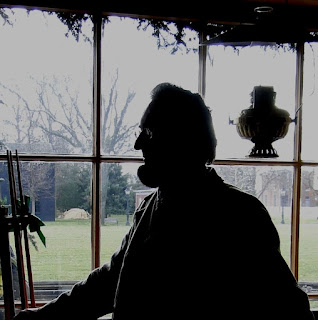
Fred Priebe - 2017
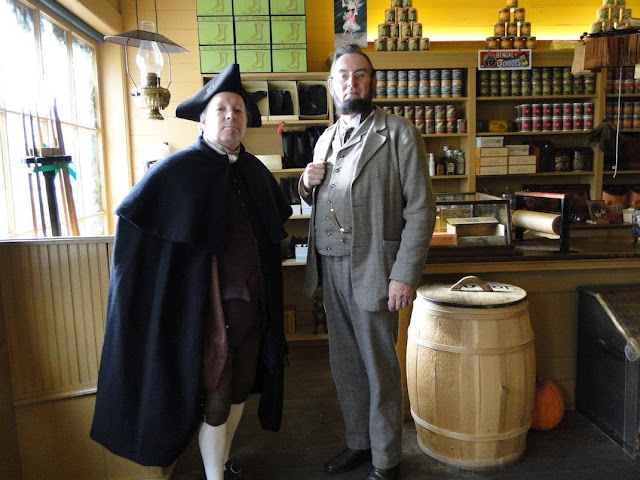
Last day working at Greenfield Village
at the JR Jones General Store


It saddens me to announce that our own President Lincoln - Fred Priebe - had passed away this morning after putting up a grand fight against pancreatic cancer.
He portrayed Abraham Lincoln for over two decades,  and he did our 16th president with true grace and honor.  When he put on his Lincoln clothes,  he became Lincoln.  He took that position seriously and gained high respect from those within the reenacting community.
Fred was also a 25 year employee at Greenfield Village,  and could be seen,  at one time or another,  at the Daggett House,  The Logan County Courthouse,  The Eagle Tavern,  Grimm Jewelry Store,  and the JR Jones General Store.
I will miss my good friend - in fact, I am honored that I could call Fred my friend.


This blog post is my tribute to this finest of men - I wrote it originally years ago,  and have just very recently modified it a little...a slight revisioning for this week's posting - I hope you enjoy a bit of his history in portraying history:
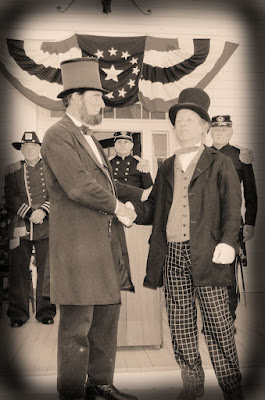

President Lincoln and I


Through my travels in the reenacting/living history community I have met some wonderful people,  and Fred Priebe is probably one of the more fascinating that I have had the pleasure to befriend.  He and his late 1st wife have portrayed President and Mrs. Lincoln and,  I would venture to believe,  probably at times spent more time as the Lincoln's than as the Priebe's!
You see,  when one would meet Fred as our 16th President,  there was little doubt they felt as if they had truly come as close as one possibly could to meeting the actual President.  Fred got into a 1st person mode as soon as he got into his period 1860s clothing,  and would rarely step out of character.
He became  Abraham Lincoln.
It was about 12 years ago that I interviewed Fred,  for I was interested in learning how he got involved in his living history portrayal.  The words are mostly his and the stories came directly from the man himself.


Well it seems that back in the days when our country still actually celebrated Lincoln’s and Washington’s birthdays as separate holidays  (and not the all-encompassing President’s Day,  as we do today),  young Fred Priebe,  who was in grammar school at the time,  was always drawn to Abraham Lincoln,  and when the class would make silhouettes of the two presidents,  Fred always made one of his hero.  As he grew older,  his fondness of the 16th president grew with him,  and he began to collect books about him and would continue studying the man.  It was also during his youth that Fred remembers watching an old television program called  “The Americans,”  which was based on the Civil War.  This helped to pique his interest in the war,  but he really didn’t study it extensively until many years later.
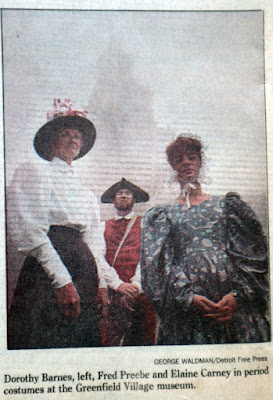
Fred as Samuel Daggett -
way back when...
Let’s jump up to the fall of 1995.  Fred,  already a veteran employee at Greenfield Village open-air museum,  was working at the historic Eagle Tavern,  a restaurant depicting the year 1850 and served up genuine meals from the past.  This was during the September  ‘Old Car Festival’  (of all events),  and he was  “working the porch,”  as he called it,  and a visitor who noticed him began a conversation and told him that,  with his beard he looked like Abraham Lincoln and should portray the 16th president as a reenactor.  Fred told this woman that  "she was nuts!”  She responded with asking Fred to check out the other Lincoln impersonations out there,  which he did.
“They were terrible!”  he told me.  “I knew as much as they did at the time!”  And he knew he could do a better job then they were doing.  You see,  Fred began working at Greenfield Village in 1987 – his very first summer there he was portraying Samuel Daggett at the Daggett Farmhouse,  and as part of his presentation he would do a speech to the visitors about the Articles of Confederation,  the first governing constitution of the United States.  This enabled Fred to learn how to role play,  and he continued this type of role-playing at the Lincoln Courthouse and then eventually back to the Eagle Tavern.  It was this experience that helped him step into 1st person as a character in history.  It taught him to ad lib and,  with unknowing help from his teaching profession,  gave him the skills needed to speak to people of all kinds.  This all helped him to gain the experience needed to bring Lincoln to life.

The woman,  by the way,  who  ‘discovered’  him was Trish Moss,  a long-time reenactor who is known today as portraying the wife of Civil War-era Michigan Governor Austin Blair.  
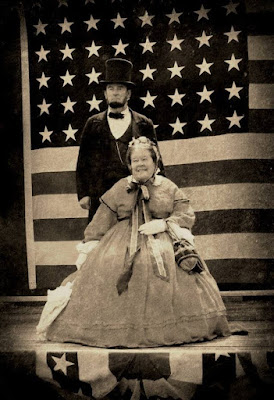
Fred and Bonnie:
President & Mrs.  Lincoln
Trish invited Fred and his wife Bonnie to her home where she guided Fred in his venture to portray President Lincoln.  It was at this visit that Bonnie,  who had little interest in this sort of thing before hand,  tried on a period dress for the first time and liked it.  On their drive home,  it was discussed and decided that Bonnie would portray Mary Todd Lincoln,  and the two became a team.
Their first event as the Lincolns was in the spring of  1996 – they only did two events that year.  But,  it grew from there and they had presentations seemingly nearly every day of the year,  portraying his hero,  with Bonnie joining him on many of these excursions.
I asked Fred what his consistent favorite event as Lincoln was and he replied with,  “A River of Time in Bay City,  Michigan.  It is a unique time line,  from the fur traders through the Vietnam era and everything in between.  There is lots of educational activities and I get to recite the Gettysburg Address daily.
“The setting for this event is beautiful,”  he added.  “It’s in a riverside park and there is a cook that prepares period correct meals from scratch – just like they used to - on an old wood stove in an 1870’s kitchen.”
His worst event ever was when he was asked to come as Lincoln to a Victorian Festival in one of Detroit's suburbs and,  upon arriving,  was told to walk up and down the street making speeches into a microphone and carrying a small hand-held speaker, all the while wearing a sandwich board that advertised his sponsor!  I think this would be a worst event ever for anyone!  Of course,  he refused to do such a thing,  considering it  "not only a dishonor to myself,  but to President Lincoln as well."  They realized how ridiculous this was and found a small stage where Fred could speak and give honor to the one he emulates.
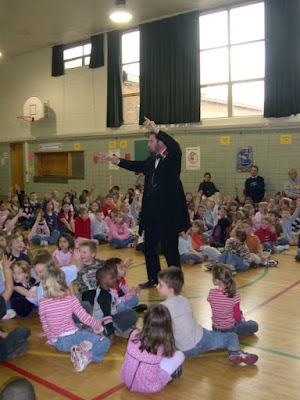
Fred speaking to Eastpointe school kids.
Oh!  He certainly kept their attention!
Over the years,  Fred had many experiences portraying our 16th president, and I asked him about the unusual questions he has received from audience members.  Hands down,  the most asked question from children is  “Is your beard real?”  followed by  “Did it hurt when you got shot?”
For adults,  the most asked question,  or rather,  statement,  he receives is  “I thought you were taller.”  Fred’s response?  “When the war began,  I was 6’4”,  but the burden of it shrunk me some!”

And,  because his beard is  real,  he is asked quite often,  "Did you know you look like Abraham Lincoln?"  when he is his  'modern self.'
I have been to many events with the Priebe's and have witnessed both in action.  My favorite,  I might add,  was at a debate between Abraham Lincoln and Stephen Douglas.  This reenactment took place during the Democrat primary season in the early spring of 2008,  when Hillary Clinton and Barrack Obama were running neck and neck for the Democratic nomination.  A member of the audience posed a question during the question & answer period after the debate had ended:  
"What do you think of having a woman or a black man running for president?"  To which Priebe,  as Mr. Lincoln - and without missing a beat - replied,  "Not in my lifetime!"
The audience roared with laughter!
Great response!
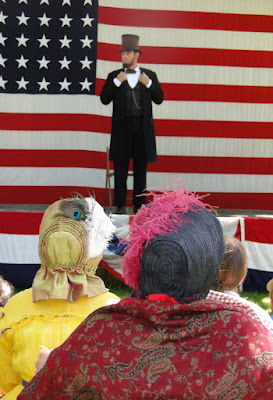

Gettysburg Address
Fred had continued his portrayal as President Lincoln as long as he could do it.  He and Bonnie participated in debates,  reenactments,  living history timelines,  festivals,  school functions and assemblies,  and wherever else they could respectfully teach the public - young and old - about who so many consider to be our greatest president.  Bonnie had passed away a few years ago,  and since then Fred married his high school sweetheart,  Ginny,  a wonderful lady who gave him all the love and care he deserved as he fought the horrible cancer.

In my original posting,  Mr. Priebe left me with these parting words:
“Strive to do what is right and stay away from what is evil,  and then you will be a good citizen and a good model for your children.  And,  as the real Mr.  Lincoln said when he was given a bible from a group of appreciative African Americans:  ‘Everything you know about living can be found in this book.  It is the greatest gift God gave to man.’ ”

Thank you very much Fred for this interview. 
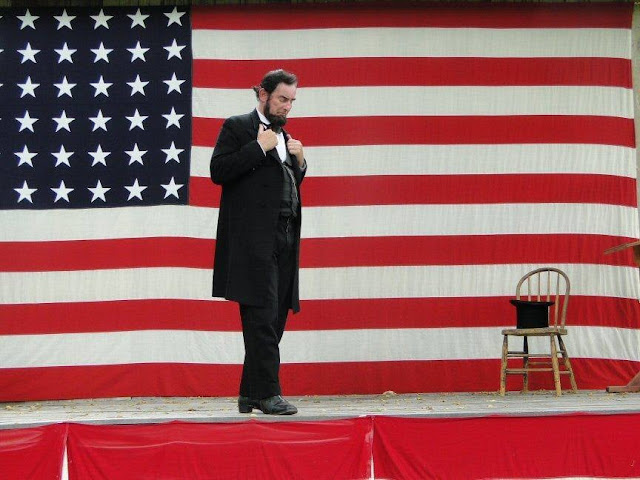


This is perhaps my most favorite photo of Fred,  taken at Port Sanilac.
I am proud to say I am the man behind the camera for this one.

So,  time marches on.
As someone wrote in the comment of my Facebook tribute:
"He now belongs to the ages."
The same quote given when the actual Abraham Lincoln passed away in 1865.
Fred deserves that quote just as much,  for he taught so many people,  especially children,  about such an important man in our great American history...and he was,  more importantly,  a Christian man who was not afraid to show it.  He lived the Christian life in his heart and soul,  all the while teaching of his historical passion as well.
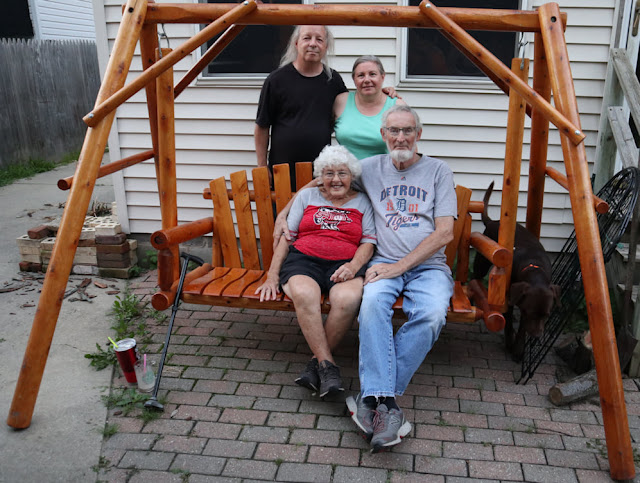
Fred & new bride Ginny came over for a visit this past August.


2017:
A sort of timeline photo here, but I needed a picture of Fred and I on his last day
working as a presenter at Greenfield Village.

During our last conversation we ever had,  on the phone about eight days before he passed away,  he thanked me for teaching him about colonial life.
He  thanked  me!
Such an honor.
My friend...Fred Priebe.
And we in the 21st Michigan were honored to have Fred as a member of our Civil War unit.
Quite an honor~~~

Until next time,  see you in time.


~   ~   ~

Friday, September 24, 2021

When History Is Destroyed, It Is Gone Forever: The 1825 Sheldon Inn

"And what do you want to bet those same people will travel out east and will  "ooo"  and  "ahh"  over the quaint New England villages that are 200+ years old."
From a commenter on a Detroit Historical Architecture page upon finding out the subject of today's posting has been razed.

(I actually wrote this post in spring 2021,  but could not fit it into the schedule until now)~

. ~ _~ .

I have to say,  I am pretty upset.
A building nearly 200 years old is a rarity here in Michigan.  Even though the metro-Detroit area has been settled by Europeans since 1701  (and centuries before by native Americans),  most structures from that early period are long gone.  In fact,  there are relatively few buildings erected before the 1850s still around.  
So now,  in typical Michigan fashion,  another important piece of the state's past,  and thus,  America's past,  has recently been torn down.
The Sheldon Inn - gone forever.
The Sheldon Inn was built and established as a tavern and stagecoach stop in 1825 ---1825!  Nearly 200 years ago!--- and,  until this past January  (2021),  it stood in its original location facing the Sauk Trail  (known now as Michigan Avenue US 12 Chicago Road).  This Inn was built by Timothy and Rachel Sheldon.  The couple moved from Monroe County,  New York,  with all their possessions in a wagon,  intending to settle further to the west,  but when they camped for the night on the Chicago Road two days from Detroit,  they were impressed with the surrounding area and decided to settle there.  On June 6,  1825,  the Sheldons purchased 160 acres near their overnight camping spot, including the property on which this building sat.  They were the third landowners in Sheldon Township,  filing their claim only a week after their first two neighbors.
It was here that they built a Greek Revival home on their land,  and the building almost immediately became an inn,  serving the influx of travelers and settlers spreading westward from Detroit.  The Sheldons farmed the surrounding land,  and soon the hamlet of Sheldon Corners grew around the inn.
Nine years later,  Sheldon Corners would become Canton,  Michigan,  which is still its current name.
In 1830,  Timothy Sheldon became postmaster of the area's post office,  and the next year,  Rachel Sheldon purchased an additional 80 acres adjacent to this property.  The town would soon boast a log schoolhouse,  two general stores,  two churches,  a cemetery,  a cobbler,  and three blacksmiths.
It is interesting to think that this inn was on the same trail - the same road - as other inns and taverns,  such as the Eagle Tavern  (originally known as the Parks Tavern when built in 1831 - now relocated to historic Greenfield Village)  and Walker Tavern,  now a museum on its original site,  both lovingly restored.  
Heading west from Detroit,  the first stop outside of the city was the Sheldon Inn.  The next tavern up would be the Eagle Tavern,  followed by the Walker Tavern...
It was because of the opening of the Erie Canal the same year that this Inn was built that many folks from New York and New England traveled west,  countless settling here in Michigan,  helping it to become the 26th state.  And it was taverns and inns such as the Sheldon Inn that these travelers stayed at as they traveled along the dirt and corduroy roads to the state's interior or further on to the Lake Michigan coast.  
And now,  due to the brilliance of the powers-that-be,  this wonderful piece of Michigan history that helped to tell this historic story is no longer.  
This really makes me sad...and,  in all honesty,  pretty angry - - - once history is destroyed,  it's gone forever.
Eighteen twenty-five...
Once a stagecoach stop,  the Sheldon Inn as it sat not too long ago in its 
original location,  still facing the old Saul Indian Trail,  is now no longer. 
Much of my anger stems from the strong hint that,  as far as I can tell through my internet research,  it has been razed seemingly for no reason.  This was all I could find about its demolition,  which came from the HISTORIC DISTRICT COMMISSION CHERRY HILL SCHOOL:
"Sheldon Inn Demolition Notification
Discussion was had regarding the call to the Township wherein the owner of the Sheldon Inn at 44134 Michigan Ave. has notified staff of his intentions to demolish the building. The owner of this Nation Register Property has called and has advised staff that the building is no longer occupied by residents as it has served as an apartment for the past several years. The Inn is not included in the Canton Township Historic Preservation Ordinance. The owner has agreed to allow the commission to enter the building and photograph anything they wish to photo document the structure. Additional consideration will be discussed with the owner to include the possible filming of the building and the return to the Township the National Register designation sign so that it can be held by the Historical Society."

Now,  it gives no definite hint of a reason why the owner wanted it razed.
Was there unrepairable structural damage?
It sure didn't look like it from the outside to me.  And allowing people to enter to photograph the inside is also a telling sign there was nothing dangerous about the building.
So why would such a historic building allowed to be torn down?
I know,  I know...yes,  the owner has the right to do as he/she pleases.  But this building played a strong role in the history of Michigan and even the U.S.
And it was nearly 200 years old!
Was there even an option for someone to buy it?
The Sheldon's added a one-story wing to the house in the 1830s for an unmarried sister.
Think of the history that took place inside these walls.  
In the great scheme of things,  saving history may seem minor to many.  But it is also important to many,  hence why we have preservation going on throughout the entire world.  And it always seems that during discussions on the razing of historic buildings there are those few who like to needle the rest of us by making snarky,  asinine remarks aimed at those who believe in historical preservation.
And,  as noted in the oh-so-true comment at the top of this post,  these very same people will travel east to visit the history preserved there,  ooo-ing & ahhh-ing at the historic buildings restored.
I believe in saving the past - houses,  objects,  even monuments - for it is something that is important to me.  Yes,  I've put my money where my mouth is and spent actual time  (and money)  in various ways working toward historical preservation.   
I just find it sad that so many in this country would rather not save the past.
Perhaps a new Walmart will replace it - wouldn't that be grand.
Truly heartbreaking.


Until next time,  see you in time.

(photos in today's posting were taken at my one and only visit to the Sheldon House in summer 2020)


To read about the oldest structures still standing in Michigan,  please click HERE
To read about some of the mid-to-late Victorian homes and buildings in Michigan,  click HERE
To read about Michigan's involvement in the War of 1812,  please click HERE
To read about historic train depots here in Michigan,  please click HERE
To read about Michigan's taverns and travel of the 19th century,  please click HERE 


~   ~   ~
Thursday, September 16, 2021

Greenfield Village 2021: The Summertime Visits

Summertime summertime USA,  as the old song by the Pixies Three goes:
School is out and we're glad that we passed,
summertime is here at last...
And there are few places I'd rather spend my summers than at historic Greenfield Village,  that amazing open-air museum filled with not only historic homes from the 1600s through the 1930s,  but of presenters who bring the past to life by doing chores of the season as well.  My visits are nearly always wonderful and I have learned so much.  I've also shared my historical research with presenters as well - most of the presenters and I have a mutual respect for each other's knowledge.  And I have to say that it was the workers at the Daggett House and,  to another extent,  Firestone Farm,  that have taught me much in my visits over the years;  presenters such as Roy,  Sharon,  Larissa,  Gigi,  and numerous others I give credit to in helping to garner my interest in period farm activities and chores along with daily life in the past.
You see,  it was by my frequent Greenfield Village visits over the past nearly 40 years that really helped me to understand more completely the Seasonal  activities and chores of the past,  which do not always coincide with our 21st century seasonal activities.
Yes,  I've been going to Greenfield Village with my wife for 38 years as of 2021  (and I even visited before that,  but not quite as often).
Now,  for today's posting you will find my 2021 summertime excursions,  dropped here month by month.  Even though most of September is technically a part of summer,  the general consensus tends to lean that fall begins on the first of that month,  and judging by the leaves on the trees,  the usually cooler days and nights,  and the way the shadows from the sun lay,  I will have to agree that the celebration of fall can begin at that point and I will leave September,  October,  and November for a later post.
Shall we,  then,  begin our summertime journey to Greenfield Village with June?
Patriotic fervor begins in earnest as the calendar turns from May to June.  
Clip-clopping through the streets lined with historic homes of the past is one of the best ways to see the Village.

The tavern  (on the right)  and the general store.
I have visited the original locations of  these two structures.
Over the past couple of years I've been making it a point to visit the original locations of the local structures that have been removed to the Village.  I have visited most but I still have a few more to go.
You will see a blog posting about it probably sometime over the winter here on Passion for the Past.

The weaving shop  (1840)  and the pottery shop  (1787)  across the pond.
The weaving shop,  on the left  (originally from the Richmond Hill plantation in Bryan County,  Georgia),  once housed cotton gins used for separating the seeds from the cotton.  At that time,  most of the first floor was open,  allowing access for horses to the drive mechanism for the gin.
The pottery shop,  on the right,  was 
originally situated on the Fairfield Plantation at the Waccamaw River near Georgetown,  South Carolina,  and once housed the threshers, grindstones, shafts, and pulleys needed for the miller to do his job of threshing the grains of rice.


Few places show farming past better than Firestone Farm.
You always know what chores are done not only per season,  but per month...and sometimes even per week,  just as would have been done in the 1880s.

Larissa was out picking raspberries on this June day.

I saw this and it looked like a painting.
Yes,  the farmers at Firestone will oftentimes purposely leave certain equipment and tools out in the fields to help create a bit of a scenario.

What would a visit be to Greenfield Village be without a stop at the Daggett House,  my particular favorite?  I cannot remember not stopping here at least for a walk-through each time.

Roy,  Chuck,  and Jan - the welcoming team at Daggett.
As we move into later June we see preparations for the Great American Holiday occur,
such as not only the buntings  'neath the Ford house windows, 
but in their flowers as well.

And colorful red,  white,  and blue ribbons tied upon the tree branches.

Cindy is always happily greeting visitors into the Ford home.

The house where Orville & Wilbur Wright were born,  originally in Dayton,  Ohio, 
stands patriotically majestic inside Greenfield Village.

Even JR Jones decorated the front of his store.

The Smiths Creek Depot,  a stop along the train line in which Thomas Edison rode
daily as a youth,  as it now sits inside the Village.
One would think it was the 4th of July with all of the red,  white,  and blue.
Ahhh...but that holiday is coming up next - - 


Let's revisit the 4th of July - America's birthday celebration!
Now,  I did an Independence Day post back in July when a few of us visited Greenfield Village while wearing our period clothing,  as I've done for years.  But what I plan to show here are a few photos that were not part of that posting:
Well,  someone delivered this broadside to me.
The colonies are declaring their independence!
They need to win the war first.

As a member of the Provincial Congress and leading Whig in Sudberry,  I felt it my duty to read the declaration to the local citizens.

Could this be Anna Daggett and her son Isaiah?

My best side...lol.
I see there's plenty of work to be done in the fields...

A few of the ladies gathered in the garden.

Jackie stops and smells the roses...it was such a busy day!


Later in July...
The Ford home -
This was the home in which Henry Ford was born in 1863.
I've also been to where this building originally stood.

Back to Daggett in late July.

I took this picture looking through one window to see out another.

The back kitchen garden is really flourishing.

Since this Cotswold Cottage is from 17th century England and was not moved to these shores until the 1930s,  this could be an English scene from the later 18th century.

This was taken from inside the Logan County Courthouse looking across the Village Green toward the JR Jones General Store.

The Henry Ford  (Greenfield Village)  recently acquired the Vegetable Building that was once a part of Detroit's Central Farmers Market,  originally built in 1860 and opened in 1861, saving it from demolition.  Like the farmers markets of today,  the Detroit Central Farmers Market was a gathering place – a commercial center,  a hub of entrepreneurship and a community space where family,  friends,  and neighbors congregated and socialized. 
The Vegetable Building from Detroit's Central Farmers Market as it looked in 1888.
Due to the acquisition,  this farmers market will once again become a destination - a resource for exploring America's agricultural past,  present,  and future.
In the above pictures we can see the rebuilding of Detroit's Central Market as it looked in late July.
And in the photo below we see how it looked in early September:

It's exciting to have a new-old structure coming to Greenfield Village.  It's been since June of 2000 that the last historic building,  the Detroit,  Toledo,  & Milwaukee Roundhouse,  officially opened there.
I am so excited to see how it will be utilized,  especially in the fall.  Wouldn't it be cool for them not only to sell heirloom vegetables there,  but heirloom vegetable and flower seeds as well?
We'll find out in spring 2022,  for that's when it will be ready for its grand opening!

Let's move up to the next month:
There is always a hint of fall in early August.  In fact,  August begins with an important day in the farming calendar:  Lammas  (or Loaf Mass)  Day,  the day in the Book of Common Prayer calendar when a bread loaf baked with flour from newly harvested corn or summer wheat would be brought into church and blessed.  It's one of the oldest points of contact between the agricultural world and the Church.
Many colonial farmers celebrated the holiday  (or holyday,  as these special days of celebration or worshiping were called)  on August 1st,  which marked the first major harvest of the beginning fall season.  Even though it is still technically summer,  August was,  at one time,  also considered one of the months of harvest time.  As such,  Lammas Day was a sort of Thanksgiving, and so it remained for many colonial families until a national Thanksgiving Day was proclaimed toward the end of the 18th century. 
On a colonial-era Lammas Day,  it was customary for the head of the household to bring to church for a blessing the first loaf of bread made from the new crop,  which began to be harvested at Lammastide,  which falls at the halfway point between the summer solstice and the autumn September equinox – roughly being August 1st.  That loaf was then used as the center of the family’s Lammas Thanksgiving feast. 
Lammas Day is still somewhat celebrated in England and throughout the British Isles and elsewhere throughout the world,  though it is a forgotten holyday by most here in America  (though a variety of Pagan religions also still celebrate it).
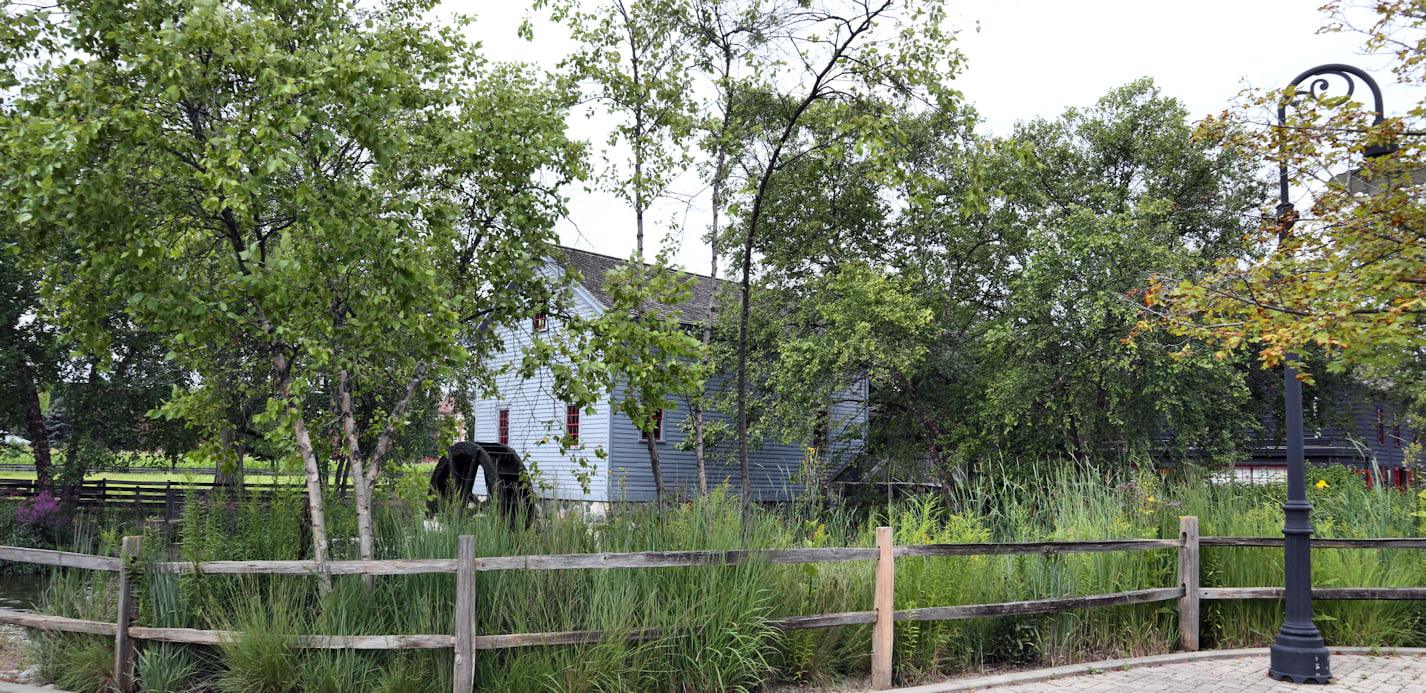
So it is on this Lammas Day we look at the Loranger gristmill. 
Henry Ford purchased this 1832 building,  originally located on Stoney Creek near Monroe,  Michigan,  and it was one of the few structures moved to historic Greenfield Village in Dearborn,  Michigan without prior disassembly.

Meanwhile,  over at Firestone Farm,  the chores continue on~
We see Tom mounding potatoes at Firestone Farm.

The Firestones had a kitchen garden as well.

Some of the late summer harvest in the Firestone Cellar.

Tom is carrying pig feed,  I believe...
Firestone is a real working 1880s farm where the chores of men and women can be seen as would have been done by the season.


The corn is a-coming up rosy on this late August day at the Ford Farm!


Looks like Tom Turkey decided to roam about the Village.
Thanksgiving's a long ways off!

Here we see the hearth from the Plympton House,  of which a brick near its center is dated from 1640,  telling us when it was built.  The wooden structure that is constructed around this fireplace,  however,  is from the early 1700s,  erected after a fire destroyed the original house,  the hearth & chimney being the remaining remnant left of the original.
This is the hearth from the Plympton House.
Pay close attention next time you are in the Plympton House and let your historical knowledge run away with your imagination,  for as you notice the  "…nest of iron pots of different sizes,  a long iron fork to take out articles from boiling water,  an iron hook with a handle to lift pots from the crane,  a large and small gridiron with grooved bars and a trench to catch the grease,  a dutch oven  (or bake pan),  skillets of different sizes,  a skimmer,  skewers,  a toasting iron,  tea kettles,  a spider  (or flat skillet)  for frying,  a griddle,  a waffle iron,  tin and iron bake and bread pans,  ladles of different sizes,  brass kettles of different sizes for soap boiling, &c.,"  you may also  "notice"  by way of historical imagination the once familiar scents of herbs drying,  a suet pudding bubbling on the hearth,  possibly ducks roasting,  perhaps a meat pie or a stew hissing,  or maybe even the less alluring aroma of milk souring into cheese and the continual process of drying out baby flannel.
As for the bricks,  Henry Ford's chief architect,  Ed Cutler,  mentioned upon tearing the house down to be shipped to Greenfield Village:  "They were all little old hand-made bricks.  Of course,  to an ordinary person,  a brick is a brick,  but these were little hand-made things and were crooked as the dickens...there were four of them that had markings on them.  I think one was 1640,  and the other was W. X. P.  In erecting the fireplace,  I put those things  (the marked bricks)  right in the front so they could be seen.  That was not quite like the original,  but we wanted those bricks to be the center of interest."
Yes,  this unassuming house,  painted in red,  has plenty of stories within its walls.

And just past the Plympton House we find,  once again,  the Daggett House from the mid-18th century.
On this cloudy summer day,  we find Jan a-waiting visitors in the Daggett doorway. 
That is the Farris Windmill to the right.  Named after the Farris family,  who ran this mill for three generations,  this windmill,  built in 1633,  was once the oldest on Cape Cod  (in Massachusetts).  It now stands at the southeast end of Greenfield Village.

Jan and the others work consistently in the kitchen garden. 
I love when they will give a tour of the heirloom plants.

The table in the Daggett parlor.
I see a horn cup,  a leather cup,  a pewter plate,  a teapot,  a rush light with
a candle,  playing cards,  and a pipe.

Here we see another rush light in the parlor of Daggett.

Inside the Daggett parlor a few of what may remind one of the  lady of the house's
treasures a-top of the cupboard..

And we have Roy working the shave horse.

So I did something I've been thinking about doing for quite a while:
I,  for the first time,  turned a couple of my blog posts into a book!
As you may know,  I have this infatuation for the Daggett House - that  "saltbox"  built about 1750 and presented as in the 1760s.  In my book I included a ton of pictures  (smaller than I'd like,  but...)  and a tightened text taken directly from two postings I published in this Passion for the Past blog  (HERE and HERE). 
I wanted to show my friends who work in the historic home,  so I brought it along with me.  I mean,  what better place to take a photo of the book than inside the house it is about?
No,  it is not for sale.  It was a bit expensive to do,  and it took me quite a long time to research and write what I have.  How can I put a price on that?
I wanted to have a concise collection of Daggett information at my fingertips,  and that's why I did it.
Pretty cool.
We'll end our summertime visits to Greenfield Village there.  September began a new month,  and,  yes,  a new season,  and,  of course,  I will have a slew of new photos of my fall time there.
But you'll have to wait until December for that one.
In the meantime,  until next time,  see you in time.


 ~   ~   ~