Showing posts with label history. Show all posts

Wednesday, October 8, 2008

And How Long Have YOU Been Into History?

Conversations around the supper table - - - - - - -
Recently I asked my mom, who lives with us, how long have I been into history. She replied that she thinks I came out of the womb into history.
I believe she's right. I cannot remember a time when history wasn't on my mind. Thinking back to the late 1960's (which, I guess, is now ancient history in itself for many!) when I was learning to read, I asked for (and received) a couple of books from the school book fair. One was called "If You Lived In Colonial Times," and the other book was about Christopher Columbus. And I read - as best I could - those two books over and over from cover to cover. Every year from then on, I would purchase more books with a historical theme: "The Cabin Faced West," "The Ghost of Dibble Hollow," "Father's Big Improvements," and others I can't remember at this time, as well as the yearly "Guinness Book of World Records" with lots of historical facts and figures.

Then, in the early 1970's ('73, I believe), the Detroit News celebrated its 100th anniversary and put out a series of replica front pages of the newspaper covering the great events of the previous century. Of course, I collected every one - still got 'em.
And Life Magazine printed a book in the '70's called "The Best of Life," covering the era of the late 1930's through the early 1970's - not exactly my favorite era in history, but it was cool nonetheless.

As silly as it may sound now, I also ate up every TV show that had a historical theme. I say silly because, well, do you remember when Samantha and Darin on "Bewitched" went back in time to the Plymouth Colony? I loved it. How about when Aunt Clara brought George Washington and Ben Franklin to the present? Great stuff! Or when they found themselves in the time of King Henry the Eighth? Not American history, but still history.
If history was involved, I was glued to the set.
Of course, "The Waltons" and "Little House on the Prairie" were watched weekly, although I would never admit it to my friends. Even the dumb nostalgia shows like "Happy Days" - not really history - was fun to watch, at least for the first two seasons. And, "Bonanza" was a family favorite, as were any of the John Wayne westerns that were shown. My father and I together would sit and watch every one of them whenever they were shown in this age before VHS and DVD.

Aside from the TV and books, I, without realizing it, sort of practiced an early form of living history. You see, the house I grew up in had two fireplaces and, after reading about how Abraham Lincoln would study by the light of his cabin's fireplace, I tried to do the same. I would turn off all the lights and sit at the hearth with a book and make the attempt to read. It was tough but, I figured if Abe could do it, so could I!
No other of my friends willingly went to this extent to get a feel of what it was like to live in the past. I was the sole nut.
It also helped quite a bit that my mother would burn candles from September through around Easter time. They were normal everyday candles, not the perfumed fancy garbage that are 'in' today. It seemed like we had light flickering from the fire in the fireplace and from candlelight lit our rooms nearly as often as the electric lights. Well, maybe not that much, but it was quite often.
And when I found out that the home we were living, built in 1941, was actually built using bricks from a 19th century building, I was elated! That was close to living in a Victorian home, I felt!

It was during this time (the early '70's) that, while playing outside, I would also pretend to be living in the colonial and pioneer days, as I'm sure other kids did. If it was a good day, I could get a friend or two to play along with me. Our own early form of reenacting, so to speak. And this sort of pretending was especially fun if we were up at the cottage in Lexington where woods and trails abounded. Now that made for great "living history!"
(I would also pretend to be one of The Beatles during this time, but that's another story!)

With me begging and pleading, my parents finally took me, at about age 10 or 11, to Greenfield Village. You would have thought it was Christmas, that's how excited I was. Walking along the cobblestoned and bricked streets of the Village, horses and carriages clip-clopping by, Model T's chugging past, the steamboat's paddle wheel splashing, and the locomotive train ride that bordered the entire Village - I was in heaven. To top it off, visiting inside the old homes and seeing period dressed docents milling about, and also watching the blacksmith - "ol' smithy" - pound the glowing metal into a horseshoe, made for a fine day in the past. I even got a souvenir, of which I still have - a set of picture cards showing some of the houses, cars, and other Village scenes.

Then came the bicentennial year of 1976. What a great time to be a history buff! The Detroit News and the Detroit Free Press had weekly articles and specials about America's (and Detroit's) colonial period, as did the TV with the movies and documentaries. Colonial themed festivals and parades also took place that year. Even a replica of an old sailing vessel blew through the Great Lakes.
And I was loving it.

But, like most teens boys, driving and girls took precedence and I left history for a number of years to pursue, well, driving and girls. And Punk and New Wave music, too.

Let's jump ahead a few years to 1982 when I met the girl I would one day marry. Our first date consisted of going to see "E.T." at the drive in movie theater and out to eat at the local Big Boys. Our conversation? Believe it or not, much of it was spent on the topic of music. Then, as the night wore on, we - well, I - turned the conversation to the subject of history. It was more like history lite - I didn't want to scare her off. But, guess what? I discovered she had a passion for traditional crafts and revered the past as well. We both even had the same dreams and hopes of one day owning a real Victorian home and living a traditional lifestyle. No kidding.
The year we were married, we bought our first antique - a mantel clock from the 1880's, and have continued to feed our thirst for antiquing and period living ever since. We, too, burn an awful lot of candles, although we have no real fireplace (yet!).

Of course, we now reenact the era of the Civil War and are able to live in that period - one weekend at a time - much to our pleasure. And, yes, our pseudo Victorian, as I call our 1944 bungalow) is heavily decorated in the mid-19th century style with (mostly) original antiques from that period.

(click the link)

To folks who participate in Living History...


I still collect books of a historical nature. It's funny, however, that the stodgy old history books from school never interested me. They spoke of names and dates, but that always bored me. I always wanted to know about how people lived - how they lived their daily lives from sun up to sun down...you know, social history. That's where most of my historical interests lie. Believe it or not, I didn't do very well in history class in school because of the names and dates, and now, history teachers call on me for information! I love it!

To repeat (for the 2nd time) my favorite quote (from Henry Ford):
"History as it is taught in the schools deals largely with...wars, major political controversies, territorial extensions and the like. When I went to our American history books to learn how our forefathers harrowed the land, I discovered that the historians knew nothing about harrows. Yet our country depended more on harrows than on guns or great speeches. I thought a history which excluded harrows and all the rest of daily life is bunk and I think so yet."
That's exactly the way I feel.

.

Tuesday, September 2, 2008

Detroit - A True Colonial City

New York (New Amsterdam), NY 1625
Boston, MA 1630
Charleston, SC 1670
Philadelphia, PA 1682
Detroit, Mi 1701
Trenton, NJ 1719
Concord, NH 1725
Baltimore, Md 1729
Richmond, VA 1733

The above list shows the years these well-known colonial American cities were founded. And right smack dab in the middle is Detroit.
Wait! Detroit? A colonial city?
Yup. Ha! It's even older than Baltimore, and only 19 years younger than Philadelphia!

Here's a quick history from Wikipedia:
The city name comes from the Detroit River (French: l'étroit du Lac Erie), meaning the strait of Lake Erie, linking Lake Huron and Lake Erie; in the historical context, the strait included Lake St. Clair and the St. Clair River. Traveling up the Detroit River on the ship Le Griffon (owned by La Salle), Father Louis Hennepin noted the north bank of the river as an ideal location for a settlement. There, in 1701, the French officer Antoine de la Mothe Cadillac, along with 51 additional French-Canadians, founded a settlement called Fort Ponchartrain du Détroit, naming it after the comte de Pontchartrain, Minister of Marine under Louis XIV. France offered free land to attract families to Detroit, which grew to 800 people in 1765, the largest city between Montreal and New Orleans. Francois Marie Picoté, sieur de Belestre (Montreal 1719–1793) was the last French military commander at Fort Detroit (1758–1760), surrendering the fort on November 29, 1760 to the British. Detroit's city flag reflects this French heritage.
Joseph Campau built this house before 1760 - his farm consisted mostly of fruit trees.
The church was built for use of the people who lived along the Detroit River.


During the French and Indian War (1760), British troops gained control and shortened the name to Detroit. Several tribes led by Chief Pontiac, an Ottawa leader, launched Pontiac's Rebellion (1763), including a siege of Fort Detroit. Partially in response to this, the British Royal Proclamation of 1763 included restrictions on white settlement in Indian territories. Detroit passed to the United States under the Jay Treaty (1796). In 1805, fire destroyed most of the settlement. A river warehouse and brick chimneys of the wooden homes were the sole structures to survive.
From 1805 to 1847, Detroit was the capital of Michigan. As the city expanded, the street layout followed a plan developed by Augustus B. Woodward, Chief Justice of the Michigan Territory. Detroit fell to British troops during the War of 1812 in the Siege of Detroit, was recaptured by the United States in 1813 and incorporated as a city in 1815.

As you can see, Detroit played an important role in the history of our nation - much more important than let on by the history books.
And here's some descriptions from primary sources of everyday life in the late 18th century on the streets of old Detroit (taken from the book "Michigan Voices" by Joe Grimm:
The first I have here are of two offenses by a couple of residents: Two cows belonging to Mr. Wm. Scott were found in the street, and a Mr. G. McDougal left his cart in the street all night. Also, a number of hogs are running in the street daily, to the great detriment of the public.
Speaking of streets, they tended to be in just as bad a shape in the 1790's as they are today:
The street opposite the church was in bad order, and there was a log missing in front of George Leith & Co. And poor Mr. Hand had no logs at all in front of his house!
Neighbor troubles are nothing new, just ask the local tanner, Mr. George Setchelsteil. He was assaulted while on horseback by Simon Girty. It seems Mr. Girty seized Setchelsteil's horse by the bridal, making use of abusive words in doing so. Mr. Setchelsteil found some means to turn his horse away and was able to distance himself from Mr. Girty. Girty, however, was throwing stones at the man, one of which struck him in the head and gave him a wound from which much blood gushed out. Setchelsteil claimed there was no provocation given to cause this.
Ah, city life. Not much has changed, eh?

It is sad that when colonial settlements are spoken of, Detroit is never on the list - never.
And it doesn't help that Detroit very rarely celebrates its colonial past. In fact, nearly all history books I have of Detroit spends very little on pre-Civil War era Detroit. For example, in the book "Echoes of Detroit - A 300 Year History" by Irwin Cohen, only 8 pages out of 131 are dedicated to its first 100 years - the colonial period - and the next 18 pages takes us all the way up to 1874! Nearly 200 years in 26 pages and just over 100 pages to cover the last 125 years.
Another book, "Detroit: A Motor City History" by David Lee Poremba does a much better job by giving the city's early history nearly 60 pages out of 149.
But, "A Motor City History" is a rarity. Most others that I have looked at while browsing in the book stores tend to forget the founding years and concentrates mainly on the automobile years.
I would like to know why Detroit does not celebrate its colonial past. I mean, even it's 19th century past is rarely celebrated; if it wasn't for those of us who do Civil War reenacting, I believe most of Detroit's pre-20th century history would be forgotten. Even Greenfield and Crossroads Villages no longer celebrate Detroit's colonial heritage - both Village's have done away with their colonial festivals.
I would love to see Detroit mentioned on the national stage as more than just a blip on the pages of history until the automobile era.
And, unless we celebrate that here locally, it will never have a chance nationally.

(If you are interested in reading about the way our colonial ancestors lived, please click HERE)


.

Monday, April 28, 2008

GETTYSBURG!!!


VACATION at GETTYSBURG
We have been planning our trip to Gettysburg since January, and it came and went much too fast. To help keep those four days in that great historical town with me, as soon as we returned to our home in Michigan, I wrote a day-to-day journal of our experiences:

Wednesday April 23, 2008
As planned we were on the road by 4 a.m. and all went very well on the ride out. That is, until we got to East 30, which takes us into town. It is an extremely steep (ascending and descending) mountain pass that makes the engine smoke going up and the brakes smoke going down. It’s so bad in fact that they have gravel run offs for the truckers (and cars, I suppose) who lose their brakes. I was really worried about my 1997 Ford Econoline - can't afford to have anything happen to it.
We finally made it into Gettysburg by mid-afternoon and checked into the Quality Inn and, as soon as we got our suitcases in the room, we were off walking down Steinwehr Street, going in the shops. We ate a late lunch at the Dobbin House Tavern (built in 1776), a great atmosphere in which to dine, then it was off visiting the town and shopping once again. Late in the afternoon, Patty and I went off to the Corner Clothiers so I could pick up my new period correct sack coat. It’s AWESOME!!! Oh, Man!! I Love It! It's from an 1861 pattern. Kara does phenomenal work! http://www.cornerclothiers.com/instocknow.htm
By nightfall we were back at the hotel where everyone but me went swimming in the indoor pool (I chose not to swim but watched Patty and my two youngest), then watched TV. Very un-19th century but the kids loved it.
A warm and sunny day.

Thursday April 24, 2008
We woke up early and we all put on our period clothing (including me in my new awesome sack coat!), and remained in our period clothing for the next three days. After our free breakfast (courtesy of the Quality Inn), we checked out of the motel, and then took a ride up Taneytown Road. We drove nearly 5 miles to the exact location where my time-travel story that I have been writing takes place – it was so cool! The lay of the land is very close to the description in my story…and I’ve never been there before! I was even able to visit Mt. Joy Lutheran Church, which is also in my story! How cool is that?
After our Taneytown excursion we parked in the back of the Tillie Pierce House in the middle of town (since we were going to spend the night there) at the corner of Baltimore and Breckinridge streets and went on a guided Civilian Tour to hear what the citizens of the burough experienced during the great battle. We had the same company and guide (http://www.gettysburgaddress.com/HTMLS/amerStory.html - ask for Pat) as we did back in ’05. We really enjoyed it tremendously. It really puts the whole battle into perspective. Many people do not realize just what went on in that town during the summer of 1863, and this tour will give you that understanding of what took place on the streets. It could be a movie unto itself

It was then back to shopping, this time on Chambersburg Street and around the “diamond” (town square).
From there it was to the Farnsworth Inn for lunch. It was built in 1810 with an addition in 1833.
Mid-afternoon we checked into the Tillie Pierce House Bed & Breakfast http://www.tilliepiercehouse.com/. Initially we had some concerns: it was pretty warm, the room we had, although fairly large, was too small to accommodate all seven of us, and Rosalia had a fear of staying there (she told Ashley she could feel someone staring at her…someone who couldn’t be seen). Another concern was trying to keep the kids busy with no TV to watch. But the owners, Keith and Leslie, were extremely nice and, since there would be no other guests staying there that night, gave us – at a reduced rate – another room for the overflow. In fact, it was the actual bedroom of Tillie Pierce herself! They also gave us a couple of roll-away beds to use. Now, if that isn’t courtesy, I don’t know what is. Keith also promised to have the air-conditioning on for us when we returned from our day out (which he did). So, it was off to shop and walk around town once again and, upon returning, everything was set up for us perfectly and comfortably.

The landing on the 2nd floor has a small shrine to the namesake of the home. It's really kind of cool, in an eerie sort of way (see the above picture). The rooms, just so you know, are filled with antiques, including the beds we slept on. It was great – a dream come true! Dressed in period clothing and staying in an actual Civil War house in Gettysburg. It does not get any better! And it didn't matter that we didn't have a TV because everyone was so tired from the day's adventures that they all went right to sleep. No problem!
By the way, Keith and Leslie did an amazing restoration job on the house and I highly recommend staying there if you get a chance. Awesome!
As we hung around the house I got a phone call from JEB from the 21st Michigan (he, Bruce, and Ray also went to Gettysburg – separately from us, of course) inviting us to Little Round Top to watch the sunset. We accepted and drove out there in the early evening. That really set a great mood – how beautiful!! Patty said that was one of her favorite parts of the trip. I took loads of pictures – most of which turned out really good.
When we left there we went back to town and ate at a pizza place called “Tommy’s.” It was so-so – pretty greasy - but we were hungry.
Back to the Tillie Pierce House where, as I mentioned earlier, everyone but me went to bed. I decided to stay up and read for a bit. While in my period clothing, I went to the un-used darkened front bedrooms (all bedrooms were on the second floor) to look out to see Gettysburg at night. Below us and also across the street I could see there were ghost tours going on. Gettysburg is considered the most haunted town in America, in case you didn't know. So I decided to see if I could scare anyone by just standing there in my period clothing, maybe looking like a spirit from the past, but no one looked up at the window I was in. I even moved the curtains to try to get attention but, unfortunately, no one noticed, so I went back to the room. I found out the next day that Tommy did the same thing and got the same response that I got - nada. He would have been even cooler, being dressed as a Civil War soldier. That would have been a riot if we could have given a bit of a fright to a few folks on a ghost tour.
Later, while lying in bed, I heard a few creaks, a couple of raps, and slight footsteps up in the garret (attic). Tom said he heard the same thing. Could it be? Hmmm... Probably the oddest thing I heard was the ticking of the wind up clock (that was already in the room when we got there) became very loud for about a minute – yes, LOUD – then quieted back down. Was it a ghost? If it was a spirit of some sort, I think it liked us. Maybe because we were in period clothing - who knows? Whatever the reason, I felt very comfortable and slept great. Rosalia fell asleep very quickly, considering how afraid she was initially. They say kids can see and feel things better than adults. By the way, Keith told me that he heard groans the previous morning – I didn’t tell anyone else in the family.
Another day of beautiful weather.

Friday April 25, 2008
We had a wonderful omelet breakfast - cooked by Leslie - that we ate in that beautiful period dining room. A fine meal, that was!

What was neat was that we had the dining room to ourselves - kind of like it was ours'. Ahhh...one day maybe...

Unfortunately, because they were going to have a full house for the next couple of nights, we could not stay another night there (there was no way we could all fit into one room – even the large Elizabeth Thorn suite that Patty and I slept in), so, by mid-afternoon, it was back to the Quality Inn. But, I want to, once again, publicly thank Keith and Leslie for what I consider my favorite part of our vacation - staying in that historical house. What an honor. And also for their courtesy and kindness.

After leaving *sniff* the Tillie Pierce House, we met with JEB, Bruce, and Ray for a personal battlefield tour. If you want a detailed tour of the Gettysburg battlefields, it doesn't get any better than hitching up with these three guys.


We went to Spangler's Spring, Culp’s Hill, and the west end of Reynold’s Woods, at Willoughby Run. We also went to the Sachs covered bridge (off the beaten path – built in the 1850’s). JEB said that General Longstreet hung three deserters there and supposedly their spirits remain.
It was a beautiful bridge.
I got reservations to have us all eat lunch at the Cashtown Inn (built in 1797). Out of the way, but a historically beautiful place.
After lunch, we split from the the other 21st members and went to the area of Pickett’s Charge. Patty, Tom, and Rob walked the entire length (me, Ashley, Miles, and Rosalia stayed at the van and slept – I walked it two years ago - no need to do it again). While they were walking the length, there was a Boy Scout troop walking it also and when they saw Tommy they “shot” him with their toy guns. He, of course, “died,” which they thought was great. The scoutmaster came up and thanked Tommy for making their day.

Continuing on the street called Confederate Avenue, we passed by the Round Tops then stopped at the Weikert home where Tillie Pierce stayed during the battle – I took lots of pictures of it. It is located right near the foot of Little Round Top – imagine what they saw while staying in that house on July 2, 1863!
More walking around town took place until the late afternoon when we went to the Gibson Photography Studio to have our tintypes taken. It was so cool (yes, I know I’ve said that word quite a bit, but it’s true!). The guy uses an actual 1867 camera and posed us authentically. The tintype turned out excellent. http://www.civilwarphotography.com/gibson/index2.html
Rob Gibson is a well-known modern "period" photographer who has done covers for Civil War Historian magazine as well as taken tintypes of the actors from Gods & Generals and Cold Mountain.


Back to the motel for the evening.

Saturday April 26, 2008
Tommy, Robbie, Ashley, and I began our day by going to the Evergreen Cemetery to search out the local graves. I took photos of many of the grave stones, including citizen patriot John Burns and Jennie Wade, who was the only civilian killed during the battle. We also found many of the graves of the citizens mentioned on the Civilian Walking Tour from a couple days previous.

After a bit more of walking the town, I split off from the rest of my group and took a tour of the inside of the Farnsworth House (known as the Sweney House in 1863), including the garret where a Confederate sharpshooter was stationed and (as the story goes) shot Jennie Wade from the window. It was chilling to be in that actual spot knowing what happened. The feeling one gets when in an area like that is indescribable. Again, I took loads of photos.


While touring the house, I met up with a couple of guys from Richmond, Virginia, and began telling them some of the civilian stories that I heard (and read) about and took them to the Tillie Pierce House to introduce them to Keith. They hadn't realized all that happened in town during the battle - most folks don't seem to know that, unfortunately.
Back with my family and, for dinner, we ate at a greasy spoon – I don’t recall the name of the restaurant, but it was cheap and filling but not that great.
In the evening, Tommy, Robbie, Ashley, and I took a Ghost Tour of the town. If you have never done one of these my advice is to do it because it was another really good time. Unfortunately for us, rain poured the whole tour time but we didn’t let that stop us from enjoying ourselves. I’m not complaining since it was the only time it rained like that during our whole time there. The stories told of the most haunted town in America were pretty cool. They kind of make you look over your shoulder a bit more, if you know what I mean. http://www.ghostsofgettysburg.com/

Sunday April 27, 2008
Up at 6:30 and on the road by 8, we had a very good (but lo-o-ong) ride home. We made it back by 5:15. I didn’t take East 30 (or, rather, West 30) back – I took the longer way around as I didn’t want to possibly have any problems with my van. Too scary - I don't need any damage done to my van. It has to last me a while yet.


--------------------------------


Visiting Gettysburg is a fantastic experience that I never get tired of – even three times in four years! I always learn something new. And, what really helps the experience is wearing period clothing, which we did the entire time from Thursday morning through Saturday night, even when we went out to eat at fast-food joints. We were stopped so many times by folks so they could take our picture, and the residents certainly appreciated it as well.
I can’t say what my favorite part of this year’s vacation was, but I really enjoyed staying in the Tillie Pierce house – an actual house that was there during the battle that has been restored back to its original 1863 splendor. I also really liked watching the sun set from Little Round Top. The two tours we took (civilian and ghost) were both excellent. I guess I just liked it all, just being engulfed by all that history.
Unfortunately, this will be it for Gettysburg for two or three years. *sniff*


We are planning a Lincoln Tour in Springfield, Illinois for next year.


Monday, March 17, 2008

The Henry Ford Museum

By now I'm sure you've read of my fondness for the Greenfield Village open air museum located in Dearborn, Michigan. If you haven't you must be new to this blog. Well, on the same grounds of the Village is the Henry Ford Museum, an indoor collection of Americana second only to the Smithsonian in scope. That's a mighty big claim, I know, but read on to see why:
When Henry Ford (the man/car magnet) began collecting all things American back in the early days of the 20th century, folks from all over were very happy to help him out by sending him all of their "junk" they had stored in their basements and garages. Items of little use, including old-time farm implements, cooking and heating stoves, yarn winders, eating utensils, furniture, watches & clocks, spinning wheels, guns, etc.
Little did they know that what they were giving away (and in some cases, selling) would one day become museum pieces - objects that told the story of the average (and not-so-average) American of the 18th and 19th centuries. Other museums at the time held paintings of the great artists, furniture of kings and queens, and items that people of great wealth once owned. But that wasn't what Mr. Ford was interested in. He wanted to show the things that made America great. He wanted the light to shine on folks like you and me - everyday people.
At one point, Ford realized he needed a place to store all of his treasures and decided to build a museum, originally called the Edison Institute, after his hero Thomas Edison.
Ford’s collection grew beyond the everyday items that he obtained: more classic automobiles that you can imagine, George Washington’s camp bed and trunk from the late 1700’s, trains and more trains, buggies and carriages, pre- WWII airplanes, an original 1940’s diner, the car that Kennedy was killed in, a writing desk belonging to Mark Twain, and another belonging to Edgar Allen Poe, a teapot made by Paul Revere, Henry Ford’s very first car known as the Quadricycle, an original MacDonald’s sign from the 1950’s, lighting through the years…the collection of Americana just goes on and on.
There is one very unique piece of American History here that goes beyond the scope of what other museums - including the Smithsonian - has: the Lincoln Rocker. 
 
This is the actual chair that President Lincoln was sitting in at the Ford Theater on the evening of April 14, 1865. To his right sat his wife Mary, and just beyond her were their guests, Major Henry Rathbone and Clara Harris. Of course, as you (hopefully) know, around 10:30 John Wilkes Booth shot our 16th president at point blank in the back of the head, and the rest of the story is history.
Except for this chair.
What most do not know is that this chair now sits in the Henry Ford Museum. According to the web site American Lincoln Online  "The rocker's importance became obvious immediately after Lincoln's death. The War Department held it as evidence during the trial of the assassination conspirators.

And from an article in the Washington Post:
In January 1867, the War Department sent it to the Department of the Interior. Interior Secretary O.H. Browning acknowledged receipt of the chair, writing, "It will afford me satisfaction to have the Chair deposited in the proper place, among other relics, in this Department for safekeeping."
Soon after, the chair - along with the stovepipe hat Lincoln wore to the theater that night - were put on display at the Patent Office building. They were exhibited for only a year or two, and in 1869 the two items were delivered to the Smithsonian. They were kept in storage, their exact whereabouts a closely held secret. 
In 1893 the chair was sent to a museum that Union veteran and Lincolniana collector Osborn Oldroydit remained in storage. Then, in 1928, Blanche Chapman Ford, the widow of Harry Clay Ford (the original owner of the chair who loaned it to the Ford Theater for Lincoln's use), wrote to the Smithsonian. Was it true, she asked, that they had the chair, and if so, "Will you kindly tell me why it is not on exhibition?" She added that if it was not of use to the museum she would like to have it. opened at 516 10th St. NW, the house in which Lincoln died. There it stayed for the next four years. It was returned to the Smithsonian (where)
Smithsonian curator Theodore Belote responded that it was the museum's policy not to show objects "directly connected with such a horrible and deplorable event." Perhaps, but Brian Daniels, a Smithsonian Archives research associate who has studied the circuitous history of the chair, thinks there was another reason: Belote, the son of Maryland slave owners, was not fond of Lincoln. He was happy to see the chair go.
In the spring of 1929, Blanche Ford's son George collected the chair. That December it was on the auction block, selling for $2,400 to Israel Sack, a Boston antiques dealer who conveyed it to Henry Ford for his new museum.  
"This is the chair that embodies a transformative moment in time for America and indeed the world," said Christian Overland , vice president of the Henry Ford museum. 
"It kind of is like the one that got away," Daniels said.

I have read that the Smithsonian as well as the Ford Theater has asked numerous times for the chair for their own respective museums. Of course, the Henry Ford Museum has always responded in the same way - a resounding "no."
Think about it: if you were the curator of such a museum, would you let this piece of Americana go? The Henry Ford Museum has also painstakingly restored the chair in 1999 and placed it in a temperature-controlled environment to ensure its longevity for generations to come.

I believe my favorite part of the museum...well...it's a tie between the carriages and buggy department and the furniture exhibit. 
The Buckboard from 1885
The Chaise from 1870

And the Concord Coach - great for travelling - from 1865
  
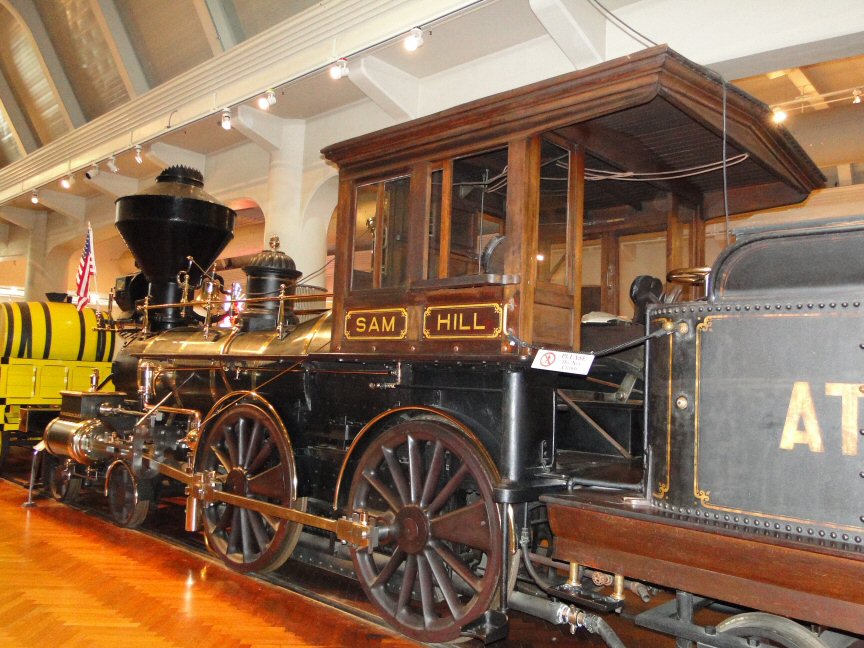
Of course, the area with the trains is truly spectacular, too:
The Dewitt Clinton from 1831


The Sam Hill from 1858

and the gigantic Allegheny from 1941


The variety of items in this museum continually astound me.For instance, they can actually say "George Washington slept here" - well, not in the museum itself, but they do have his camping bed and other supplies from 1770 belonging to our soon to be 1st President!


.

And then there's a wonderful piece of mid-20th century that one rarely sees any more - Lamy's Diner from the 1940's

Please see the description of this wonderfully
interesting cupboard below the picture.
(The following information came from The Henry Ford site. I found it fascinating in that it brought this beautiful piece of furniture to life):
We believe that Hannah Barnard was born in the late 17th century, probably in Hadley, Massachusetts. She was 31 (a "spinster") when she married John Marsh in 1715 and died shortly thereafter giving birth to her daughter, Abigail. We believe that this was Hannah's "marriage" or "dower" chest--a fairly expensive piece of furniture she received or had made specifically to be brought into her new household. Her press cupboard stored precious household linens which were time-consuming to make, and may have held silver or ceramics in the upper portions.
The colorful hearts, petal flowers, vines, and half-circles are characteristic of a number of "Hadley-chests" made around Hadley, Massachusetts nearly three centuries ago. Six of them include women's names painted on the front, such as this. It is unusual for a piece of furniture to be decorated with anyone's name, much less a woman's. Why was her name put on the front?
We're not sure. Perhaps, after thirty years as a Barnard, did Hannah not want to forget her family name as she entered into marriage with Mr. Marsh? Or did it mark the fact that Hannah was well aware that while women could not inherit property, they could inherit moveable furniture? Did she ask that her name be painted there? Or was she surprised and embarrassed when she received it from her family or her betrothed?
We can only speculate. What we do know is that it is one of the few pieces of furniture that we can say was made for, and used by a woman.
The Hannah Barnard press cupboard is currently on display in the Fully Furnished exhibit in Henry Ford Museum.

As I said, I never cease to be amazed at the amount of American history found here inside this awesome museum - and to think that Greenfield Village is right next door!!
I will do future postings on other wonderful historical objects that are displayed inside this world of Americana.


Saturday, February 16, 2008

The History Channel


Can someone please tell me the difference between The History Channel and the Discovery Channel? You can't, can you? Thought so. Why do we have a channel dedicated solely to history but there is very little actual history to be found on it? Look at the shows they have scheduled: Ice Truckers, The Universe, Shockwave, UFO Hunters, Monsterquest, Gangland, Human Weapon, and on and on...
The only show that remains of the Civil War era is Civil War Journal. Do you know when that is on? 7:00 a.m. on Tuesday mornings! How about a Revolutionary War Journal? A War of 1812 Journal? A French and Indian War Journal?
How about a show on America's museums? Greenfield Village, Colonial Williamsburg, Connor Prairie, Plimouth Plantation, Old Sturbridge Village, just to name a very few. In fact, upon a Google search, I found each state in our union has wonderful museums - outdoor and indoor - that are deserving of national recognition. Why can't The History Channel have a series on something like this?
How about everyday life as lived by the average person from the 19th, 18th, 17th, or before centuries? From their occupations and tools to clothing to personal hygiene to etiquette to mourning practices - the subject matter is endless.
How about a series on restoration that would be broadcast in the evening?
How about anything before World War 2, and especially before the 20th century???
It does not take a highly paid program director to come up with such ideas. And, please don't tell me that no one would watch. That line is a load of crap.
Am I alone on my opinions of The History Channel?

Thursday, November 15, 2007

Greenfield Village


I took the above five pictures at Greenfield Village. (from the top): (1) Christmas at the Daggett Farmhouse (2) inside the general store (3) The Ford Farm (4) Dinner at the Eagle Tavern (5) A Colonial Scene - all homes in this shot were built prior to the 19th century.

As mentioned in other blogs I have written, I love visiting Greenfield Village in Dearborn, Michigan. The collection of old homes and structures is second to none: where else, in one area, can you visit the original homes of the Wright Brothers, Henry Ford, Daniel Webster, Harvey Firestone, and Stephen Foster? There are other historical structures placed there as well: the building where Abraham Lincoln practiced law, the shop where the Wright Brothers built their first-to-fly airplane, and Thomas Edison’s Menlo Park complex (can you say electric light, phonograph, and “hello”?). Then there are the odds and ends buildings, showing great examples of life as lived in past centuries: Sarah Jordan Boarding House, which was the first home lit by electricity, Daggett, Plympton, and Giddings houses – all from the colonial period; Adams, Chapman, and the Ann Arbor houses – great examples of Victoriana; two 19th century schoolhouses, Smith’s Creek train depot, a general store, a carriage stop, and even a stone cottage from 17th century England. And so much more.

It’s a history lover’s dream!

I do, however, have a number of complaints of late:

First off, I am not fond of the streets, curbs, and sidewalks that were installed a few years ago. The modern concrete really took away the step-into-the-past ambience that the Village once had. I was told it was for those in wheelchairs, but the previous set up worked for over 70 years.

Second, the Disney feel that was given to the place (Model T rides galore and the entrance ticket booth) does not help with the stepping-into-the-past experience either.

Third, they’ve taken away public candle dipping (we always made our own candles every summer and used them during Christmas), the steamboat ride – always a favorite -, and the Colonial Days festival, which was a yearly highlight for me and my family.

Now for the good stuff about Greenfield Village:

1) They still have Civil War reenactments every Memorial Day weekend (although the constant running of the Model T’s takes away from the historical accuracy).

2) Their Christmas celebrations are the BEST anywhere (it used to be called “12 Nights of Christmas,” and is now called the more politically correct “Holiday Nights”- as if any from the Jewish or muslim faith would ever come to this event knowing what it actually is).

3) Hallowe’en in the Village.

4) The fact that they pride themselves (rightfully so) on historic accuracy in their presentations (except for said Model T rides during the Civil War weekend).

Now, what would Ken change if he were suddenly put in charge? Well, first thing, correct the wrongs that I listed above. Then I would open each house – get rid of the dog-gone plexi-glass in many of the buildings – and have 1st person presenters ala Colonial Williamsburg. At least on the weekends.

I would also get an original layout of the Village from an old guide book and re-arrange the buildings back to what Henry Ford originally planned. I’d also bring back the cobbler shop, the cooper shop, the Plymouth House, get a working smithy to show the craft of a blacksmith, and truly keep the Village where Mr. Ford intended – pre-20th century.

Because I am a perfectionist and an amateur social historian, my complaints seem to be making Greenfield Village out to be much worse than it actually is. But, it’s because I still have such a love for the Village (there’s that Passion for History again!), and these so-called changes and “improvements” (when they really aren’t improvements at all) are very hard to take. If it ain’t broke, as the saying goes, don’t fix it.

It's still a great place to go for American history - you would do yourselves a favor to visit Greenfield Village and the Henry Ford Museum (I’ll write about the museum another time).

In a future blog, I’ll write about some of the neat GFV items I have collected.

Wednesday, November 7, 2007

Amazon .com Reviews

I love to write, as stated in my previous blog. And, if you would like (and if you enjoy my style of writing), here is the link to my Amazon.com reviews. As of this writing, I have 150 written, but I add at least one a month - at times more.
If you have the same interests as me, you might like to see what I have to say about some of the product available to enhance your historical (and some non-historical) passions.
http://www.amazon.com/gp/pdp/profile/A3P98J5DZ00A75/002-4049274-7729626
(I hope it works)

Monday, November 5, 2007

History, Genes, Reenacting, and Time Travel

Why is it that the past enthralls me so much? I have asked myself that question many times but I have no absolute answers. I don't believe in reincarnation, but I do believe in the passing of genes. Of course, we know that genes are passed on from parent to child. What I mean is, (correct me if I'm wrong) it's genes that make us act like, look, even sound the way we do, right? "You have your great grandfather's talent for carpentry," "you sing just like grandma," or "I can't believe how close you resemble your grandfather when he was your age." We've all heard something similar, right? Then why can't genes be passed on that enable us to have the same feeling as our ancestors? I mean, if my great great grandfather truly embraced life and his era, then can that passion be so strong that it can be passed down? Can memories (or snippets of memories) be passed down as well? Or am I nuts?
I belong to a Civil War reenacting unit where I portray a civilian postmaster. I wear not only accurate clothing of the era, but I also study the speech and etiquette as well, as does my wife. And we both find ourselves enjoying stepping into the lives of our ancestors very much, and do it as often as possible. We found that the more research we do for our 19th century persona, the more we find that we identify with that era in so many ways. It's almost scary. It's very much a kind of time travel, at least in the way we make the attempt. When in our period clothing, we try to fully immerse ourselves in our portrayal. And every so often, you get that certain magical split second where you really are "there...
This subject will be continued...