Thursday, August 17, 2023

Colonial Kensington 2023: Back at The Kensington Metropark Farm Center

What a weekend this was!
Colonial Kensington always seems to rank at or near the top of the full-fledged bonafide reenacting events I participate in,  whether Rev War or Civil War.   For years it was held at an area known as Martindale Beach,  and even back when it was near said beach area,  it was pretty darn amazing.  Then  through a series of circumstances,  the event was moved to another location,  and that was...well...not my favorite location,  mainly because it was in a remote area and couldn't be found by the visiting public.  The event itself,  however,  wasn't bad,  as you can see by clicking the link.
For the past two years it has been held in a third location,  of which is my favorite:  The Kensington Metropark Farm Center.
"Meet farm animals and get a glimpse of rural life at the Kensington Metropark Farm Center.  Take in the sights,  smells,  and sounds of life on the farm and see live farm animals like chickens,  goats,  sheep,  cattle,  and draft horses.  Visit a 150-year old restored barn  (winner of the Michigan Barn Preservation Network  (MBPN)  2012 Barn of the Year Award),  the poultry house,  or the barn exhibit room and kids’  area.  Take a short walk to the riverside,  where you’ll find a one-of-a-kind  “green”  building  (made exclusively of natural materials),  a stone labyrinth,  a grass maze,  and an early skills area – including a blacksmith shop and brick oven.  An herb garden,  field crops,  and old-fashioned farm equipment are also on display.  Special programs on the animals,  historic techniques and other farm-related topics are held throughout the year."
And then,  one weekend a year,  there's us!

....~~~~~~....~~~~~....~~~~...


So here we are again.  This event just puts me on a sort of high,  for the realism is seen plainly;  modernisms are kept pretty much out of sight except at the far ends of the area.  This 2nd year at the farm location proved to be just as good and grand as last year,  telling me the new location is no fluke.  
Let's go on a picture tour - most photos herein are mine,  through there are plenty from others' cameras,  of whom photographer names are listed at the bottom of this post.
I am blending the two days together,  so it may seem like one lo-o-ng day!
Walking along a dirt road,  which turns to the left and into the world of  the past
where America's Revolutionary War opens up to all treading the same path.

From the military tents you can see the Living History Village sign overhead.

Charlotte & I - 
We spent most of our time in this area known as Living History Village.
This little makeshift village,  actually called Living History Village,  was opened here in 2014.  It was built by the Chief Pontiac Programs members,  a group of volunteers who operate a hiking trail and other programs with outdoor experiences for all age groups.  They also offer classes,  presentations,  and have informative conversations for guests.  As they state on their web page:  Learn the skills that all settlers on a farm needed to know to be self sufficient.  A farmer in an early settlement needed to be able to make or repair almost anything themselves.
On top of all that,  the Chief Pontiac Programs group has life skills experiences,  including hands-on blacksmithing,  woodworking,  fire starting by flint and steel,  rope making & splicing,  bead work,   weaving and spinning and other fiber arts,  and outdoor cooking classes.
I also know they do maple sugaring in the early spring.  I hope to attend that myself.
Holy crap---!!  What an amazing group,  eh?
And what wonderful opportunities for modern folk,  especially kids.
Where was this sort of thing when I was a kid???
I love their name and the fact that they pay homage to Chief Pontiac in that manner.  And,  yes,  before anyone gets their hackles up,  they have Native American personnel that support the activities at the Kensington Living History Village throughout the summer programs.  Support is also present during the Kensington Maple Sugaring programs at the Kensington Farm Center.
Well,  then,  let's begin here - - - at Lorna's Kitchen:
What a great set up for cooking demonstrations!

I think this building is a brilliant idea for teaching the public.
Sometimes they offer hands-on classes!

Lorna from  "Lorna's Kitchen"  -  this is where visitors can see food
as how it would have been cooked on the hearth... in a cabin or an 18th century home, 
using the same type of cooking irons and pots & pans.
...and she also shows cooking techniques over a bonfire.

Also in this living history area there is a blacksmith shop.
I did not take full exterior photos of the buildings this year - for shame! - but here is one I took last year,  and it shows the blacksmith shop as well as the woodworking shop on the far right.

And the blacksmith worked his craft for visitors.

While just outside the blacksmith shop,  under a tent,  we have the reenacting world's renown  'smithy,'  Richard Heinecke,  who was working on projects of his own.  Yes,  Richard is a blacksmith and makes everything he sells;  I have purchased so many items from this man!  Top Notch all the way!

Here are a few of Richard's wares - just a few...a quick glance!  Period items for camp
and for home!  Not in our sight are candle holders and kitchen utensils.

There was no one in the woodworking building,  and since I remembered from last year that they had the tools I needed for processing flax - the break,  scutching board,  and hackle - I offered to present,  and they accepted.
It was kind of nice that I didn't have to bring my own items!
I very much enjoy speaking about flax and of its importance in not only American history,  but in world history.
We had pretty decent crowds come through,  especially on  "no rain Sunday."
As I am constantly in a state of research,  I also added something I learned earlier this year,  which was that the Sumerians also used flax to make fabric,   Sumer being considered the earliest known civilization,  and it is said this process dates back at least to the 7th millennium BC.
On Sunday Jackie and I sometimes split the shared information,  and she spoke to the public about the leftover flax,  called tow,  and what it was used for.
I do very much enjoy having visitors experience these old crafts by allowing them to go through the process with me.
This young lady had a genuine interest in the process and wanted to help.
She worked the flax break,  the scutching board,  and even the hackle!
See the video below:

Video taken by Ian Kushnir
Get them interested in history while they're young!

On Saturday,  when I was off visiting and snapping  "quick sketches,"  Charlotte would take over in showing how flax was processed.  I very much appreciated that!

And,  throughout the weekend...
Amy weaved for the public.
Perhaps next year,  if I do flax again,  she can set up near me and we can work
together,  for once the flax was processed and spun on a spinning wheel it would
then oftentimes get sent to the weaver so he or she could weave it into fabric.

Sunday brought sunny skies and Norman,  Pam  (and Jackie,  too) - - - 
Charlotte could not make it on Sunday,  but I had a few other visitors join me.

The visitors received more than a battle reenactment,  as you can see:
Dr.  Bloodsworth explains to his audience the benefits of 18th century  "modern"  medicine.

But he was not the only doctor in the camps:
Dr.  Henry Trippe
He,  too,  was often crowded with interested on-lookers. 
I happen to catch him during a slow moment.

My son,  Robbie,  was at Colonial Kensington this year.  He was there with his military unit,  the 1st Pennsylvania.  Of course,  father & son had to get our picture taken together...but not in the way most  "normal"  human beings do:
My son,  Robbie,  and I.
We're goofs - here we are being Italian and talking with our hands.  Since my father was Italian,  I suppose we're allowed,  right?  And at any given time we'll quote lines from the Beatles' film  "A Hard Days Night"  or  "Help!"  Most people have no idea what the heck we're talking about in our pseudo-Liverpudlian accents,  but we do,  and we'll be laughing at each other while everyone else will look at us all dazed and confused.
English blood runs through our veins as well - don't want anyone to think
we are appropriating anyone else's culture  (lolol)~
We're just sorta off the wall - - - !

But Robbie,  like his old man,  takes history and reenacting seriously,  and will do his best to keep the past alive in a most accurate way.  And he is always ready and willing to learn:
Robbie got the cooking fire going in the 1st Pennsylvania
camp - with flint & steel.

Robbie also spent time writing letters.

Me & Robbie - I like this shot!

And we had a few friends come along to visit - who I have not seen in years!
To my surprise,  my friend Rae and her husband Josh showed up - -
and did they make a splash!
Both are long-time Civil War reenactors - and so are Josh's parents.  Rae has come out numerous times with us in 18th century clothing,  but it's been since before covid that we've seen them.  Josh mentioned how much he really liked this period and plans to come out more often,  which I think is pretty awesome!

Rae and Josh were both wearing what I consider to be high-class French fashions.
Thank you both for the poses.

Next up we have some good friends  (and almost relatives)  Sue and Dave.
This loving couple got married only a short time ago - 
My son Robbie married Sue's 1st cousin,  which is why I noted that we were  "almost relatives."

Saturday afternoon we had the threat of rain ~ ~ ~ ~ ~ ~ ~
It wasn't supposed to rain.  In fact,  the darkest clouds moved past.
It was the lighter clouds that brought - - - 
...what's this?
Rain!
Actually,  a down pour!!
It rained Friday night,  with a tornado touching down a ways away,  but the same storm went in the Kensington direction.  Luckily,  nothing but a bit of rain occurred.  It did muddy up the road quite a bit. 

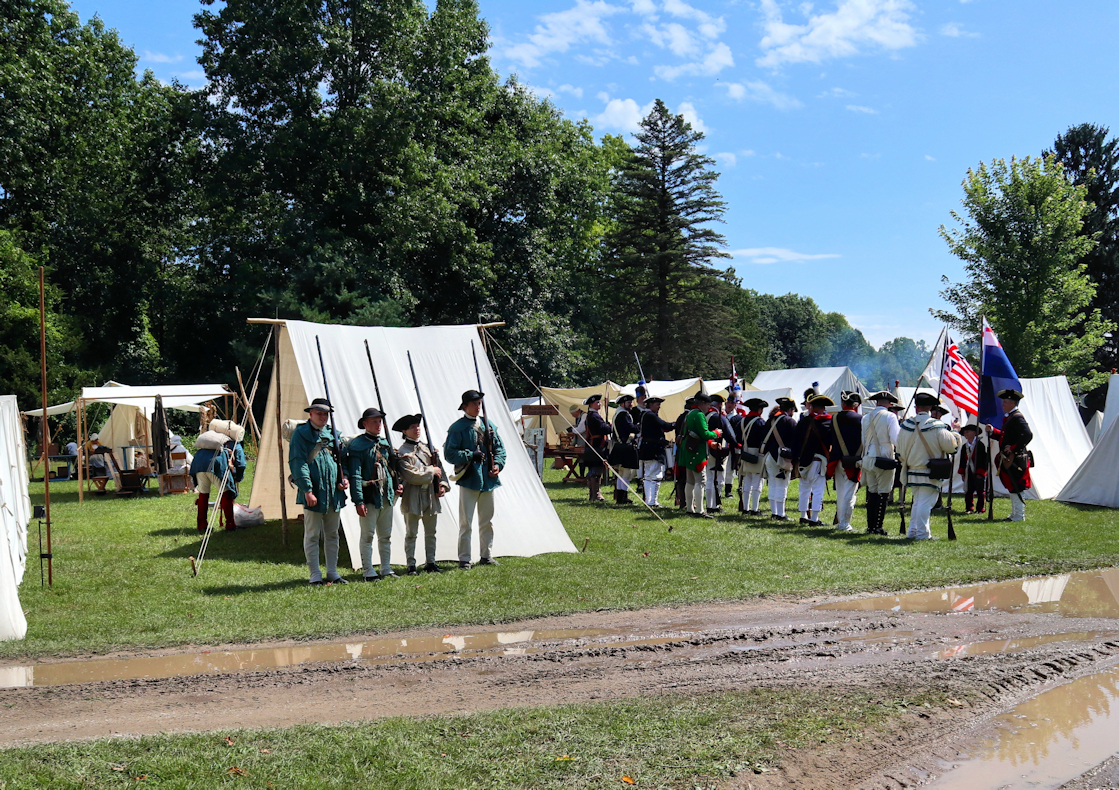
Let's visit the military camps for a bit:
The front portion of the military camps.

The 1st and the 13th Pennsylvania row of tents.
Americans!

Coming through the raindrops - - - 

The 1st Pennsylvania on Saturday.

...and on Sunday.

1st Pennsylvania preparing for battle~

The Massachusetts Provincial Battalion prepares for battle.

There was a good rain that fell over night Friday,  and then again
early on Saturday afternoon.
You know,  it rained in the 1700s as well.  As Pastor Gerring said, 
"This is authentic 18th century rain!"
Indeed.

'Twas a good battle,  including cannon and musketry.

Certainly we do not have as many people on the field as would have been seen 250 years ago,  but it does give the visitors a good idea of the battles and tactics of
long,  long ago.

The fight for Independence was,  to me,  a cause worth fighting for.

To be fair for the reenactment,  on Saturday the British won,  and on Sunday
it was the American's turn to take the field.

Nicholas Gerring replicates  (sniper)  Timothy Murphy,  who was told:  
"That gallant officer is General Fraser.  I admire him,  but it is necessary that he should die,  do your duty."  Murphy scaled a nearby tree,  took careful aim at the extreme distance of 300 yards,  and fired three times.  The first shot was a close miss,  the second grazed the general's horse,  and with the third,  Fraser tumbled from his horse,  shot through the stomach.  General Fraser died that night.  British senior officer,  Sir Francis Clerke,  General Burgoyne's chief aide-de-camp,  galloped onto the field with a message.  Murphy's third shot killed him instantly. 

I always enjoy hearing the period music,  especially when you have the fife & drum & pipes.

Oh!  The people you meet walking down a reenacting street!
Here are a few folks that were here,  there,  and everywhere throughout this little Revolutionary War town:
Tony and Richard

Scott and CarolAnne

Jim & Sarah

Tony & Chris

Jackie & Pam

Does anybody know this Revolutionary War hero?
Why,  it's Ken Roberts!

Brent

Paula & Family

What a super time Colonial Kensington was!  And we got word to be ready,  for it will return next year - and so will I!!
It seems like actual bona-fide military reenactments are becoming less and less.  It used to be that there were several each month through spring,  summer,  and fall.  Now we're lucky if we can eek out a half dozen for the entire season.  This year alone there are only five Revolutionary War events listed within a two hour drive from metro-Detroit:  Patriots Day,  Frankenmuth,  Colonial Kensington,  Vermillion Creek,  and Fort Meigs  (in Ohio - which is the same weekend as Kensington...go figure).
In Civil War there are even less:  Hastings/Charlton Park and Jackson.  If you want to drive a bit there is the Van Raalte muster and maybe one or two more.
So we need to do our best to keep what we have.
Please---if you are a participant,  make sure you attend.
If you are not a reenactor but enjoy going to them,  please continue to do so---and bring family & friends along.  If we all work together,  we can save what we have,  and,  perhaps,  even add a few more to the roster.
Oh,  and getting the young people to join up is important as well.  We don't want the hobby to die off with us older folks.

~~~Note added in 2026~~~
Sadly,  for varying reasons,  this was the last of the Colonial Kensington reenactments.

Until next time,  see you in time.


Besides my own pictures,  I would also like to thank a few for the use of some wonderful photos:
Barb Baldinger
Charlotte Bauer
Carol McMann
Ian Kushner
Norman Gerring
Karen Kemmer
Richard Reaume


To read more about flax,  please click HERE

And here are links to all of the Colonial Kensingtons that I have participated in,  each loaded with photos:
Our first time out as Colonials to Kensington
Benjamin Franklin,  Paul Revere,  and a great battle.
Paul Revere and lots of military photos
Traditions plus lots of quotes from those who actually lived it
I brought my tent here for the first time and had quite a few visitors.
I brought a few historic flags along for presentation purposes

2020 - The wonderful world of covid...no event.

A new location!  A great event but too out of the way for spectators, sadly
Another new location - - 1st time at the farm!


~~     ~~     ~~


Wednesday, August 9, 2023

From June 2023 - Blacksmith, Soldiers, & Log Cabin Weekend at Waterloo Farm

I don't always wear colonial clothing at Waterloo - just mostly.
In fact,  here I am in 1860s clothing.
Back to the 1700s soon!

~~     ~~     ~~


"Just pretending"...yeah,  right.
That's a real flame shooting
out of that cannon!
A little late but,  quite frankly,  I just somehow forgot about this event and meant to write a posting about it a few weeks back,  for this event took place in mid-June.  I suppose now's as good a time as ever,  right?  I mean,  out there it's still summertime...
This event celebrates Michigan's log cabins,  the soldiers that fought in the American Civil War,  as well as the blacksmiths that were so prominent around here in the 19th century.  In fact,  celebrating our log cabin heritage is nearly a holiday here in our mitten state,  and throughout the lower and upper peninsulas,  wherever there are historic log cabins,  there are celebrations of those wonderful pioneer structures that helped to build not only our state but our country,  all on the third weekend every June.
Charlotte and I took part in Waterloo's celebration,  though we were dressed in our 1860s clothing rather than 1770s as you normally see us,  for we are representing log cabin pioneers of the mid-19th century.
I think it's great that Waterloo goes beyond only speaking on the log cabin and allowing the occupation of blacksmithing into the picture,  along with the soldiers from Michigan as well,  both demonstrating their skills and equipment.  The interest in history needs to grow,  and be on a positive note rather than the prominent negative so invasive today,  so including life during the times of these cabins are an important addition.
Inside the cabin,  we were also inclusive to our touring groups;  when we saw kids,  we let them know what their lives would have been like,  for example.  The same with adults,  both male and female.
Also,  Charlotte found time early on to weed in the garden.  It's unfortunate that we live so far away and cannot make it out more often,  but we do our best to do what we can.
From a distance...

As Charlotte herself commented:  "Just me livin'  the Victorian reenactor dream!  Weeding the garden at the cabin but it’s mostly grown over.  Turnips are doing great!"
We did not have much rain in the spring,  but by June we had quite a bit so
the weeds really took off.
We will work on ideas for next year's garden - it's all a learning experience.

Mark and Dan were there.
But just who exactly are these two?
These two also play an important part in our
  Charlton Park living history event

The Cary family.

Jim represented General Custer.

Of course he spoke on what happened at Little Big Horn.  But Custer was much more than that,  and he gave a good lesson that goes beyond the Facebook University School of Little Knowledge  that too many people tend to get their historical information from.

Visitors were able to see,  up close and personal,  cannon demonstrations.

I always enjoy hearing  (and feeling)  the boom of the cannon!
As Tom Bertrand wrote:  "It was loud and blew lots of leaves off the poor tree."

Allison and her husband along with their carpenter friend.

He brings along all of his own period tools to work with and demonstrate.

There were also numerous blacksmiths demonstrating as well.

Why...look---toymakers!

Quilting and chair caning was also demonstrated.

And music...sweet music...there was music everywhere...
But not Modern contemporary music or anything like that.  Rather,  it was period
music from the 19th and early 20th century.  All played in a traditional manner.

And then there was this musician who I met:  Eddie Josephs,  and he brought a variety of country instruments...some electrified.
Eddie performs with the Tin Penny Band,  and their
musical genres include bluegrass,  Irish, 
and jugband music.
But this day he was a soloist - - - 
...until I came along and asked if I could try his red,  white,  and blue guitar.  He proceeded to tell me it is a replication of the guitar that country music legend Buck Owens  ("Act Naturally")  used to play.  I vaguely remembered that - -  but,  yes,  he allowed me to play it.  And then he asked me to play a song,  so I chose one of my old-timey favorites  (with only three chords)  "Hello Stranger...",  originally done by The Carter Family back in the late 1920s or early 1930s.  Emmylou Harris also recorded it in the 1970s.  Anyhow,  I played it,  he played along,  and I actually sang!  Now,  I have no singing voice,  but Eddie didn't seem to mind and we just went right through that old tune.  It's been a long time since I played guitar - I'm very rusty,  but I sure did enjoy myself and thanked him profusely!

Though I am more comfortable - more me - in 18th century
clothing,  I very much enjoyed taking part in this 1860s day.
Hey---any day in the past is great for me!
I had so much fun that day at Waterloo Farm for their Blacksmith,  Soldiers,  & Log Cabin weekend!  I saw so many friends,  new & old,  and spoke to so many visitors - it's not often I wear my 1860s clothing anymore - - !
Thank you Waterloo!

Here is a video to watch and give you an idea of this wonderful museum:

Until next time,  see you in time.


To read more on Michigan's celebration of Log Cabins,  please click HERE
Here are the links to all of our cabin day experiences  (so far):

If you are interested in our other cabin excursions,  please click the links below:
To read about our 2020 autumn excursion at the cabin,  click HERE
To read about our 2021 wintertime excursion at the cabin,  click HERE
To read about our 2021 springtime excursion at the cabin,  click HERE
To read about our 2021 summertime excursion at the cabin,  click HERE
To read about our 2021 summer harvesting of the flax at the cabin,  click HERE
To read about our 2021 autumn excursion making candles at the cabin,  click HERE
To read about our 2022 winter excursion at the cabin,  please click HERE
To read about our 2022 spring excursion at the cabin,  please click HERE
To read about our 2022 summer excursion at the cabin,  please click HERE
To read about our 2022 autumn excursion at the cabin  (Pioneer Day),  please click HERE
To read about our 2023 winter excursion at the cabin - Candlemas,  please click HERE
To read about our 2023 spring excursion at the cabin - Rogation Sunday,  please click HERE
To read about our 2023 late spring - more planting at the cabin  (& early farming history),  click HERE
To read about the 2023 early summer weeding at the cabin  (and a timeline event),  please click HERE
To read about our 2023 summer excursion at the cabin  (Lammas Day),  please click HERE


~     ~     ~

Wednesday, August 2, 2023

Experiencing Our Research - Summer Cabin 1773: We Celebrated Lammas Day

"History as it is taught in the schools deals largely with...wars,  major political controversies,  territorial extensions and the like.  When I went to our American history books to learn how our forefathers harrowed the land,  I discovered that the historians knew nothing about harrows.  Yet our country depended more on harrows than on guns or great speeches.  I thought a history which excluded harrows and all the rest of daily life is bunk and I think so yet."
Henry Ford - explaining why he said  "History is more or less bunk!"  (1916)
.

If you haven't noticed,  a good many of my postings here on Passion for the Past tend to center around rural farm life & country living of  times gone by.  Like Henry Ford,  it seems most of what I read about the 18th century in history books tend to focus on the wars and of politics,  all of which are important.  But we tend to forget that the greater majority of the 18th century population were farmers and country folk.  So I suppose I'm with the majority here.
I hope you enjoy reading about our summertime Lammas Day excursion,  which centers on farm life during the times of this country's founders~

................................................


Our 18th century home.
It was supposed to be a very hot and muggy day on July 28,  the day we ventured to the Colonial Cabin at Waterloo Farm.  But,  though it was hot and muggy in the metro-Detroit area,  it wasn't too bad out in Grass Lake at Waterloo Cabin,  about an hour to the west.  The weather prediction actually caused a discussion beforehand on whether or not we should even do it,  for thunderstorms were included as part of the weather pattern as well.  But one comment from a Citizens of the American Colonies member - "we haven’t weathered thru a storm yet at the cabin" - convinced some of us to move ahead,  which we did,  and I am glad we did,  for each time we are there,  no matter the weather,  helps us to understand the past and our ancestors even more.  Each and every time is a learning experience,  like the times when we venture to the cabin in the dead of winter in bitter cold temperatures.  
Yes,  we enjoy that,  too!  
And I am proud of what we accomplish there. 
Out there it's summertime - milk & honey day...
(a computer painting)
However,  the weather was not nearly as bad as predicted for us on this day:  yes,  it was hot  (as you'll see by the pictures),  but only in the low 80s,  nothing like they said it would be for us,   and though it was muggy,  the heavy humidity didn't really kick in until after two o'clock.  There was a slight  "summer breeze" a-blowing as well,  which made us feel fine.  You see,  there are moments of life when everything looks in the right place.  And our duty is to notice it,  appreciate it,  let it penetrate our mood.  It reminds me of the  (decidedly non-colonial)  song  "Summer Breeze"  by Seals & Crofts,  which is about the joy of life.  The song describes the pleasant sensation of summer,  when the fresh breeze blows on your face,  people are happy,  and life seems perfect in all aspects.  The chorus is a romantic description of those moments of happiness and wellness:
Summer breeze makes me feel fine
Blowin’  through the jasmine in my mind  
(jasmine being a plant which produces fragrant white flowers).
That's how we felt that day,  celebrating the beginning of harvest while still in the midst of summer. 
And,  by the way,  it did not rain as predicted.
But,  it's summertime and it's supposed to be hot and muggy and breezy and,  yes,  rainy...to be perfectly honest,  it would not bother me if it rained the entire day for one of our visits  (though I prefer it not to),  and I would still go just to understand and experience those regards as well.  Okay...maybe for part of the day... That's the way I generally try to look at things,  whether I'm in the now or in the past.
Yes,  it would be different than being at my 21st century home where I could watch a movie or play on my computer or even go shopping to kill time.
So being where we were and the time of year,  yes,  we really did have a great time!  And we got to celebrate another holiday/holyday of times past as well - Lammas Day!
Summer of days gone by...
As living historians & historic reenactors,  we are sometimes asked why we,  as grown adults,  will dress up and pretend that we are living in the past.  My first response is,  "Who's pretending?"
Seriously - - who is pretending here?
We are  living in the past during these excursions.
~Mind!  I said  "during these excursions"~
So far at our colonial cabin experiences this year we've celebrated Candlemas  (HERE),  we celebrated Rogation Sunday  (HERE),  and now we are celebrating Lammas Day  (click HERE for a history lesson on that special colonial-period celebration).
Our loaves of bread ready to be blessed.
August begins with Lammas Day  (or Loaf Mass Day),  the day when a bread loaf baked with flour from July-harvested wheat or corn would be brought into church and blessed.  It's one of the oldest points of contact between the agricultural world and the Church.
Many colonial farmers celebrated the holiday  (or holyday,  as these special days of celebration or worshiping were called)  on August 1st,  which marked the first major harvest of the beginning fall season.  In fact,  oftentimes the words  "fall"  and  "autumn"  could be replaced with  "harvest."
Yes,  even though it is still technically summer,  August was once considered one of the months of harvest time.  As such,  Lammas Day was a sort of  Thanksgiving,  and so it remained for many colonial families not only here in America,  but in many parts of the world,  especially the British Isles.  
On a colonial-era Lammas Day,  it was customary for the head of the household to bring to church,  for a blessing,  the first loaf of bread made from the new crop,  which began to be harvested at Lammastide,  falling at the halfway point between the summer solstice and the autumn September equinox.  That loaf was then used as the center of the family’s Lammas Thanksgiving feast.  
We did our best to replicate this tradition,  though  'twas not actually on Lammas Day - - our celebration was held on Friday July 28 - four days before.
Close enough,  I would say.
So for the first part of the day - the coolest part - we spent time weeding the large garden.
Yes,  the weeds had taken over!
Our day began with Charlotte and my wife,  Patty,  out in our garden.
It was desperately in need of weeding.  Patty and I had great plans to come out to
weed and care for it a few times each month,  but,  unfortunately,  due to so
many things coming up in our modern lives,  it wasn't to be.

Out of everything we planted last May, 
the turnips are doing the best.
The traditional illumination for autumn/Hallowe'en pranksters out in the night was provided by turnips or mangel wurzels,  hollowed out to act as lanterns,  lit with coal or a candle,  and often carved with grotesque faces.  Turnip lanterns usually represented supernatural beings and were used to chase evil spirits or to scare people,  while in some cases they were set on windowsills to guard homes against evil.
Irish immigrants brought the jack-o’-lantern custom to North America.  Here,  turnips were slowly replaced by pumpkins to make the iconic Halloween decorations,  and eventually became the plant of choice.
Our turnips still have a way to go...
Perhaps we'll carve a face into the turnip for October's Pioneer Day
held the 2nd Sunday in October at Waterloo.

Our beans are doing well also.

This is not pretending~
Like a true frontier woman,  my wife removed her wet,  muddy
shoes and decided to just go barefoot for a time.  You can see the
bottom of her apron is wet - as was the bottom of her blue skirt -
we had plenty of recent rainfall.

Charlotte and I weeded around the pokeweed plant.  Pokeweed is poisonous but its berries can - and will,  in our case - be used for dyeing wool.
We all had our time outdoors - not pretending and not posing - 
doing the garden,  digging the weeds.
Who could ask for more?

I enjoyed having Norman come out to visit and take part with us.
He is a long-time reenactor,  going back to the 1970s!

He is now a member of Citizens of the American Colonies.


Patty also spent time knitting and visiting with Charlotte...

...in fact,  the four of us had quite a few different conversations.
It wasn't a large group,  but summertime is usually smaller.

Since there was no church nearby,  we had the Lammas Day blessing done inside  "our home."  Our minister,  Norman Gerring,  gave a wonderful blessing to help us celebrate
this holy day.
Norman,  though not an actual minister in real life,  might as well be,  for he is as strong a Christian as any minister I've evet met;  he researches the prayers of the period,  and researched the clothing he would wear as a man-of-the-18th century-cloth.  Yes,  he takes in stride the silly  "Quaker Oats"  comments.  We who do living history appreciate all he puts into this hobby.

My wife cuts the bless'd bread.

Charlotte & Patty both prepared our summer Harvest meal

Our summertime Lammas Day Feast included cucumbers,  beans,  and tomatoes  (grown in my wife's garden at our home),  melon,  cherries,  peaches,  pickles,  various cheeses,  beets,  and fresh-baked bread with butter.  Not all was made and baked here at the cabin;  most of the preparation was done beforehand.  Perhaps if we had actually spent the entire weekend here it could have been done,  most likely in the firepit outside the cabin rather than the hearth to keep the cabin cooler,  but we usually spend only a day there at a time.
Of course,  we more than likely would not have had all the variety of fruits,  being that we were in a frontier cabin,  but we also wanted to enjoy a few extra items that were available during the 18th century.
  

We certainly enjoyed our meal and the camaraderie between us.
My wife told me it was one of the most relaxed and enjoyable days she's had in a while.
And that's what it's all about - - -  

Ladder back chair
I very much enjoy that we are not just going to the cabin and going through the motions.  We are actually celebrating colonial life in the way I've not seen done elsewhere,  and that makes me proud.
We also attempt to up our game in sometimes smaller,  more subtle ways.
Can you see what we did this time?
Think:  chairs.
"Upping your game"  doesn't always have to mean something major or in your face;  Charlotte noted a while back that our chairs - wooden folding chairs - are incorrect,  that perhaps something like a ladderback chair might give it another touch of realism,  especially being in a period structure.
Well,  she is right - can't argue about that.
Now,  I already have numerous ladderback chairs in my collection so I brought a few along.  We already had a bench there so we were good with that.  But,  as stated,  sometimes it's the little things that can make a difference without realizing it.
Does this mean I'll never use a wood folding chair ever again?
Nope----it only means for certain events,  such as when we're at our colonial cabin surrounded by four walls of authenticity,  I/we will try to  "up our game."
Yes,  sometimes it really can be the little things that can make a difference to the discerning eye.

<0>

Whether one is doing it for the public or for personal reasons,  it can be challenging to see if we can be good enough in our researched historical knowledge to  "be there,"  if you catch my drift.
Experiencing our research.
No Hollywood history.
Larissa  was not here this time,  and she
always takes a selfie with all of us.
So I took one on her behalf.
Our greatest challenge this time is that our garden isn't what we hoped it would be.  Patty & I had all intentions on making it out to weed three to four times a month - perhaps once a week - but our modern life kept on getting in the way.  Of course,  living the distance from the farm that we do,  and gas prices being what they are,  added to our unavailability.  If we could've made it out as we had hoped - more than the two times we did - I'm sure our yield would have been much more promising.  My wife knows how to garden well - our home garden is coming along wonderfully.  
So,  it can be a challenge for some but,  in most cases,  it can be quite satisfyingly successful,  even if things don't always go as planned..
As for the wearing of period clothing at a private event - strictly for ourselves - it's a way for us to become a part of the past...a sort of a spirit within the walls of an ancient structure.  I suppose unless you are into living history,  it can be difficult to explain.  Maybe this is what Robert Plant meant when he wrote:
"There's a feeling I get when I look to the west
And my spirit is crying for leaving.
In my thoughts I have seen rings of smoke through the trees
And the voices of those who stand looking."
Yep---those lines make more sense to me now.
But there's something more...
Aren't we,  in a way,  emulating our own ancestors to some extent?
Keeping their spirit alive?
I mean,  this was the time of my 5th and 6th great grandparents,  and my maternal side have been in this country as Quaker farmers since 1710,  so the sort of life we are showing here would be quite familiar to them.
Only we're not Quakers.
So when someone asks me why I do this hobby,  I can honestly say I enjoy taking a trip and experiencing - not just visiting or pretending - the past.

Until next time,  see you in time.


To read what life was like in an 18th century autumn,  please click HERE
To read what life was like in an 18th century winter,  please click HERE
To read what life was like in an 18th century spring,  please click HERE
To read what life was like in an 18th century summer,  please click HERE
To read about spending a year on a colonial farm,  please click HERE
To read about 18th Century Homelife: Spinning, Dyeing, & Weaving as Told by Those Who Were There,  please click HERE
To read a post I wrote about the little things,  such as shadow portraits and bourdaloues,  that can make a historical difference,  click HERE

Here are the links to all of our cabin day experiences  (so far):
If you are interested in our other cabin excursions,  please click the links below:
To read about our 2020 autumn excursion at the cabin,  click HERE
To read about our 2021 wintertime excursion at the cabin,  click HERE
To read about our 2021 springtime excursion at the cabin,  click HERE
To read about our 2021 summertime excursion at the cabin,  click HERE
To read about our 2021 summer harvesting of the flax at the cabin,  click HERE
To read about our 2021 autumn excursion making candles at the cabin,  click HERE
To read about our 2022 winter excursion at the cabin,  please click HERE
To read about our 2022 spring excursion at the cabin,  please click HERE
To read about our 2022 summer excursion at the cabin,  please click HERE
To read about our 2022 autumn excursion at the cabin  (Pioneer Day),  please click HERE
To read about our 2023 winter excursion at the cabin - Candlemas,  please click HERE
To read about our 2023 spring excursion at the cabin - Rogation Sunday,  please click HERE
To read about our 2023 late spring - more planting at the cabin  (& early farming history),  click HERE
To read about the 2023 early summer weeding at the cabin  (and a timeline event),  please click HERE


Postscript:
The cabin we use as our colonial frontier home was originally built in a different Michigan location in 1840 and was brought to Waterloo about 50 years ago.  I say this because we let the visitors know we were not from the 1840s but from the 1770s,  and that cabins,  in general,  had not changed very much at all from the 18th century to the 19th century. 


~     ~