Friday, May 31, 2024

Historic Classroom Presentations, My First-Ever Daggett Visit, Historical Honors, and Other History Fun

"Instead of you going to a museum,  we're bringing the museum to you!"
I'm paraphrasing,  but this is part of our introduction when my partner in time,  Larissa,  and I present to school kids.  Which is what we did recently.
We also let them know that we experience living in the past at the Waterloo cabin,  and utilize many of the things we were about to show them.

(0)

Your hosts with the mosts!
Imagine a teacher who gets so into her history lesson that she convinces her students to dress the part by having their parents either make or purchase period costumes/clothes so they can live for a day  (while at school)  as if it were during the time of the American Revolution.
That's exactly what Mrs.  Jewell,  teacher at the Catholic school St.  Michael the Archangel in Livonia,  Michigan,  does with her 5th grade students every year.  And this year Larissa and I were a part of that historical experience when we were asked to do a daily life presentation for the kids,  and were we excited to do so!  These young scholars really knew their stuff and were excited to have us there to teach them even more.  They were everything a presenter wants for an audience:  attentive,  interested,  smart,  and armed with good questions.
Oh---and like I said,  they dressed the part! 
Mrs.  Jewell makes a whole day of colonial activities for the kids,  from the Revolutionary War to home life studies.
For this class at St.  Michael's,  we learned that the kids were well-prepared for our coming - their teacher did such a great job in teaching them about this time period,  of the Revolutionary War,  and of some of the daily life of the era.  We brought numerous  "artifacts"  to accent our talk and to help the children visualize life of 250 years ago.  So what our program did was to show them how their lives would have been like during the 1770s - their daily chores and the activities they might have/would have done.  In other words,  we showed What Life Was Like in America for the Common Folk in the Period That Produced the Declaration of Independence.
Because of all this,  the 5th graders really got into the spirit of  '76
Here is a group picture - awesome kids!
Awesome staff!
Upon entering the classroom and seeing all of these excited 5th graders dressed in their historic costumes was so cool,  and,  well,  that right there set it off on the right foot.  These are the kids that will understand history - they'll feel it deep down into their soul.  All because of the way they were taught and how their teacher utilized many resources rather than only a book.
You can see a few of the  (mostly)  replicated artifacts we brought along.
But I think the one I enjoyed talking about the most was the trencher.
When it came to setting the colonial table,  one of the most important objects was the trencher.  These thick,  rectangular wooden dishes had hollowed-out spaces in the middle for food.
We explained how more than one would eat from the same trencher - oftentimes it would be mother and father eating together first,  then perhaps it could be refilled with food for two or three of their children to eat together.
Larissa also explained about eating etiquette and how colonials would eat with their knives as well as with their hands.  Just these little scraps of daily life information is what seemed like the students really  "ate up."  (see what I did there?)
I have read multiple  "rules"  about children and parents eating together:
Some say they did,  while other say they did not eat together.
Some rules mention children eating while standing.
Some rules stated that children waited until their parents were done,  then they could eat,  sometimes from the same trencher their parents used.
I've read and heard that eating with fingers was quite acceptable.
I suppose it may have depended on the wealth and class and general area in which they lived for some of these rules.

Larissa had a  "model"  come up and try on a couple of colonial clothes.
As per usual for our presentations,  we called on kids to come up to try out some of the items we brought along,  such as the yoke and buckets,  a tricorn/cocked hat,  and even Larissa's apron,  and she showed them how to turn an apron into a small sort of carrying basket.
We brought up the type of drinks colonials drank,  and these 5th graders certainly surprised us with their knowledge:  wine,  beer,  cider,  and even tea,  though when tea was mentioned I commented about it being thrown in the harbor.  And,  yes,  the kids all knew about that,  too!
This young lady struggled a bit with the yoke and buckets...
I don't believe she could have lifted it had the buckets been filled with water or milk.
I  even struggle with that!  But we explained that had she been alive 250 years ago,  she most likely would have been able to lift them with little problem,  for she would have been used to the chore.
At the end of our presentations,  we like to open it up for questions,  and these kids had some well-thought out queries.  In fact,  one young man asked what was the music like at that time.  Of course,  we were prepared and explained that the music they may have heard could have come from guitars,  fife & drum,  pianos,  violins,  dulcimers,  maybe an organ,  and especially acapella singing.  Church was a great place to hear music. Or if they were upper class they may be able to attend a classical music concert.
But mostly acapella singing or from church.
Another asked me why I had a bow/ponytail in my hair.  Larissa quickly informed them my hair was tied back in a queue and we explained it was a part of the fashion for men of the day.  I gave them a bit of a lesson on how The Beatles  (who they all knew)  started the long hair fashions when I was young,  and now,  showing how fashions change,  it's mostly short hair for men and boys.
Fashions come and go and constantly change.
We enjoyed the variety of questions,  for we could see their brains were ticking.
To keep in the spirit,  they were planning to have a colonial tea party after we left and then they were going to play colonial games!

A few of the boys helped carry out the items we brought along with us.  
They were fighting over what they could help to carry - the only
thing I did not allow them to touch was my scythe.  Even though it
has not been sharpened in years,  the blade is still pretty sharp.
And pointed.
Once I packed my van,  I called the boys over as I stood on a patch of grass so they could try the flail - they were absolutely giddy with excitement - and a couple even said they'd love to come out to  "our"  cabin and live like the colonials did,  especially if they get to thresh wheat with the flail!
I explained how to use the flail.
All hands went in the air when I asked who was first.

I am very thankful that Larissa thought to take pictures.
The pictures herein show what makes the historical presentations we do so special to these school children.  This is how you get kids interested in history,  and this they will remember all their lives.
I also love the fact that the teacher spends a goodly amount of time teaching on the beginnings of our country.  I pray it will help to instill a life-long pride in our nation.
This brought back old memories from when my own daughter's class did something very similar for Thanksgiving and the pilgrims way back when she was in 4th grade:
The classroom was turned into the Mayflower.

There's my nine year old daughter.
Though there were no actual historic presenters along the lines of Larissa and I to help out,  the kids themselves were,  instead,  the historic presenters and did a fine job.  However,  if their teacher had not recently retired,  I know a few 17th century historians I could recommend to give these kids an even deeper lesson.
I do not remember which pilgrim she portrayed,  but I was very proud that my daughter memorized her biography.  Yep---she had her index cards for help...just in case.

My young daughter,  Rosalia,  and her teacher,  Mrs.  Walling.
Now,  for those of you wondering where the Indians - the natives - were,  they were in the class across the hall with their teacher.
This was a wonderful presentation for my daughter and all of her classmates - and,  even though it took place in 2009,  it is still remembered to this day!

Also,  to show the effectiveness of learning by doing...or witnessing the past:
There's no question about which is my favorite historic house and historic family:  the Daggett Family and the Daggett House.
My first time ever visiting that house occurred in the summer of 1983 - and I recently found pictures we snapped with what appears to be a cheap camera on that first-ever visit.  I believe it took place sometime over the 4th of July holiday weekend,  for I wrote  1983  on the backs of the pictures. 
Daggett House  (known at the time as the Connecticut Saltbox House)  
on our first time seeing it - 1983.
The three photos here were taken on mine and Patty's very first visit to the Daggett House,  back in 1983,  only about five years after it was first brought to Greenfield Village.
Out the back kitchen door of   "The Connecticut Saltbox House"  (now known as
the Daggett House).  In fact,  I'm not even sure if the Village knew anything about the Daggett's this early on  (check out the links below for more info)~
This was my first face-to-face experience with the colonial era:
colonials working/presenting in an 18th century house!  Just imagine~.
I read about that period often,  but now it was here,  right before my eyes!
This house has remained my favorite ever since.
It was when my wife  (girlfriend at the time),  Patty,  & I visited the Daggett House back in summer 1983 that we also saw a spinning wheel in use...live and in person...for the first time.  It was mesmerizing – so much so that Patty now spins on a wheel herself!
Obviously,  by looking at the quality of the photos here,  this was back in the times before digital photography was available to the average person.  I only wish I had a photograph of the spinning that day.
However:
This is not a picture that I took - this was taken by a Greenfield Village photographer back in 1979  (with a much better camera).  Since I did not take any pictures of the spinning wheel on our first visit in 1983,  this is as close as I could find...and it is close to what is in my own memory.
It’s this need to see  “the real thing”  that can make all the difference in the world. 
I sometimes wonder and am truly amazed at how few people - even museum people - actually  "get it"  when it comes to history.   That's why we,  as historic presenters,  truly can and hopefully do make a difference to so many,  both young and old,  in sticking to the subject at hand,  keeping truth,  and remaining agenda-less. 

Onward - - - - - - 
In mid-April,  my friend,  Tom,  and I were a part of a local timeline event.  I spoke with visitors about the beginnings of the Revolutionary War and what lead up to it.  Tom gave a presentation on the medical practices of the time.
Tom & I at the Eastpointe Military Museum in April~
Sadly,  through  no fault of the hosts.  the timeline skipped the entire 19th century  (which would have included the War of 1812,  the Mexican-American War,  the Civil War,  and the Spanish-American War),  and went from the Revolutionary War  (just Tom and I - no military),  directly to World War I  (the Great War),  then to WWII,  and then to Vietnam.
Again - it was no fault of the hosts for the history that was missing...it was due to the reenactors of those eras who were missing.
Folks,  for us to keep history alive,  we need you to come out and participate.
I know...I probably sound like a broken record...but it's true.  
Let's keep this hobby going and let's keep the past alive!

Speaking of keeping history alive:
I am proud and honored to be featured in the  "People"  section of the April 2024 edition of  Early American Life Magazine.  It was early this past winter when I received a phone call asking if I would be interested in being interviewed for an article.  Of course,  I replied that I would,  and it was a short time after when another call came through from the author.  Oh,  we spoke for probably an hour or so,  me rambling on and she getting it all down and continuing asking questions.  Well,  it was on Saturday,  April 27,  when I received my copy in the mail - not my subscription copy but the  "first issue."
The April 2024 Issue~

I was honored upon being asked to be interviewed.
Imagine being in such a well-known history publication! 
In the article,  the author included the major topics I hoped would be there:  my presentations with my presenting partner,  Larissa  (including pictures!),  Greenfield Village and the Daggett House,  Waterloo Farm Museum and Cabin and our 18th century excursions there,  candle making,  flax processing,  reenacting and living history,  and other subjects near and dear to me.
Yes,  I am pleased.
And honored.
(A couple of small corrections,  however:
We don't spend the full weekend at the Waterloo cabin - just one day at a time,  
pretty much sun up to sun down,  and the quote for candles should have read,  
"If I was really going to do it  *right*  I'd've used tallow.")
To think that I am featured in a well-known and well-respected history publication!  Sadly,  the magazine is going through a few changes,  with deaths and retirements of some very prominent people on staff,  so things are going much slower than anticipated,  but I have high hopes to see it rebound soon.  I prefer to purchase the hard copies of books,  magazines,  and the like,  and Early American Life is the only magazine I still subscribe to.
This was quite the honor for me,  but I've been blessed with other honors.  In fact,  it was at a Sons of the American Revolution  (SAR)  presentation in spring 2022 when President Chris White spoke and surprised the heck out of me with another:
Detroit Metro Chapter SAR President 
Chris White did the honors.
"The Bronze Good Citizenship Medal is designed to recognize an individual who has made an important contribution to the community.  Ken Giorlando has been a living historian for almost 20 years.  (He)  actively writes multiple history-based blogs including Passion for the Past...and Greenfield Village Open-Air Museum.  He also maintains the Friends of Greenfield Village Facebook page.
Throughout the year you may run into Ken at Greenfield Village,  Mill Race Village,  Historic Fort Wayne,  Cass River Encampment in Frankenmuth,  Colonial Kensington,  or many other places around the Midwest.
We first met Ken at Colonial Days at Historic Fort Wayne back in 2018 and have been following his exploits around the Midwest since then.  Along with Larissa Fleishman,  they hone their first-person skills as 18th century farmers.  Their Year in the Life of a Colonial Farm  (presentation)  was the highlight of our 2019 annual meeting,  and we look forward to their presentation today along with Bob Stark.
In recognition of Ken's ongoing efforts to keep history alive in our community,  the Detroit Metro Chapter of the Sons of the American Revolution is very pleased and honored to present him with the SAR Bronze Good Citizenship Medal."
The Sons of the American
Revolution Bronze Medal
I was then presented with the Bronze Medal along with the certificate.
I cannot even begin to tell you how honored I was/am to receive this.  When Chris read the above words,  I absolutely had no idea what was going on.  No warning---totally oblivious.  Taken off guard.  
I wasn't sure how to even respond. 
Yes,  it was meant to be a surprise.  In fact,  I learned that Patty & Larissa both knew about this for a couple of months beforehand!  As Larissa wrote  (on Facebook):  I love it when a good surprise goes off without a hitch!  Very well deserved!  Thank you for sharing your passion for the past  (😜)  with us all and always motivating me to never stop learning.  I’m so glad I get to do history with you!
This,  coming from my friend who  "accredited"  historians look up to!  I was/am touched...and,  yeah,  a bit emotional.  For me,  this is as great an honor as I could ever receive...especially knowing it came from those who are descended from men who fought in the American Revolutionary War.
With over 50 years of research behind me,  I don't need an expensive piece of college paper telling me I know history - this  is my  degree,  which all comes from actually true history people,
It was also wonderful to have my wife,  Patty,  there,  who is also a member of the DAR - Daughters of the American Revolution.  Given the fact that she never comes to our presentations,  I should have figured something was up when she decided to come along...but I was 100% oblivious.
And now I have my  "accreditations"  in a shadow box hanging up. 

But that wasn't the only award I received from the Sons of the American Revolution:  
In 2019 my family and I were recipients of  the wonderful Flag Certificate of Commendation,  once again from the National Society of the Sons of the American Revolution – Detroit Metropolitan Chapter - for my displaying of historic American flags.
Yup---I continue to fly them...interchangeably.
I began collecting historic flags two decades ago and have been purchasing
them ever since.  I fly them at my house frequently,  which garners great conversations
from passersby,  and I especially love to fly them at our historical reenactments, 
which also is a great teaching opportunity.
Another honor - - - - - - - - - 
I am holding the certificate given to me..
The replicated sewn cotton historic flags seen in this picture,  besides my bunting, are:
~the white Minutemen flag from Culpeper, Virginia from 1775
~the Grand Union Flag from 1775 (both hanging off the porch)
~the orange 1775 Gadsden flag that I am holding
~the Liberty & Union flag that Robert  (on the right)  has, also from 1775
~and Miles  (on the left)   is holding the Betsy Ross flag from June 1776.
And we have a few mini-modern American flags in the front garden.  
Since this picture,  my historic flag collection has doubled.
So...when's the next event?
And the beat goes on...

Until next time,  see you in time.


Here are a few links to postings you might enjoy:
Daggett House  (part one

Daggett House  (part two)

Daggett House  (part three)

Daggett House  (part four)

And click HERE for links to other houses inside the walls of Greenfield Village~


(((((((00)))))))


Friday, May 24, 2024

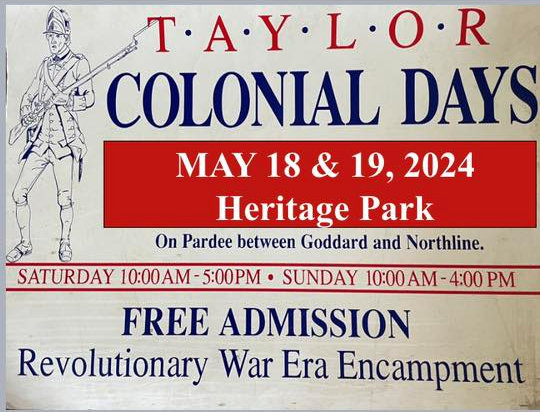
The Taylor Colonial Days Reenactment 2024

The price is right!
Well,  we lost Colonial Kensington,  at least for this year.  But we have gained Taylor Colonial Days at Heritage Park,  so that's a plus.  
And the best way to keep these events going is to participate  (if you are a reenactor)  and/or attend  (if you simply love history).
There's little worse in this hobby than hearing those who rarely attend  complain when events are cancelled  (pick your reason why:  "but...but...I  had  to get my grass cut!"   "But...but...it looked like rain!"  "But...but...")~
Yes,  I realize attendance is not always necessarily the issue with historic reenactment cancellations. But to bring new ones in  (and keep old ones going),  attendance is a must!

{|}

A new event!
Or,  rather,  an old event brought back to life after a 30 year hiatus.
So,  in my opinion,  it's a new event!
And I welcome it,  especially since we lost Colonial Kensington for this year.
My hat is off to the Lees  (Doug,  Dalton,  and Sheila)  and the 49th Regiment of Foot for being the hosts of the Taylor Colonial Days event at Heritage Park in Taylor  (Michigan).
And what a great time it was!
The sun was out for nearly the entire weekend,  with temps in the mid-70s and a light breeze.
But it coulda been raining for all I cared - we have another Revolutionary War event!
So...here's how it went:
A few of us friends were hiking along the wooded pathway at Heritage Park in Taylor when we came upon a stone circle.  Taking a rest on the stones,  a sudden buzzing noise could be heard and the wind kicked up,  almost violently.  We had no chance to remove ourselves from the stones quick enough,  and before we knew it - - 
Zap!  Crack!!
"...an otherworldly white light engulfed the whole area,  and there's a loud explosion and two barks,  and...everything goes dark."
Upon opening my eyes,  the sun was peeking through the leaves of the trees,  the wind became a gentle breeze once again,  creating dancing shadows all around.  My initial reaction was these were the Michigan version of  Outlander's Craigh Na Dun Standing Stones,  similar to the Ocracoke stone circle in North Carolina's coastal Outer Banks region.
So...did we actually travel through time...?
Just as seemingly time itself,  our clothing had changed as well.
We found ourselves in the clothing fashions of the  '70s!
No...not the 1970s...or even the 1870s...but the 1770s!

We followed the same path out...

And we stepped out into a world foreign to us...for the past is a foreign place. 
Had we taken leave of our senses?
What had come over us?
Upon exiting the woods we found a camp - a military camp.
Perhaps we entered...the reenactment zone~~~~~~~:
A smaller encampment - but an excellent and informative one!
This is only the first year for this re-reenactment - just wait until you see how it
grows in time!

Most of us in this picture are members of Citizens of the American Colonies.
This group was formed in 2015 and are made up of mostly Civil War reenactors
who also have an interest in the 18th century time period as well.

Jennifer saw a similar photo and wanted to replicate it -
and she did very well.

Jenny read the latest news to Amy from the Virginia Gazette.

I set up my own photo-scene - - 

The log cabin here was built around 1850 and is the City of Taylor’s oldest existing home.
As I've said in previous posts,  a cabin is a cabin is a cabin.  In other words,  log cabins have generally changed very little in 300 plus years,  so a cabin built in 1850 can still be well-suited for colonials as well.
 
I glanced up and saw young TJ strolling atop a rolling hill.
I snapped this because of how it looked.

A couple from the Highlanders entertained with
traditional fife & drum music.
For a time,  they played at a busy intersection near the park to,  
ahem,  drum up visitors.
I think it must've worked for I heard many a horn honking at them.

Members of  The Belletre Detroit were there - it's always good to see 
Detroit's French roots!
Based out of the Detroit/Southeast Michigan area,  Belletre is a French & Indian War reenacting society dedicated to the preservation and education of the mid-18th Century military and civilian life.

There was also an 18th century fashion show.
Here's some fashion fun:
The shoe buckle of the eighteenth century is an alien object in the twenty-first.  Shoe buckles were a characteristic feature of eighteenth-century dress and were widely worn from the 1690s onwards—forming part of the classic male ensemble of buckled shoes,  stockings,  breeches,  and coat—though they seem to have fallen from favor a century later,  as fashions changed. 
But,  just as fashions changed 200+ years ago,  some of the older folks,  just like today  (moi!),  clung to the fashions of their own youth.
From the excellent book  "Paul Revere and the World He Lived In"  by Esther Forbes:
"As the century advance(d),  small boys begin to appear---all eyes,  all ears,  they watch  'old Mr. Revere'  in church,  on the street,  at his foundry.  Some sixty or seventy years later,  when asked,  they remember him well.  Rowland Ellis remembers  (Paul Revere)  as a  'thick-set,  round faced not very tall person who always wore small clothes.'  The Ellis family pew in the  'New Brick Church'  was directly behind that of Revere, and there Mr. Ellis says,  "I used to see him as regularly as the Sabbath came."
The oddity of small clothes alone would be remembered by a small boy.  The old elegance of knee-breeches,  ruffled shirts,  long stockings,  and cocked hats had passed out of fashion years before.  Others besides Paul Revere  (also)  clung to their picturesque costume of their youth.  There were a number of these  'last leaves'  about Boston.  It may have been a sin for small boys  'to sit and grin...but the old three-cornered hat,  and the breeches and all that,  are so queer.' "
So,  as we are portraying the period of the American Revolution,  I suppose we are safe in our shoe fashions.  And since I often portray Paul Revere,  I suppose the wearing of my  "small clothes"  works well into my old age!

Doug,  on the left,  is part of the organization who put
this Taylor event together.  He and his crew did a great job
and I see only positives and growth in its future.
That's Tony from the 1st Pennsylvania on the right.
Both men are primary players for our Patriot's Day event.
Unfortunately,  Doug has to wear a boot to help his foot.
Doctor's orders.

Hi Ho,  Hi Ho...
The 49th Regiment of Foot marching off to war.

The battle was not any one particular historic battle.  Instead it was more of a tactical to give an overview of what battles were like during the American Revolution.

Part of the explanation during the tactical was to explain that the guns/muskets used by reenactors are the real deal and could be very dangerous.  Just look at the flames shooting out of the barrels of two here.

The American Patriots - George Washington's Continentals.
Often,  people get the militia and the Continentals confused.  But the difference was that the Continental Army provided a more professional and centralized force,  while militias offered localized defense and support.
For contemporary Americans the difference between militia and regular,  or  “Continental,”  soldiers is hard to grasp.  Both fought in the war.  Both suffered casualties.  Both have supporters who claim they won the war.
For all the benefits of a militia force,  George Washington knew for the United States to gain its independence and to create a truly nation state,  a nationalized standing army needed to be created.  This professionally trained Continental Army would serve as the backbone of the American war effort with militia providing support when possible.
In part,  this was due to the idea that these emergency soldiers,  summoned from home on short notice,  the militia lacked confidence on the battlefield.  
(However),  Washington and some of his generals learned to use the militia as auxiliary troops around a core of regulars with triumphant effect at battles such as Cowpens.

For the Saturday tactical,  the American Patriots won by driving the redcoats back.

These guys did a fantastic job showing the battle tactics of the Revolutionary War.
The musket fire gave the visitors an idea of what the sound was like.
When you hear these muskets firing,  you are hear what George Washington heard.

The 49th  (Princess Charlotte of Wales's) (Hertfordshire)  Regiment of Foot was a line
infantry regiment of the British Army,  raised in 1743.
Scott Mann from the Queen's Rangers was also on hand.

Here we have American patriots.
For this event there were a variety of men portraying soldiers from different units.
Lucky for me,  I have Tony Gerring to tell me who they are representing:
From l to r:  2 men from the 10th Virginia  (1776),  2  (me and Len)  from the 1st Continental Regiment  (May of 1776);  1 from French Marine from the 1778 time period.  He has the golden anchors on the turn backs at the bottom of his coat;  1 sailor,  and 1 Continental Marine  (in the green and white coat);  and 5 soldiers and 1 officer from the 13th Pennsylvania Regt. 

With an 18th century bow,  the battle/tactical had ended...
The visitors had shown a real and true interest in this period in history.  I certainly let many know that we were at the beginning of the semiquincentennial,  and some responded with telling me they remembered the bicentennial and that they couldn't believe it's already been 50 years since that celebration took place.  I suppose that's another reason why I am excited about this new Colonial Taylor event - more history to share and to help build up excitement for America's 250th.
Let's support our local events - they need us...and we need them to keep our hobby alive! 
America's Semiquincentennial is here!
As you can see,  it was a very good reenactment - one that will continue to improve and grow.
This year of 2024 I turned 63.  That's not exactly young.  But it is not too old to still enjoy myself and participate at these reenactments.  Oh,  I don't do military,  as you probably know,  so I do not have to march and drill in the hot sun.  Instead,  I can enjoy times past  'neath the shade of a tree,  if I must.
Or in the woods...
Over the coming weeks and months there are multiple time-travel opportunities to take part in,  including a school presentation,  more time at the cabin,  a time-line event,  the wonderful 4th of July at Mill Race Village gathering and celebration,  multiple Revolutionary War reenactments with soldiers and battles  (Frankenmuth and Vermillion Creek to name two),  and even a couple of Civil War events.  Oh!  And a return to the historic Port Oneida Farm Fair in August!  And that's not counting my period-dress Greenfield Village visits!
Yes,  God willing,  I will have a wonderfully busy summer ahead of me to spend in the past. 
And I plan to post those I attend right here on Passion for the Past:  damn the torpedoes,  full speed ahead!

Until next time,  see you in time.

{|}


Thanks to the photographers who contributed to today's posting:
Sheri Graham Engelbrink
Jennifer Long


.................:::.............

Friday, May 17, 2024

Spring Colonial Cabin Excursion 1774

Researching and studying daily life history of the colonial period is what we do,  and bringing to life what we've learned is what we're all about.
I hope you enjoy this post as we continually try to keep upping our game by learning new things.

^    ^    ^

Being that we are,  as of this writing,  in the merry month of May,  we had another wonderful seasonal day spent in the 1770s at the Waterloo Farm Cabin.  We were there for the annual Jackson County Free Museum Day event,  where folks could visit most of the county museums for free,  including Waterloo Farm Museum.  In fact,  a number of our visitors mentioned that they were going around to as many of the museums as they could!  Of course,  donations are always accepted,  and there are souvenirs to purchase and food to eat.
And a trip back in time:
Our springtime cabin crew~
For our backstory:  we moved from near Boston to the frontier of Connecticut to get away from all of the excitement of the Bloody Massacre and the Spilling of the Tea.  We want to just raise our crops.
What this day means to us is spring has sprung and it is time for planting!
Springtime truly is the season of rebirth,  and thoughts for the majority of the populace in 18th century America was the need to accomplish a successful growing season,  for in those long ago days,  Spring was considered a time for preparing for the rest of the year;  a time for a new beginning.  A time for leaving the winter darkness and cold behind to look toward sunny warmth and renewal...rebirth.  It would set the pace for the rest of the year.
Charlotte made a wattle for the garden.
A wattle is made by weaving flexible branches around upright
stakes to form,  in this case,  a sort of woven lattice-type fencing. 
Some folks may call what we do reenacting.
But we are not reenacting anything - we are actually living history and doing the work and chores of those who lived in the 1770s...getting our hands dirty,  perhaps a bit callused,  and,  yes,  our sometimes grass-stained,  dirt-stained,  ash-stained,  and sweat-stained clothing takes on the appearance that shows we're not afraid to work.
In fact,  you can see that the curly chips I shaved off the soon-to-be broom handle are not only all over the floor,  but all over my lap as well.
Dirt,  wood slivers,  and calluses...
I do very much enjoy speaking to the guests who come through.  Most are history people and actually have a curiosity about the past,  so they are not afraid to ask questions.

But let's had back out to the garden:
For the farmer's wife,  spring was her time to plan and prepare for the all-important kitchen garden.  The kitchen garden was where plants for use in the kitchen and homelife were planted and cultivated.  Though there would be vegetables,  herb seeds were among the first things to go into the ground.  Some herbs were even used for pesticides to deter flies,  fleas,  and moths.  And dill,  fennel,  rosemary,  tansey,  thyme,  sorrel,  and basil were considered to be essential to any colonial garden.
Alongside the herbs,  this is what many colonials planted in their kitchen gardens in April or May in the northern colonies,  as well as in the upper middle colonies,  and even in the settlements on the frontier Great Lakes region:  onions,  potatoes,  peas,  skirret,  lettuce,  leeks,  cabbage,  and asparagus.
Parsley,  skirret,  and sorrel were planted for use in salads  ("sallets")  as well as seasonings for meats that had been heavily salted for preservation.
Charlotte  (on the left)  and my wife Patty  (right)  spent most of the day out in the kitchen garden.  The two here planted pees,  a variety of green beans,  lettuce  (inside the wattle),  and spinach.  Patty & I plan to go back out to the cabin before month's end and plant pumpkins.  
One of the problems for us is not being able to spend a lot more time weeding in our cabin kitchen garden than we are able.  This is due to the fact that the cabin is so doggone far away from where we actually live.  To get to the cabin from my house is about an hour and a half drive.  I know that may not seem too far,  but with gas prices up and car wear & tear,  that drive will soon add up to a substantial amount.  So this year we have something worked out.
A couple of teepee garden trellises were also made.
There's a local lad who,  in exchange for a chunk of the kitchen garden to plant his own crops,  he will also weed our portion as well.  Hopefully it will work.
Pastor Gerring blessed the plants as he did last year.
It was in May when the patch of land for growing flax would be harrowed and sowed.  Flax was important in a number of ways,  including the spinning into linen after preparation,  as well as for making candle wicking.  And to help with a mental scene,  from the book A Day In a Colonial Home by Della R. Prescott“Daughter,  take this flagon  (a container for holding liquids)  of buttermilk up to the flax patch.  We saved this much in the churn.  ‘Tis ten o’clock and father and John must be hungry.  This drink will help them through the next hour.”
However,  we did not plant flax this year.
Next year for sure!
Watering plants in the 18th century was not done by a hose...
...or a sprinkler!  But a shoulder yoke & buckets filled with water.
The family that did not have time to plant a garden,  especially those out on the frontier,  faced a winter of intense hardship.  What was available for a family to eat in winter and spring depended on a wife's careful preservation of their excess produce.  And,  as so many of her time  (and even in our modern times),  she often worried over the threat of the damage a late frost could do during blooming season.
Our seasonal home.
Some of my very best time-travels have taken place inside!
God called men and women to perform particular tasks or work in this life:  women were invariably called to be housewives and mothers,  and men were called to specific work as farmers,  carpenters,  store owners,  coopers,  and so on.  Do not be angry at these words,  for this was the colonial thought process.  
(Italicized taken directly from the book,  "The American Farmer in the 18th Century" by Richard Bushman).
By definition,  the shaving horse is a simple foot-operated vice that allows you to hold a piece while having both hands free to work.  A shaving horse is relatively easy to build and extremely useful to anyone who uses hand tools to shape spindles for turning,  chair legs,  barrel staves,  shingles,  and the like.  Other typical usage of the shaving horse is to make a handle for an ax,  hammer,  shovel,  or broom,  for just some examples.  They are also used in other crafts as well.  'Twas a very important combination of vice and workbench - a tool for the farmer and wood worker.
So,  what do you suppose happened as I learned more about the shave horse and seen it in action?
I spent most of my day working at the shaving horse making a handle for a broom.
I did not bring my own shave horse this time - instead,  I used the one that belongs to Waterloo Farm Museum.  Much of my day was spent explaining the process to the many guests who came through.
I love the idea that I have been experiencing the chores and occupations of the past,  and it's been a dream come true.  It's my hope to continue in this manner and even expand.  
Here is Norm & myself with a few guys from the future:
Bob sitting next to Norm
Brian,  president of the Waterloo Farm Museum
and in the doorway we have Jim - volunteer.
Brian and Jim also reenact the mid-17th century period.

I appreciate Chuck and Roy from the Daggett House at Greenfield Village for feeding my historical interests.  These two men,  by doing the chores of the time,  allowed me to learn and,  therefore, accomplish the living history that I do.  My friend,  Larissa,  was also a guide,  and it was she who taught our cabin ladies about hearth cooking.
And we are so happy that she is a major part of our crew.
Larissa did not cook in the hearth this day,  and so was able
to spend more time speaking with visitors.
Due to extenuating circumstances,  there was no cooking on the hearth for this visit.  But there will be multiple summer visits as well as the couple we do in the fall.  Our fall harvest is perhaps my favorite.
As I've mentioned previously in other postings,  we don't do 1st person,  for it would come off too close to acting.  We simply keep our conversations focused on the time period in which we are representing.

And my wife enjoys spinning on her spinning wheel or,  as she does in the springtime,  digging the garden and planting.
This day,  May 11,  was our wedding anniversary.
I'm so glad we were able to spend it with friends doing what we love.
This day was not what we originally planned,  but Patty & I made a great day out of it by spending our time in 1774 at the Waterloo Cabin with awesome friends...and wearing my favorite clothing!

Both Patty and Charlotte did an impressive job on the kitchen garden.
Had this actually been 1774,  we would have been living out on the frontier since autumn 1770 - nearly four years - shortly after the Bloody Massacre On King Street in Boston,  meaning we would have been able to clear acres of land for crops.  So,  rather than working the shave horse as I did,  I more than likely would have been out plowing,  harrowing,  manuring,  sewing...but since that is not feasible for us---for me---I worked on other colonial-era projects.
I did no gardening this time around.
I will when Patty & I come back out to do a little more
planting in a few weeks,  for we're hoping to plant pumpkins.
As I hinted earlier,  my wife and I didn't plan to be at Waterloo Cabin this weekend.  We had made vacation plans that,  unfortunately,  due to family illness,  had to be cancelled.  Well,  postponed,  shall we say.  Family always comes first.
We are still wishing and hoping and thinking and praying that we will still be able to carry out our plans later this year.   But,  by participating at the cabin during the Jackson County Free Museum Day event,  we were able to salvage what could have been a wallowing-in-sadness-and-depression weekend.  It,  instead,  certainly was a bright spot.
We are not perfect,  but I believe we are heading down the right path.
God is good.

Until next time,  see you in time.

Thank you to Brian,  Charlotte,  and Norm for adding to the pictures taken!

I mentioned that we'd been out at the frontier cabin for four years - since 1770.  The following are the links to all of our cabin day experiences  (so far):
If you are interested in our other cabin excursions,  please click the links below:
To read about our 2020 autumn excursion at the cabin,  click HERE
To read about our 2021 wintertime excursion at the cabin,  click HERE
To read about our 2021 springtime excursion at the cabin,  click HERE
To read about our 2021 summertime excursion at the cabin,  click HERE
To read about our 2021 summer harvesting of the flax at the cabin,  click HERE
To read about our 2021 autumn excursion making candles at the cabin,  click HERE
To read about our 2022 winter excursion at the cabin,  please click HERE
To read about our 2022 spring excursion at the cabin,  please click HERE
To read about our 2022 summer excursion at the cabin,  please click HERE
To read about our 2022 autumn excursion at the cabin  (Pioneer Day),  please click HERE
To read about our 2023 winter excursion at the cabin - Candlemas,  please click HERE
To read about our 2023 spring excursion at the cabin - Rogation Sunday,  please click HERE
To read about our 2023 late spring - more planting at the cabin  (& early farming history),  click HERE
To read about the 2023 early summer weeding at the cabin  (and a timeline event),  please click HERE
To read about the 2023 autumn Pioneer Day event we participated in,  please click HERE
To read about our 2023 Thanksgiving celebration in early November,  please click HERE
To read about our 2024 Winter experience at the cabin,  please click HERE
~And that brings us up to today's post.


.               .
      .     .
                         .