Friday, June 10, 2022

Stepping in a Time Zone: The History Alive Timeline at the Chesterfield Historical Village (and a bit on raw wool, too!)

Four weeks is just too long to go without wearing my period clothing.
May 7 was the last time I was in my knee breeches,  cocked hat,  buckled shoes,  and waistcoat,  and I went until June 4 before I was dressed that way again.  Simply too long in between.
Can't let that happen again! 

..........................................


Hey---that's me---Colonial Ken,
representing the early 1770s.
"You're obsolete,  my baby,
my poor old fashioned baby...
I said,  baby,  baby,  baby,  you're out of time."
That's what I'm told,  that I'm obsolete,  out of touch,  and out of time.
Well,  I'm not exactly called  "baby" - some of you may recognize this bit of a lyric from a 1966 Rolling Stones song  (that they just happened to perform in concert for the very first time ever this year on their 60th anniversary tour).
But,  yeah,  I suppose I look sort of out of time.  However,  don't let the modern fashion police fool you - I am up on current events as much as the next guy,  and I am quite aware of all that's going on with the war in the Ukraine,  the  ridiculously high prices for food and other items,  the extreme price of gas that everyone but politicians seem to be talking about...yeah...I'm very aware.
But,  had I been strolling about the 1770 scene,  I would have blended in pretty well with the times.
So it was on the first Saturday in June when I found myself  in a swirl of various time periods,  for I was at a timeline event.  It's been about a month since I was last in period clothing,  which was during our spring planting at the frontier cabin event in early May.
Too long!
But it certainly felt good to be back.
Timelines seem to be increasing in popularity for a variety of reasons.  Some may not like them or agree with me,  but timelines are not necessarily a bad thing,  for they can give the visitor a good overview of the passing of time and the changes that have and had occurred.  In fact,  timelines are actually pretty cool, for,  in all honesty,  and,  aside from a battle,  nearly everything else can still be presented.  Yeah,  I'm pretty okay with timelines in general.
If you look under the title of my Passion for the Past header,  you will note the general description of this blog:  "A Journey Through Time With A  Living Historian."  I recently changed that from  "Thoughts and Social History for the Living Historian,"  for I believe the new description fits my blog postings much better;  as a living historian,  I am  taking a journey through time.  So when I have that time-travel opportunity,  I jump on that horse and ride - and that's exactly what I did at the timeline event in Chesterfield,  Michigan.
It wasn't a fast ride - it was more of a relaxed trot along the perimeters of time.
And I'm so glad to have you come along on the journey with me.
A journey through time - soldier and civilian~
From left:  a citizen of the American colonies from 1772. 
Next we have a representative from the Mexican War - late 1840s.
Our third time-traveler is an 1860s Civil War soldier.
And finally we have a citizen from 1917 - one of the many women who helped out
in a myriad of ways during The Great War..
At the time of the First World War,  most women were barred from voting or serving in military combat roles.  Many saw the war as an opportunity to not only serve their countries but to gain more rights and independence.  With millions of men away from home,  women filled manufacturing and agricultural positions on the home front.  Others provided support on the front lines as nurses,  doctors,  ambulance drivers,  translators and,  in rare cases,  on the battlefield.
Instead of  "Sister Susie's Sewing Shirts for Soldiers" 
(which was a World War I era song that tells about a young
girl sewing shirts for soldiers fighting abroad),  we have 
"Debbie's Baking Doughnuts for Doughboys"  (lol).
Every housewife in the U.S.  was asked to sign a pledge card stating that she would  “carry out the directions and advice of the Food Administrator in the conduct of my household,  in so far as my circumstances permit.”  This meant canning food for future use,  growing vegetables in the backyard and limiting consumption of meat,  wheat and fats.  Most of all,  women were expected to bolster the morale of their families at home and loved ones overseas.
One observer wrote that American women “do anything they were given to do;  that their hours are long;  that their task is hard;  that for them there is small hope of medals and citations and glittering homecoming parades.”

Next we have a Union representative for America's Civil War:
Some say that Civil War reenacting is dying out.
I say whoever is saying that is nuts!
Sure,  it might lay low for a while,  but it isn't going
anywhere.  We won't allow our history to be pushed
away or cast aside for anyone!

Here we have 18th century Voyageurs and Native.
The Voyageurs were of French origin,  though they did not come directly from France.  Rather,  they came from the large French settlements in Montreal and Quebec.  From the 1670's until the 1800's,  French fur traders and homesteaders started settling in the Macomb County area of Michigan,  north of what is now Detroit.  I find this very interesting since Macomb is not only the county this event is taking place in,  but it is the county in which I have lived nearly my entire life.
More folks who participate as Voyageurs  (and I see one from the
French & Indian War on the left).
The knowledge these folks have is outstanding.  It would be great to see some
young folk join up and learn the old ways to keep this history alive. 


Representing the western theater of World War Two - the same my father
fought in 1945  (Okinawa).

Mexican War - The 4th U.S.  Infantry
The Mexican–American War,  also known in the United States as the Mexican War and in Mexico as the Intervención estadounidense en México,  was an armed conflict between the United States and Mexico from 1846 to 1848.

It's when you see people bring accessories,  such as these
punch-tin lanterns,  and work on period crafts that visitors can
really see history come alive.  I must admit,  at this event I
did not bring much of anything except myself. 
Next time,  however... 
 

Paula has quite the collection of period toys for both kids and adults. 
She garnered a lot of  interest from passersby.  

Paula and I.
(photo taken by Richard Reaume)

A few of the ladies taking a stroll.
This Chesterfield event was lightly participated in,  compared to last year.  I hope that does not become the norm,  for there were plenty of interested spectators milling about.  Folks,  the only way we can keep this hobby going and growing is to participate,  research as much as possible  (and never stop researching),  and get younger people to join up and come out.
Speaking of interested young people,  I have another story to tell---a true story about wool.
" 'Wool,'  you say?"
Yep.
I have a friend who,  along with his wife and kids,  live on a farm about an hour's drive from my house.  Jason purchased the farm,  which included their 1876 house,  a number of years ago when he wanted to leave the business world and work the land.  But he wanted to work the land in the old ways as much as he could.  He knew it would be a tough life,  and he found out rather quickly that this was true to fact.  But he keeps at it,  using modern machinery and methods as necessary,  but mostly trying to keep things in the past as much as possible.
So they have a flock of  sheep of  the breed Babydoll Southdown,  which come from England.  
Babydoll Southdown Sheep before shearing.
Members of this ancient breed are the diminutive version of the Southdown breed of sheep,  which originated in the South  "Downs"  of Sussex County,  England.  There,  they were known for their hardiness,  fine fleece,  and their tender meat.
Click HERE to learn more about Babydoll Southdown sheep~
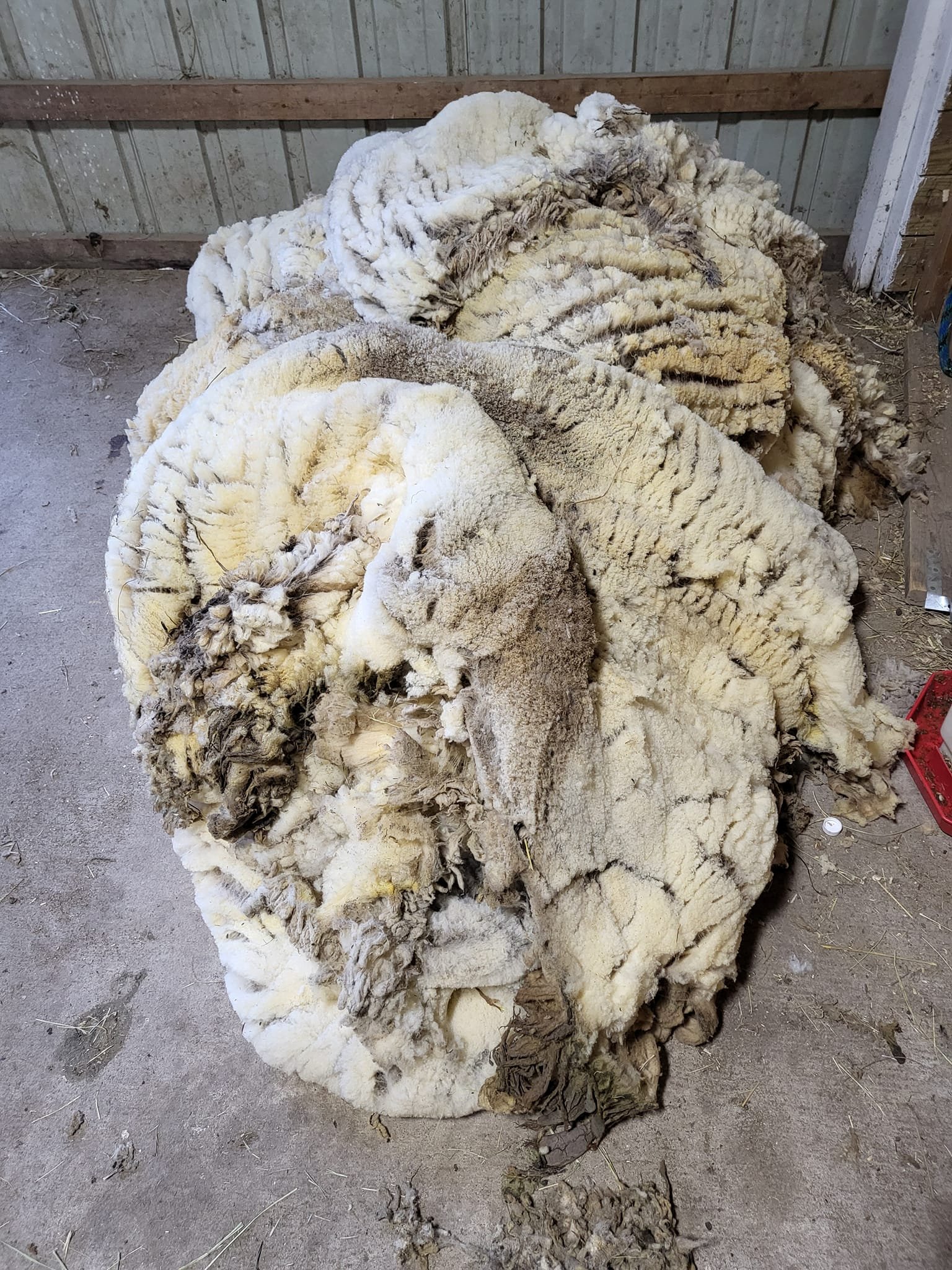
Here is the wool after shearing.
Jason announced to me that we - my wife & I - got  "first dibs"  on the wool.
We couldn't turn it down!
So the first free day we had - only a few days later - we drove out to their farm to grab our claim.  Patty and Jason's wife skirted it before we put it into bags.  In fact,  we used 14 large trash bags!
My van loaded up with the 14 large trash bags filled with the freshly sheared wool.
I still had all that wool in my van the following day...Monday...and it was back to the classroom for me  (my van smelled like a barn on wheels---lol).
So when I mentioned to the students that I had a van filled with freshly shorn wool,  the kids were excited and interested in seeing it and seeing what it felt like.
Always a history teaching moment!
(I got approval to post these photos of the kids)
The students were very interested in the wool and how it felt.
A few made  "eewww!"  comments  (get it?  Ewe??  Oh!  I crack me up!),
but most enjoyed touching it.  And none had ever seen raw wool before.
This young man really liked the wool,  and he grabbed a bit and asked if he could take it home to show his brother and his mother.
Why,  of course he can!
(Yes,  that's me on the right)
Next up for the wool:  sorting,  followed by washing/scouring,  picking,  hand-carding  (though much will find its way to the historic carding mill in Frankenmuth),  spinning,  and then,  if she wants she can dye it  (using natural resources like tree bark and certain plant varieties...and even cochineal beetles!),  and finally she can then spin it into whatever her heart desires.
From  "sheep to shawl"  can take a year  (or more)  for a project to be completed.
Here is my wife in a photo taken a few years back,  though this photo is a posed one
taken inside the Daggett House at Greenfield Village. 
However,  she really does spin and goes through the process mentioned above, 
including knitting period-correct items that we can use at our living history events.
I hope to get her to come into my classroom maybe next school year to do a demonstration.
For me,  seeing the student's reactions to the wool in my van was pretty neat.  If there is any way I can incorporate history into our day,  I will,  and I try to do so as often as I can.
So!
Saturday we had the historical timeline event,  Sunday we went to my friend's farm to get the wool,  and Monday my students got an off-the-cuff unplanned woolen history lesson.
What a fun three days!  Which is how history should be.
And there's more to come.
Until next time,  see you in time.


Information for the women of WWI came from THIS source.
For further information about historic textiles  (spinning,  weaving,  etc),  please click HERE  - loaded with photos,  by the way -


~   ~   ~

Wednesday, June 1, 2022

Visiting An 1860s Farmhouse Museum and Other Historical May Activities

I know some may find this shocking,  but I don't participate in every reenactment I attend.  Sometimes I just want to go and watch without taking part.
Yeah,  I know...crazy talk.
But it's true,  as rare as it is.
Welcome to St.  Clair Shores past.
For instance,  on a recent Saturday I visited the Selinski-Green Farm House in St.  Clair Shores,  Michigan,  not far from where I live.
According to the web site:
the Selinsky-Green Farmhouse Museum,  which is located behind the St. Clair Shores Public Library,  represents the history of a family that was typical of the late nineteenth century settlers in this area.  John and Mary Selinsky,  Polish immigrants,  came to Erin Township  (now St. Clair Shores)  in 1868,  bought property and built their salt-box structure of log timber framework.  They sold it to their daughter Ernestine when she married German immigrant John Green in 1874.  Green descendants lived in the house until 1974 when the State Highway Commission bought the house and land to make way for the I-696 I-94 interchange.  The Museum was moved to its present location and is owned by the City of St. Clair Shores under the direction of its Historical Commission.  It is listed in the Michigan state register of historic sites.
The Farmhouse has been meticulously restored over the past years by our dedicated volunteers.  Thanks to them,  this piece of St. Clair Shores history has been preserved and restored for our future generations to enjoy.

The first thing I took note of  is that this structure from the 1860s was built in what we now call a  "saltbox"  style,  with the elongated slanted back roof.  Houses built in the later part of the 1860s were usually not in this lean-to manner,  a style that went out of fashion over a half-century earlier.  That's not to say they completely stopped building them this way - just saying there were not nearly as many as a century earlier. 
(Kim Parr photo)
These break-back / lean-to / saltbox structures are a classic staple of New England architecture,  first appearing in the United States around 1650,  making them among the oldest examples of American Colonial-style architecture.  They remained a popular choice in the 17th and 18th centuries.
They were not as popular here in the Michigan/Midwestern area - not unheard of,  just not as popular.
The Selinsky-Green Farmhouse Museum from another angle.
It's difficult for me to imagine just how close we came to losing this historic house.
Our metro-Detroit area tends to be too quick in removing our past.

The Curator of the farm house is Kim Parr:
Kim  "inventories,  curates the collection,  and create programming to match the mission and tell the story of the culture and how the Selinsky-Green family lived in St.  Clair Shores from the time they built the house.  I also see to the care-taking of the building inside and out.  Part of this includes working on efforts to make the home as accurate as possible.  Restoration and preservation projects are on-going."
Kim Parr and Jackie Schubert share kitchen duties.
Kim,  like a few other of my friends,  has such a life-long love for history & research - she worked at Greenfield Village decades ago,  and when she left there,  she took over the Crocker House Museum in Mt.  Clemens,  Michigan  (another historical home).
It was from Crocker House that she jumped to Selinsky-Green Farm House Museum.
Kim also mentioned that,  "We are working on plans to build a small barn like the one that the family had just behind their home  (when the house stood)  in its original location on Grant Street off of 11 Mile Road."
How exciting!
I remember the days when one would enter a historic house and there would be a modern-dressed docent,  usually speaking in a monotone voice,  only remotely attempting to make history interesting,  which usually didn't work.  The way the past is shown these days is so much better...and more accurate,  for those who live history tend to dig deeper into the past to make it come alive in ways that even those with a slight interest can be engrossed.
When I visited on this Saturday in late May,  Kim,  along with living historian Jackie  (another of my good friends),  were focusing on Spring-time recipes.  As Kim said,  "Since they would have had a plethora of eggs,  it is logical that they would have eaten many types of egg recipes  (including)  baked goods that included a lot of eggs."
Rhubarb was often referred to as  "pie-plant"  in historical cookbooks.  "So,  we included Pie-Plant Birds-nest.  It's much like an upside-down cake.
Kim at the wood stove.
We also made a sorrel soup.  Sorrel is often a favorite amongst people of Polish decent.  It is much like spinach in leaf and texture,  however,  it has a more sour taste to it.  You can use spinach in this recipe and drizzle the soup with some lemon to get a similar taste to the herb of sorrel.  When planted in your garden it should spread and come up every year."
And Kim also stated,  "We are lucky to have a wonderful functioning cook-stove to demonstrate historical cooking."
Yes,  Kim learned hands on how to cook on wood and coal burning stoves during her time working at Greenfield Village.  
"I believe I have cooked on every functioning stove they had.  Every stove had its own quirks;  its own personality."
She also learned how to cook on the hearth at Daggett Farm.  "It was a great learning experience,"  she said,   "not only how to cook,  but to learn what resources were available in each era." 
Kim noted how interesting that after cooking all those years in a historical fashion,  "it crept into my daily life.  I don't pay much attention to how long to cook something or what temperature is perfect for this or that.  I usually stick with 350 baking temperature for everything and just keep checking on it."
It is amazing how the past can creep into your everyday modern life.  Kim is not the first to mention this - I,  myself,  have this happen to me as well.  And so do other history friends of mine.
Yeah...me getting a little fancy with the camera.
Okay,  so we did some posing.
However,  this would not have been an uncommon sight:
instead of heading to the store for needed foodstuffs - perhaps
sorrel for the soup - the  ladies of the house,  as seen here, 
would have headed,  instead,  to the kitchen garden to
pick what was needed.
 

Now,  is this not a scene out of America's mid-19th century past?  It's almost as if we're seeing spirits of long ago who,  for some reason,  have remained here on Earth.

I have worked with both Kim and Jackie at different times  (and different
time periods).  As living historians,  I greatly enjoy and am honored in being
included in their time-travel adventures.
 

Kim very much enjoys her job as the Selinski-Green Farm House curator,  and said,  "This museum is very homey and offers a good view of what your house may have been like if you lived in the Shores in the 1870s - 80s era."
I love that!  This statement is exactly how I look at history!
Kim continued,  "My hope is to offer more living-history programs for our community.  Many of our volunteers are working on creating period clothing from authentic patterns to the era of this house.  This summer we are having  'chores on the farm'  for children to learn what their role would be to the family.  The hope with such programs is to teach our community helpful living skills that they can take away and use life-long.  Our ancestors have many worthy skills that are exceptionally helpful for us all."
Yep---even in our modern time.  In fact,  I try to show my own grandkids traditions of the past:
My eldest grandchild,  Benjamin,  took to breaking flax with the flax break like
there was no tomorrow.  Yeah,  he wore his Papa's  (me!)  cocked hat!
He also dipped his own candle!
In fact,  he wants to dip again this year...and so does his sister, 
who is a little older now and can help out as well.
Ben proudly holding the candle he dipped himself!
If you get them interested in history early,  it could turn out to be a life-long love affair!  Ben's father - my son - is very much into gardening and teaches his kids about it as well.  I wish I would have paid more attention to my grandpa's awesome garden  (he was a farmer back in Sicily before immigrating to the US).  I can only imagine how I would be today had I spent time gardening with grandpa.  But,  alas,  I was a typical little kid nimrod and strayed away from  that sort of thing,  unfortunately,  for that was for old people  (or so I thought in my pea-brained mind).  Since then,  however,  my interest in gardening/farming has grown immensely,  and I not only have researched historic farming,  but now I actually take part in it!  
My wife and I~
So my farming practices date back about a hundred years earlier than the
Selinsky-Green era,  but many of the standards are the same.
This was taken during our spring planting at the  "frontier cabin"  at
Waterloo Farm in early May.
With my grandpa,  who was born in the 1890s,  farming back in Sicily the old way - using horses and the like - I can only imagine what I could have learned from him.  You don't know how I wish I could go back and learn of his ways.
To visit the Selinsky-Green page,  click HERE


Now,  let's move on to a few other historical adventures I had in the Merry Merry Month of  May:

I put together a reenactment depiction of the Battle of Lexington and Concord,  signifying the beginning of the Revolutionary War.  It took a lot to do but the outcome was amazing and so satisfying.  I am pleased and proud of all the reenactors who participated:
The Redcoats were there - - 

...and so were the patriot militia...

And there I was,  speaking to the public about the occurrences of what
happened at both villages.
Yes,  we are in Michigan,  but it's all of our history to share,
and we tried to do it proud.

And then this - - - - - 
Okay,  so the reenactment took place April 30th,  but this note
actually came out in May the the Northville  "Ville"  magazine.
This makes me so proud:  not sure if you are aware but this
Lexington & Concord reenactment I host at Mill Race Village
is my baby,  and I've worked hard to get it off the ground, 
so a comment/letter to the editor such as this makes me extremely happy.
If you'd like to see more photos and read about our Lexington & Concord event,  please click HERE


Here is a picture of  Larissa and I taken by Jerry Jordan at one of our 1772 cabin excursions - this one from early May.  Larissa is another living historian that I admire for her historical knowledge and am proud to call her  "friend."
You are as good as who you surround yourself with,  and I consider people like Larissa,  Kim,  Jackie,  Charlotte,  and a few others the best of the best.  It is such an honor for me.
~(scroll up five pictures for another cabin picture shot the same day)~
If you'd like to see more photos and read about our spring cabin adventure,  please click HERE


Every year,  just before Memorial Day Weekend,  my patriotic décor'  (ie flags)  come out.  My bunting is hung on the porch,  50 star flags surround my birch tree  (awaiting the flowers to bloom),  and,  of course,  I hang a variety of historic flags off the front of my house.
It remains this way through Labor Day in September.
Yes,  I am a proud patriotic American.

Speaking of Greenfield Village - - 
this year of 2022 has been a very stressful one so far,  in a myriad of ways and reasons.
Sometimes I just need a break:
And that's exactly what I did - I visited my place of solace.
May is a wonderful month to visit Greenfield Village,  for spring activities abound.
It was also when we would have our big three-day Civil War Remembrance reenactment held over Memorial Weekend.
Alas,  that has been put on a "pause"  (whatever that means).
But I still enjoy my visits and try to make it there as often as I can - thank God it is only about a half hour drive for me.
So when I do go I always take a few pictures,  and usually will have a few fine conversations with presenters,  and sometimes even with visitors.  In fact,  when I visited on Memorial Day itself,   I met a mother / daughter who are Greenfield Village members and had never been down to visit the Daggett house!! 
Can you believe that?? 
I practically grabbed them by the hand and dragged them there-------lol - okay...no I didn't really do that.  But I did tell them it was a must see,  so they decided to head to it directly.
'Tis always a fine way to spend a May morning...
Stepping through the 1832 Ackley Covered Bridge.

Early in May - - spring has sprung!
In the distant center is the McGuffey Cabin,  built in 1780.

The Loranger Gristmill,  built in the early 1830s.

Hearing the horses clip-clop...yeah...sounds of the past.

There  'tis!  My favorite house inside the Village - the Daggett House
from the early 1750s.
If I had money,  I would buy a bit of land and replicate this house.
Yes I would.

One of Daggett's finest - Gigi.
She and I always seem to find ourselves having wonderful
history conversations - we will share our information.

From May through the end of the year,  the Daggett kitchen garden requires
daily work.
If you ever have a chance to visit,  ask the presenters for a garden tour.  All the plants are heirloom,  used as they would have been used back in colonial times,  some for eating and some for medicinal,  and some for  "cooking with."
Fascinating stuff,  this.

Planting beans.
No big deal,  right?
Except - - beans were a common fare in the 18th century,  both for regular folks
and also a part of  a soldier's rations.
It always amazes me when I learn how much of today was also a part of yesterday.
Just in case you were interested,  Roy was planting heirloom variety:  
Scarlet Runner
and Mayflower beans.

At the other end of the village...
Ahhh...life on an 1885 farm at Firestone Farm.

The Firestone field a-waiting to be plowed.

Morgan plowed - sometimes the ladies of the house enjoy getting out with the
guys plowing the fields.

This time it was Tedy's turn to plow while Morgan held the reigns and guided the horses.

Spring plowing,  summer haying & harvesting,  and especially the fall harvest are the best times to visit Firestone Farm.  If I had the money to donate  (which I don't,  but if I did)  I would donate enough money to turn land around Daggett into a farm field to show more of the colonial side of farming.
How cool would that be??

John watered the horses.
He did his  plow share  as well,  now it was his turn
to speak to the interested visitors walking past.

Back to Kim for another moment - a Kim from an earlier part of her history career:
It seems that most living historians I hang out with,  including those wonderful ladies I am with at the cabin,  including Jackie and Larissa and Charlotte and a few others,  tend to have that passion for the past in their souls,  too.  
Kim and I during her tenure presenting mourning at Greenfield Village's Adams House during the Civil War Remembrance reenactment a number of years ago.  Besides her historic cooking prowess,  she is a mourning historian and actually began the mourning program at the Village many years ago.
In fact,  I originally met Kim when she worked at Greenfield Village back in the 1990s, 
and we've been friends pretty much ever since..

So my merry merry month of May consisted of  one reenactment that I participated in  (two,  if we count the Patriot's Day event we did on April 30th!),  one reenactment I visited in modern clothing,  and three visits to historic Greenfield Village.
It might not seem like much for me,  but I believe for most people it probably seems like I overdo it  (lol).  And you'll note that most of this post is,  once again,  centering on farming.  Farming tends to be over-looked in most history books,  aside from a paragraph or two.  Yet it was the farmer who made America.  It was around WWI that,  in part,  due to his strong pacifism,  a number of newspaper articles were published expressing Henry Ford's anti-war sentiment,  called him an anarchist,  among other things,  and quoted him as saying,  "History is more or less bunk..."  which has been repeated often ever since.  What most folks don't know is that this  "bunk "  comment was taken out of context and was originally stated for reasons other than what the press said.  It is here that I quote from the book,  A Home For Our Heritage by Geoffery C. Upward:  "...what  (Ford)  meant and explained many times in later years was that written history reflected little of people's day-to-day existence.  'History as it is taught in the schools deals largely with...wars,  major political controversies,  territorial extensions and the like.  When I went to our American history books to learn how our forefathers harrowed the land,  I discovered that the historians knew nothing about harrows.  Yet our country depended more on harrows than on guns or great speeches.  I thought a history which excluded harrows and all the rest of daily life is bunk and I think so yet."
Amen!
So far the time-travel summer ahead looks promising for both reenacting eras:  the Revolutionary War and Civil War,  so if things go as I hope,  then my time in the past should be plentiful.
I can't wait!

Until next time,  see you in time.


If you are interested in other posts I wrote about Michigan's past,  please check out the following:

An Eyewitness Journey Through Michigan's Past: 1768 - please click HERE

For Michigan's colonial history,  please click HERE

Welcome to the Michigan Territory: Visiting the Oldest Buildings Still Standing,  please click HERE
 
A War of 1812 and Regency history of our area,  please click HERE

For Michigan's history as told through fashion,  please click HERE

My hometown of Eastpointe's history:  HERE

Tearing down the past:  HERE

A mostly 19th century tour of Michigan buildings - click HERE

A tour of Michigan taverns from the 19th century,  please click HERE

Historic Michigan buildings now at Crossroads Village,  click HERE

Michigan's 19th century school houses,  please click HERE


~   ~   ~