Showing posts sorted by relevance for query voyageur history. Sort by date Show all posts

Thursday, September 28, 2023

River of Time 2023: New Location in Saginaw, Michigan

Morning has broken...
The first dawn of Autumn.

So,  I awakened about six of the clock in the morning of September 23.  Due to the fact that this was the first dawn of Fall - and being that it was now late September,  it was still dark - the sun does not begin to show at this time of the year until closer to seven.  But here I was,  up-and-at-'em,  and excited to make the nearly two-hour trek to Saginaw,  Michigan for the wonderful River of Time reenactment.  However,  as I was in my back room gathering up a few 1700s items to wear at the event,  such as my buckle shoes and my cocked  (tricorn)  hat,  I noticed a few apples we picked the previous Sunday a-sitting separate on our table,  right in front of the crate,  which was also filled with apples,  and,  with that,  a picture popped into my head.  So I lit a candle and surrounded it with the fresh-picked apples.
Yep---it was a good way to get me mentally ready to travel back in time---I,  myself  (along with Larissa & Jackie),  would be dressed to about the year 1775.  
It was going to be a great day...

~~~~~........~~~~


Michigan knows how to celebrate history.
Michigan knows how to celebrate fall.
Put the two subjects together and you have the River of Time historical timeline event.  And the day we took part was the first day of autumn;  the sun was out,  the sky was blue,  it was beautiful,  the temps were,  too...
Three of  us who are part of the core cabin group were there at River of Time together:  myself,  Jackie,  & Larissa,  and,  per normal for us,  we had such fun together,  with lots of laughs and good conversation.  
We spent most of our time roaming the complex of Johnson's Pumpkin Farm,  enjoying seeing the different eras in time.
If you are unfamiliar with fall in Michigan,  we do it right and we do it up big.  We celebrate the fall here by going to cider mills,  pumpkin farms,  and apple picking orchards,  purchasing cider,  doughnuts,  pies,  fruits,  vegetables,  pure maple syrup,  and even traditional craft items,  usually homemade and oftentimes totally unique / one-of-a-kind.  Let me tell you,  the cider mills are packed every weekend from Labor Day through early November - thousands of visitors and patrons visit these places each weekend;  it's a wonderful tradition of which my family and I also partake.  Johnson's Pumpkin Farm is one such place,  only this year they have welcomed us reenactors:


"Your favorite mid-Michigan reenactment event has moved to the farm!  Take a step back in time at Johnson’s.  Speak with in-character reenactors to learn about the history of our country.  Period music will entertain and the ever popular root beer will be flowing!" 


Over the past few years I have participated in a number of timeline events,  including last year's River of Time  (while it was still in Bay City)  as well as a more recent one in Monroe this past July;  this sort of reenactment seems to be growing in popularity.  But if you look at the schedule of events,  even the least fan of history can find something of interest:
There is so much to see - a travel through time.
And there,  at noon on Saturday,  I,  as Paul Revere,  was part of the schedule of events,  sharing time and the stage with Ben Franklin.
I am honored.
But Ben & I did not share the stage together. 
We,  instead,  spoke of our accomplishments separately.
Since Ben Franklin had much more to speak about,  for his life is more well-known,  it was decided I would go on first,  as a sort of opener,  so at high noon,  I began my story,  and I am very pleased to say I had a wonderful good-sized audience at hand to hear of my most-famous midnight ride.
This early patriot I was portraying did more than most people realize - too many still believe the myths and rumors and,  in more recent times,  condemnations,  without taking the time to search for themselves for the truth  (isn't that the way it is these days?  I call them Facebook University grads lol) - and I like to believe Mr.  Revere himself  is happy with what I'm doing.
It is an honor for me to portray my childhood hero,  Paul Revere.  
I also work on de-Longfellow-izing him,  that is,  pointing out that the Poem written in his honor,  Paul Revere's Ride,  was far from the truth:
As is stated on the Paul Revere Heritage Project website,  “(Longfellow)  meant to retell the story taking the liberty to dramatize Revere’s individuality,  patriotism and the fight for independence.  Longfellow created a national icon from a local folk hero hardly known outside Massachusetts.  He also dramatized Revere’s ride creating a national myth.
During  (the last half)  of the nineteenth century Longfellow’s poem was considered a historical account and evidence of what happened the night of April 18,  1775 and many textbooks were written based on Longfellow’s poem.  During the 20th century,  textbook writers and historians tried to portray a more objective account of the facts.  They argued about the inaccuracies of the poet’s account and what were the real events,  they tried to demythologize the poem. 
Nevertheless,  Longfellow's poem has become so successful and ingrained in every American mind that readers no longer remember it as a poem but as a national legend.  It is a reminder of the patriotism that led to independence and a part of the American culture."
Patriotism is a wonderful thing,  so I can appreciate that.  Even with his human faults,  however,  Paul Revere,  in my opinion,  was a great man who did wonderful things and deservedly belongs in a good place in American History,  to be sure.
I enjoy speaking to audiences of all ages,  but I must admit I like when I can grab the attention of the younger kids - elementary and middle school - for if I can light a spark in them for history,  they'll hopefully remember it for life,  just as my love of history through my old history books as a pre-teen has clung to me.
To read a more concise piece on Revere that covers the truth of  what happened on the night of  April 18th,  1775,  please click HERE.
One of the things I really got a kick out of  was when people would ask to have a photograph taken with me,  for it's not everyday one can meet Paul Revere.  
It truly is an honor.

It was also my privilege to introduce the next speaker/presenter,  Benjamin Franklin.  
Bob Stark as Benjamin Franklin - yes,  he even looks like him!
Bob as Ben did not do the more conventional presentation;  instead he went into the audience and asked them if they had any questions.  Some asked about his inventions while others mentioned his role in the Declaration of Independence.  It was a bit more personable type of presentation.
Franklin was followed by Abby Stark  (who just so happens to be his daughter!),  with a very interesting speech and lesson on colonial tea.  Abby is new to public speaking in this manner and she did very well - she held a good audience while explaining the importance of tea in the colonies,  and,  of course,  of the Boston Tea Party,  which,  in this year of 2023,  is the 250th anniversary  (1773).
Of course,  Larissa,  Jackie,  and I remained to listen to Abby to help giver her some moral support.
She's only fairly recently began giving Colonial Tea Presentations - a timely and
fascinating topic for the 250th anniversary of the Boston Tea Party.
More often she can be found helping her father at The Salty Lantern sutlery.
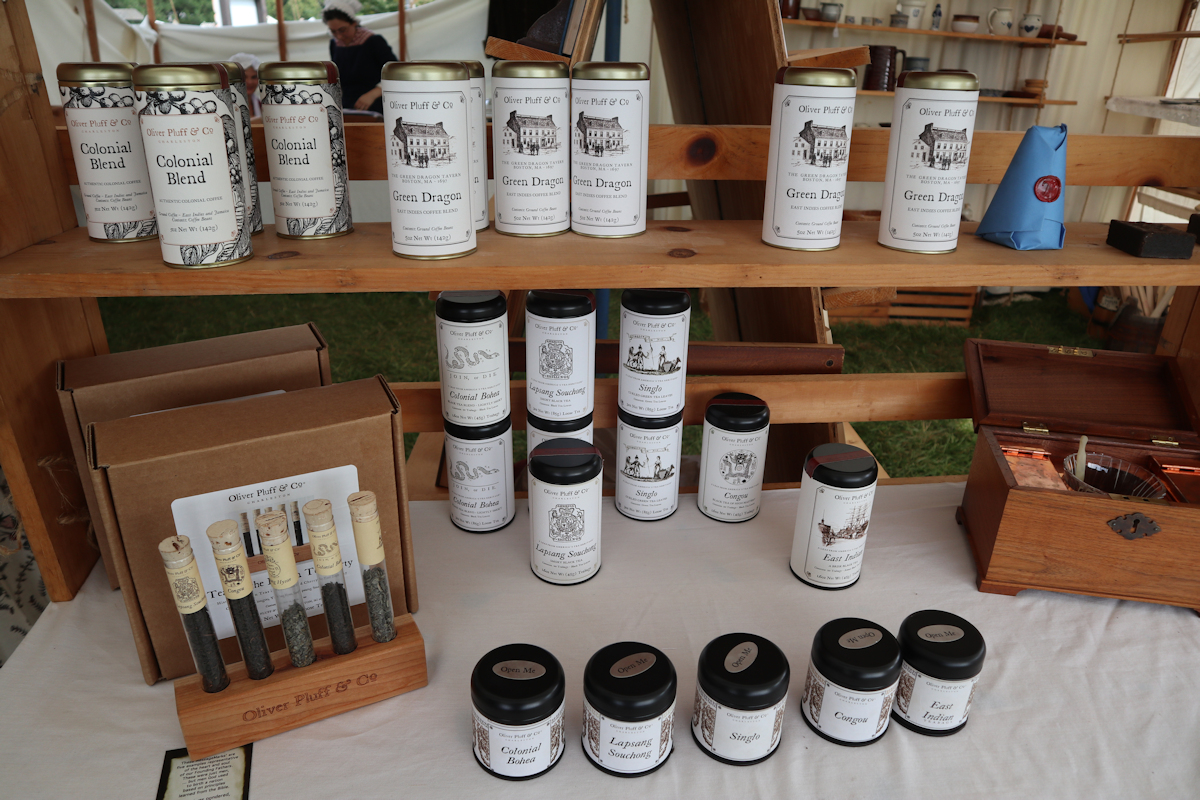
When the presentations had ended,  Larissa,  Jackie,  and I visited Ben Franklin's  (and Abby's)  Salty Lantern sutlery,  where Abby sells the type of tea that was dumped over-board by the Sons of Liberty on the night of December 16,  1773!
And patrons can purchase the same tea-types from that fateful night,  though on a much smaller scale,  for  the three tea ships in Boston Harbor contained 240 chests of Bohea, 
15 of Congou,  10 of Souchong  (all black teas),  60 of Singlo,  and 15 of Hyson 
(both green teas).

In fact,  Jackie did!
A taste of history~
Ben/Bob is a wood worker,  and he makes many period items that can work for reenactors and modern folk who have a penchant for tradition,  including wooden rope bunk beds.
So,  my companions,  along with Abby,  decided to try them out,  and had a little fun in the meantime:
"Time to wake up,  Wilhelmina!"

I have absolutely no idea what they were laughing at,  but just look at their faces!

We very much enjoyed roaming throughout the large encampment:
Revolutionary War was represented - - - 
here we have the 49th Regiment Of Foot~

And we hade some wonderful period music:
The Tittabawassee Valley Fife & Drum Corps played the familiar period music
as well as field music of the Revolutionary War era.

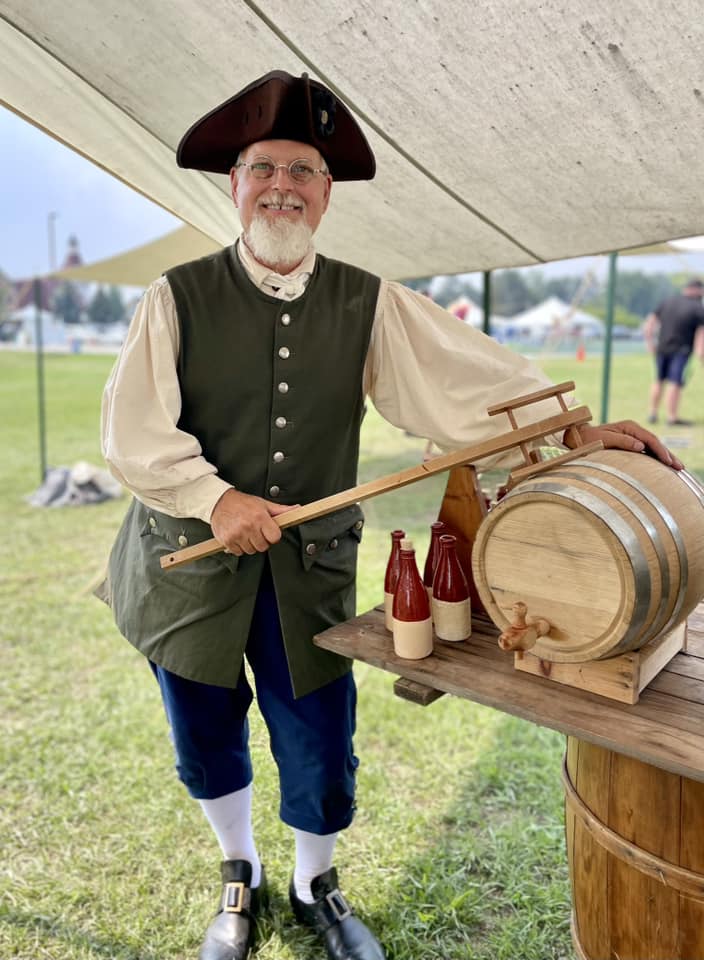
And then there was Larry Kula,  the Colonial Brewer:
Would you like a glass full?
Some beer a-brewin'

The introduction of hops resulted in a change in the definition of beer and ale.  By the 1500s beer had become a malt beverage with hops,  while ale was a malt beverage made without hops.  This distinction was maintained for about 200 years.  During this period fines were imposed for putting hops into ale.  Soon,  the preserving qualities of hops won out over the prejudice against its flavor.  During the 18th-century the distinctions between beer and ale became more vague.  The term ale is sometimes used to indicate a stronger drink,  but this usage is not consistent.

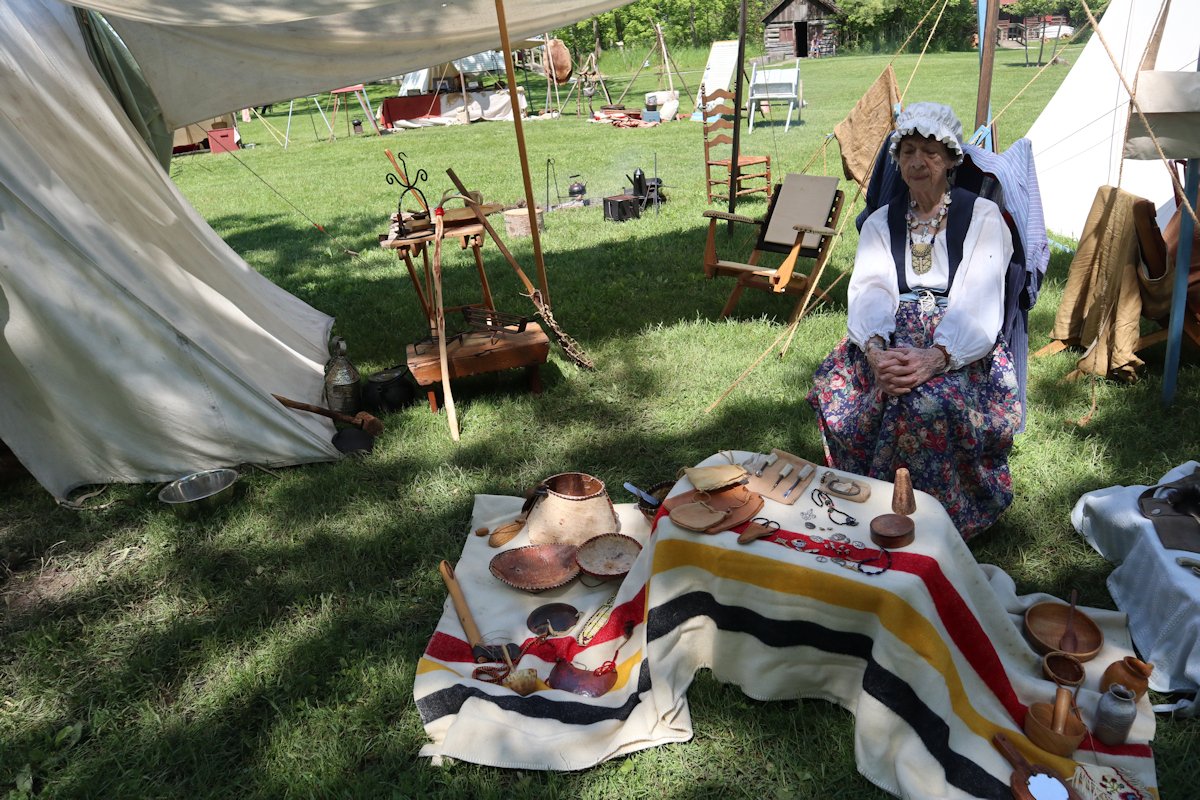
Just a ways away we visited with the Voyageurs,  most depicting life of the 18th century:
The Voyageurs always have a wonderful set up and display.

A blacksmith was on hand...

In the Voyageur camp~

In the Voyageur Camp

I have reenacted with the Lac Ste.  Claire Voyageurs,  but this group are
 the Great Lakes Voyageurs.

I always love it when Native Americans come out and participate.

The Civil War was represented as well.

A little intermingling of two different time periods:  Revolutionary War era
and the Civil War era.
But Butch was kind enough to give each of us a slice of freshly baked carrot cake!

More from the Civil War camps.
I was hoping to see a few more eras in between Civil War and World War Two,  but,  unfortunately,  no one depicting Span-Am,  WWI,  or even earlier,  such as War of 1812 were there.  And that's a shame,  for here is an opportunity to teach history to thousands of people.
Well,  there's always next year.  And I hope we see the periods I just mention,  as well as the citizens of the 1910s,  1920s,  and other known decades.
Maybe even a few Rosie the Riveters!

So now we jump up to the 1940s:
My own father fought in WWII,  so I do enjoy seeing all of the period's collectibles - items my father would have seen and known.  I often wonder what he would have thought of those who reenacted his war life?

At around three o'clock they had a WWII plane do a  "fly over,"  which was very cool to see.
I was able to get a couple of nice photos:
I do not know what kind of plane this was,  but the schedule said there would be a 
"WW2 Fly Over."

I was able to snatch a close up!

Richard is wearing 1940’s era French civilian clothing with a
WWI French infantry military side cap.


Desert Storm - early 1990s.

One particular stop we made was to visit long-time friend and long-time reenactor,  Will Eichler.
For years he has put together historical snippets on his You Tube channel,  Civil War Digital Digest.  As is noted on the web site:  "Civil War Digital Digest is your first stop for high quality videos on American Civil War era history and living history topics.  Avid living historians,  relaxed armchair generals,  and teachers will find resources that both educate and entertain."
For more information,  please check this link out:

But that's not all Mr.  Eichler is delving into when it comes to promoting history: 
Escape into history,  by way of the present and future.
So,  upon entering the tent I came across Will,  someone I've known dor a long time now,  and he explained this new venture of his: HistoryFix - another opportunity for those of us who love history - accurate history -  to literally watch and learn.
TaraLynn Lusko and Will Eichler
At River of Time,  Will was mainly promoting HistoryFix,  which was launched on June 14,  2022,  and,  well,  it worked,  for I ended up subscribing to the channel the next day!
As is written in his flyer:  "Tired of sifting through generic content on mainstream streaming platforms?
Yearning for a streaming service that caters specifically to your passion for history?
Whatever you enjoy:  American Civil War,  World Wars,  modern history,  or others - there's something for everyone to enjoy.
With History Fix you get access to an extensive and growing library of carefully curated movies,  series,  and documentaries - all dedicated to capturing the essence of various historical periods."
Will pointed out that,  "The point is we focus on people being able to enjoy a History where they are – whether movies or documentaries.  Whether online or on an app.  Whether first century or 21st century."
And isn't history what this is all about?

To be able to walk around and seeing all of this American History come to life right before your eyes - from Native Americans on up - is always exciting,  even for those not heavily into the subject,  and personally for me it was such an honor to play a part,  as Paul Revere.  Being stopped a few times by folks who enjoyed my presentation was an honor indeed.  
But it was great hanging out with a few of my  "besties" - - - 
The three amigos.
We had just a good time here at River of Time.
I am already looking forward to next year!

Being that this is a working farm,  there were also chickens,  cows,  and even an emu!
Larissa met Doug the Emu!
The emu is native to Australia,  where scientists believe it began roaming the Outback some 80 million years ago.  The birds were originally imported to the United States as breeding stock for zoos - emus were originally imported to the United States from 1930 to 1950 as exotic zoo stock,  but a 1960 exportation ban in Australia has since barred emus from crossing the border.  The expanding emu population in the United States are domestically bred.

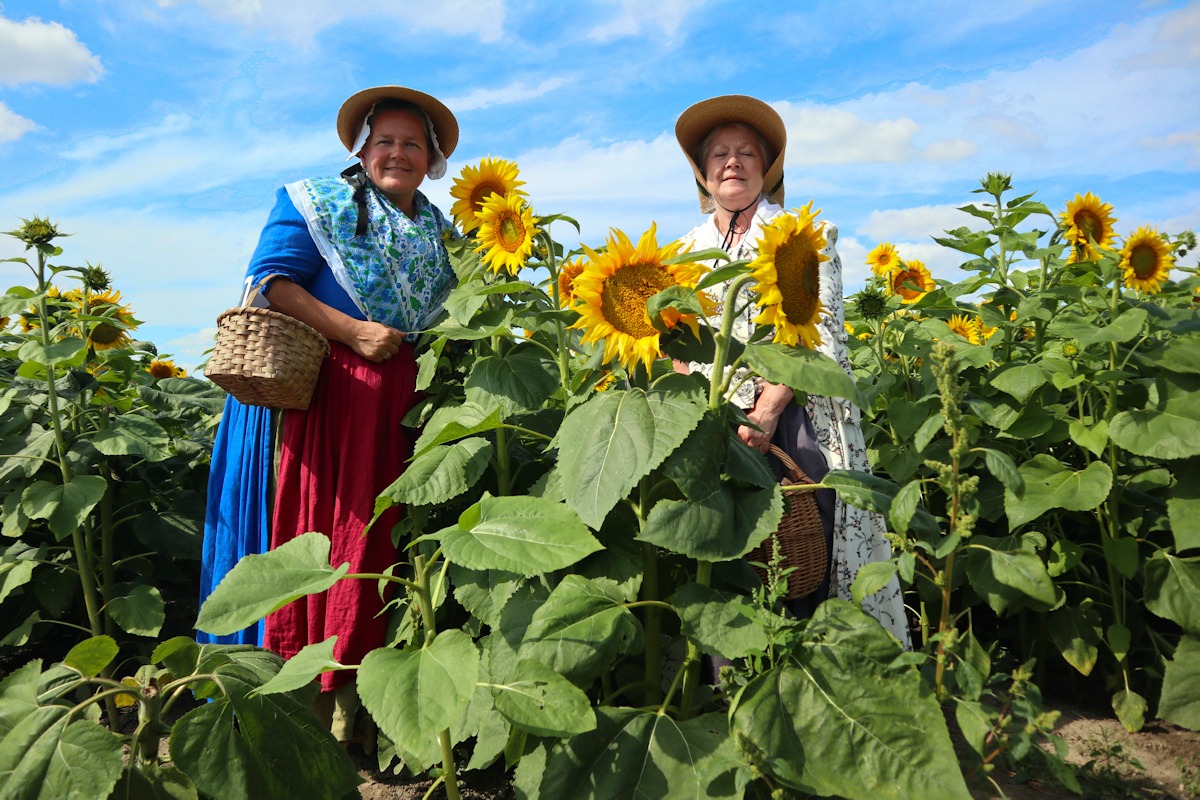
And we also walked through the humungous patch of sunflowers:
Sunflowers...as far as thee eye can see!
(From THIS site):
The story of sunflower is indeed amazing.  The wild sunflower is native to North America but commercialization of the plant took place in Russia.  It was only recently that the sunflower plant returned to North America to become a cultivated crop.  But it was the American Indian who first domesticated the plant into a single headed plant with a variety of seed colors including black,  white,  red,  and black/white striped.
Sunflower was a common crop among American Indian tribes throughout North America.  Evidence suggests that the plant was cultivated by American Indians in present-day Arizona and New Mexico about 3000 BC.  Some archaeologists suggest that sunflower may have been domesticated before corn.
My two friends,  here,  simply loved seeing so many!
Sunflower was used in many ways throughout the various American Indian tribes.  Seed was ground or pounded into flour for cakes,  mush,  or bread.  Some tribes mixed the meal with other vegetables such as beans,  squash,  and corn.  The seed was also cracked and eaten for a snack.  There are references of squeezing the oil from the seed and using the oil in making bread.
This exotic North American plant was taken to Europe by Spanish explorers some time around 1500.  The plant became widespread throughout present-day Western Europe mainly as an ornamental,  but some medicinal uses were developed.
Sunflower became very popular as a cultivated plant in the 18th century. 
The Russian Orthodox Church increased its popularity by forbidding most oil foods from being consumed during Lent.  However,  sunflower was not on the prohibited list and therefore gained in immediate popularity as a food.
By the early 19th century,  Russian farmers were growing over 2 million acres of sunflower.  During that time,  two specific types had been identified:  oil-type for oil production,  and a large variety for direct human consumption. 
By the late 19th century,  Russian sunflower seed found its way into the US.  By 1880,  seed companies were advertising the  'Mammoth Russian'  sunflower seed in catalogues.  This particular seed name was still being offered in the US in 1970,  nearly 100 years later.  A likely source of this seed movement to North America may have been Russian immigrants.
The native North American sunflower plant has finally come back home after a very circuitous route.  It is the Native Americans and the Russians who completed the early plant genetics,  and the North Americans who put the finishing touches on it in the form of hybridization.  Those early ancestors would quickly recognize their contributions to today's commercial sunflower if they were here.
You know,  there's always history to be found in what may be considered the most common thing,  including the sunflower.  I suppose that's the way my mind works...always looking at everything as a journey through the past.

A variety of historical flags...
After decades at a park in Bay City,  this year River of Time was moved to a new location,  and I,  for one,  loved it.  I loved the atmosphere of the cider mill and the literally thousands of people who came through,  most of which were not necessarily  "history people,"  but rather,  cider millers  who happened upon us.  Well,  sometimes these are the best types of visitors,  for there is an opportunity to teach that large portion of folks who,  oftentimes,  get their  (wrong)  information from Facebook memes,  uninformed friends who get their information from Facebook memes,  or from Hollywood movies.
I could not even imagine seeing history in this manner when I was in school.  This sort of living history was a part of the east coast,  but rarely here in Michigan back in the 1960s and 70s.  You see,  Living history timelines such as Bay City / Saginaw River of Time are such amazing events to see the past come to life - to see progression from over a few centuries - culminating to the modern visitor.  
"Reenactors have the best knowledge and abilities for our historical presentations,  and our volunteers are able to support our event with their hard work and dedication to event logistics.  Reenactors find our first-person impressionists and help put together the programs for our education tent in addition to doing their own reenacting."

Afterward,  Larissa,  Jackie,  and I went out to eat at one of the local restaurants.  And per usual for us,  we went while wearing our 18th century garb.  Well,  except for Larissa who,  due to a malfunctioning garment,  had to change back into her modern clothing,  so she was sort of the  "odd man out!"  lol~
We found,  only by chance,  a very nice place to dine called  "Saginaw Old Town Restaurant & Tavern."
A tavern!  Why...taverns were the pulse of 18th century urban life,  and their importance to the local community of that time cannot be overstated.  We colonials are very familiar with taverns!
This was a very good place to eat - good food,  fair prices,  and unique atmosphere!
Guess what else?
There was a room inside that was connected but separate from the rest of the restaurant,  which was where the hostess sat us,  and that extra room where we ate was once an old train caboose!
"Our restaurant is full of history!
We have been part of Old Town Saginaw for more than 40 years!
Part of our building is a train caboose —
and you will find train memorabilia and decor throughout."
Now,  we colonials have no idea what a caboose is,  but we certainly ate our delicious food inside one!
We seem to choose the kind of dining establishments that each of us are pleased with - so far we've had no strikes outs!
Yeah...this was a good day with,  God Willing,  many more to come.
River of Time has a future!

Until next time,  see you in time.


Besides my own images,  many thanks to the following for allowing me the use of their photos:
Larissa Fleishman
Larry Kula
Debbie Purdue
Richard Reaume


~~~...===...~~~

Friday, June 14, 2024

History Alive! - Chesterfield Timeline & Another Period Dress Colonial Visit to Greenfield Village

A timeline is  "a visual representation of a chronological sequence of events along a drawn line that helps a viewer understand time relationships."
At the Chesterfield timeline event for 2024,  visitors could walk from camp to camp and experience life during the time of the Voyageurs,  Revolutionary War,  the Civil War,  WWII,  Korea,  and up to the Vietnam era.
Hopefully,  in future years,  more period stops along the past will be available for our guests.

/^\

I don't think timeline events get the credit that they should.  I remember in school I would stare and study timelines in my history books,  for at a quick glance one could see how we got from one end -  *there*  to the other end -  *here*.  
At one glance we could see the history of the world.  
At one glance we could see the history of America!  
But it was those years,  marks,  and notations in-between that I loved the most and I would study intently.
History at a glance.
Now,  imagine seeing that timeline come alive right before your eyes...actual people from those in-between notations seemingly popping out off the line and standing right before you!
That's  what timeline events are all about.
I've done timelines for years and enjoy the heck out of them.  In fact,  one of my favorites was one called Michigan History Told Through Fashion: 17th Century Through the 20th Century.  
In early June - just two weeks ago from this writing - I took part in my fourth Chesterfield timeline,  and it was nice to see quite a few other reenactors there. 
It grew! 
History comes alive...
Formally known as  "History Alive - A Timeline of Historic Reenactors at the Chesterfield Historic Village,"  having the opportunity to speak with the visitors about daily life during the time of the Revolutionary War is always something I very much enjoy doing.
The visitors making the trek around the historic village grounds were able to visit with a variety of historical folks from the past,  and all brought those old school history books to life in a much more interesting manner.
I was dressed in my 18th century clothing and I spent most of my time with reenactors of  "my"  era,  such as the Lac Ste.  Claire Voyageurs.  
Yet,  there were others there as well:
A Mountain Man,  a Native American,  and thou...er...me.

Mark,  descended from the Osage tribe,  showed curious
visitors how to start a fire with flint and steel.
He did a wonderful job in doing so~
Mark & I often have wonderful conversations about our ancestors:  his Native,  mine British.
Mark's Heritage:  The Osage are a Native American people distantly related to the Oceti Sakowin  (Sioux).  The Osage,  along with the Kaw,  Omaha,  Ponca,  and Quapaw tribes,  speak a Dhegiha Siouan language.  The Osage call themselves the Ni-u-kon-ska,  which means  “people of the middle waters.”  They are part of the Wahzhazhe, or the  “water people.”  The French called them the Osage.
My Heritage:  I am descended from Quaker Farmers who settled in Buck's County,  Pennsylvania from England in the early 1700s.  Although William Penn was granted all the land in Pennsylvania by the King,  he and his heirs chose not to grant or settle any part of it without first buying the claims of the Native Americans who lived there.

Ms.  Paula always has wonderful period-appropriate
children's games and items for sale
Paula is a part of the Belletre Detroit,  a French & Indian War reenacting society dedicated to the preservation and education of the mid-18th Century military and civilian life based out of the Detroit/Southeast Michigan area. 

Me with Richard.
Richard has been a reenactor for over 50 years!
He not only does the Revolutionary War period,  but also
the War of 1812,  Civil War,  and WWII.
Super guy!

A Chocolateer!
Mike has been demonstrating making chocolate for a number of years now.
One day I'm going to have to taste the chocolate he makes.
Then there are the Voyageurs,  who befriended,  learned from,  and intermarried with the local Indians who were already here when they arrived.
Micki & Barb~
Now,  in the 21st century,  the Ste. Claire Voyageur reenactors/living
historians recreate this life from the 17th,  18th,  and early 19th centuries. 
 
I have visited their encampments numerous times over the years and have befriended and reenacted with these fine folk,  not as a Voyageur myself,  for I portray New England,  but as friends.
They really do a great job teaching the history connected with the original Voyageurs,  Coureur de bois  (French/Indian trapper of the Great Lakes),  early settlers,  and military of the Great Lakes fur trade era.  Their living history reenactments of the lifestyles and skills of the era include demonstrations and displays of canoe building,  traditional crafts and skills,  trade goods and artifacts,  blacksmithing,  campfire cooking,  cannons and weaponry. 
Lorna utilizing her skill as a weaver.
One of the things I like about the Ste.  Claire Voyageurs is that you will find the greater majority of them working on a variety of traditional crafts,  such as what Lorna is doing in the above image.
Portraying Mountain Men.
I,  sadly,  did not speak to them about the men they are representing,
nor their clothing.
I know little about the history of such men - please forgive me - only the basics,  and I'm not even sure what I know is actually true.

Curtis has a spread of items a Civil War soldier might
carry with him on a march.

It was great to have the Sons of Union Veterans set up there.

They,  too,  had a few military men along.
Now to get a few 1860s civilians,  men & women,  to take part.  In fact,  all the participating eras should include  "the homefront"  to accent their presentation and tell a more complete story.

This father and son team had a gun display that covered much of the 19th century.
Included were muskets,  rifles,  and pistols.

WWII is still a very popular period for many men  (and women with their  "Rosie"  presentation).  

Paul is dressed as a WWII US Marine.
Between WWII and the Revolutionary War,  we are beginning
to see a greater variety of time periods growing.

World War II Italian soldiers.
I believe they are representing the men under Mussolini.

There were also a couple of men showing the Korean War.

And then there were those who showed American soldiers in Vietnam,  which is the earliest war I personally have actual recollections of.  I recall seeing war news footage on the TV,  as well as seeing the protests against the war.  The draft was a topic often spoken about whenever I saw my older sibling's guy friends come over - anyone male near draft age.  Then there was the music - the A.M.  hits and the F.M.  alternative.
I remember writing President Nixon,  pleading with him not to draft my older brother.  I must have been about nine or ten years old,  and the thought of my brother going off to war horrified me,  especially after seeing all the footage shown on the TV news.  The reply I received from the White House came in a manila envelope which included a booklet about the Nixon Family and of the presidency with a note written more or less as a form letter thanking me for my letter.
I wish I would have kept it - I was so proud.  I mean,  it still may be around somewhere,  but if it is,  it is lost between a couple of houses,  buried within piles of boxes.
"On Dec. 1,  1969,  the United States held its first draft lottery,  which gave young men a random number corresponding to their birthdays.  Men with lower numbers were called first and told to report to induction centers where they could be ordered into active duty and possibly sent to the Vietnam War."
Due to a bum leg from a car accident that prevented him from being accepted,  my brother did not get drafted,  thankfully,  though he had a low number so he would have most certainly been called.  
I was very happy,  needless to say.
Yeah...the mind of a 9 or 10 year old...
My sister's then boyfriend was called up to go overseas.  I sent him numerous letters and he even wrote back.  I believe my sis still has those letters packed away.  I would love to see them again.
When he returned,  he and my sister got married.~
So there're my own personal homefront stories about the Vietnam era.
Is it history?
I couldn't tell you - but the stories are true from when I was a kid in around the year 1970.

One of the occurrences that sadly surprised me at the Chesterfield History Alive event was how few people are actually aware of  America's 250th birthday celebration - leading up to July 4,  2026,  America's 250th birthday.  So I passed on the information to visitors as well as to historical society members.
Someone in Lansing's not doing their job!
We are leading up to celebrating America's 250th birthday!
The Chesterfield History Alive event was very well done.  However,  I would love to see a timeline where all  of the Eras of US History are showcased,  but that would be up to those reenactors representing each time period to take part to represent the history,  now wouldn't it?
But just think...
Colonial America & Revolution (1565-1783)
This would include the great explorers,  the first European settlements,  and Native villages.
And,  of course,  the Revolutionary generation:  French & Indian War and the Revolutionary War
And the Voyageurs 
The New Nation/Early Republic  (1783 - 1860)
This would include expansion/Lewis & Clark,  the War of 1812,  and the Mexican-American War 
Pioneers & Mountain Men & Natives
Civil War  (1861 - 1865)
This would include soldiers and civilian fashions 
Reconstruction/Industrialization  (1865 - 1889)
This would include cowboys and inventions  (electric light,  phonograph)  and Native villages
Gilded Age
The Progressive Era  (1890 - 1913)
This would include Spanish American War
And the Gilded Age plus the Titanic period along with the growing popularity of the automobile,
World War I and the Roaring 20's  (1914 - 1929)
This would include flappers,  radio,  and Jazz & Country music,  movies,  speakeasys
The Great Depression  (1929 - 1940)
This would include Swing music and culture
World War II  (1941 - 1945)
This would include the military,  V for Victory patriotism,  Big Band music,  and Rosie the Riveters
The Modern Era  (1945 - 1979)
This would include the advent of Rock & Roll,  The Beatles,  teen culture
the various anti-war & civil rights protests
From a poster I purchased for my son:
"History of the American Soldier"
Yeah...let's bring this to life!
(click the picture to enlarge)
~Can it be done?
But,  of course it can!
Oh,  maybe not each aspect,  but at least a representation.
To have all of these eras represented to some extent would be a dream come true!
And what better way to show the history of America?~
One never knows...
Okay now,  don't leave yet - - the history isn't over - - how about another period-dress Greenfield Village visit:
~A Special  Visit To  Greenfield Village~

Here we have a few photos taken at Greenfield Village of my friend Norm and I.  We visited the historic open-air museum just a few days before the Chesterfield event.  Often he & I  will dress in period clothing when we go there - he as a preacher,  and me usually as an anyman  of the period.
Whereas the weather at Chesterfield was A-1 perfect,  it was a damp day at the Village.
No matter,  for we always enjoy ourselves. 
Norm is coming up around the bend...
This could be merry-old-England,  for that's where the building
and the walk-way are from.
The structure and walk-way here were built around 1620 in 
Chedworth,  Gloucestershire,  England.
Now why am I showing an 18th century man at a 17th century structure?
Because though the building was built around 1620  (or maybe before),
it was still an active place from that time through the early 20th century, 
so pretty much any pre-20th century period can work well.
  

Dovecotes,  such as the rounded structure on the left side of the picture below,  were built to house doves or pigeons.  In the 17th and even in the 18th century,  birds caught from dovecotes provided edible relief from the smoked and salted meats during the long harsh winters.
Still in England...sorta...but with early America thrown in!
Lots of history in this picture:
We see,  on the far left,  the 1620 forge - next to that the dovecote from the same year.
In the far distance,  barely seen,  is the Daggett House built in Connecticut around 1750,
and then center right in the distance we have the 1633 Farris Windmill from Cape Cod.
Closer to the front right center is what I used to think this was a sundial,  but, I learned it is actually an Armillary Sphere.
Around the time the Cotswold Cottage was built,  the armillary sphere was the prime instrument of all astronomers in determining celestial positions.
The same shot as the photo above,  only zoomed in a bit and from a slightly different angle.  The Daggett House can be seen a bit more clearer.  

Meanwhile,  inside the Daggett great hall we see weaving tape on the box loom~

Imagination sets in,  pretty soon I'm singin'
Doot,  doot,  doo,  lookin'  out my back door.

Spending time in the oh-so-important kitchen garden.
I call it Anna Daggett's  "farmacy"!

Norm and I standing just outside the Giddings House,  built in 1750.

The interior of the Giddings House.
This room to the left of the front door is the hall/best room/drawing room/the Sunday parlor~ take your pick at what to call it,  for during the later 18th century,  it went by all four titles,  though  "drawing room"  seemed to be the term most often used in the wealthier homes.

Here we have the Plympton House,  which has an illustrious history all its own,  including involving Indians,  a fire,  and even one of Paul Revere's riders.
There is a link at the bottom of today's post that will take you to much more information.
Built in Sudbury,  Massachusetts in the early 1700s,  this well-preserved primitive two-roomed structure  (one room above the other),  with its simple sheath covering of walls and a low,  open ceiling with a central  "summer"  beam,  reflects the typical colonial architecture of the earliest period of New England,  and the furnishings show the simplicity of home life of these early times.
The Plympton interior is such a great example of early 18th century living.
You are looking at the interior of an original home that represents life in America just a little time before the birth of Ben Franklin  (1706),  only a decade or so after the Salem Witch Trials  (1692/1693),  within 100 years after the Pilgrim Mayflower crossing  (1620),  and nearly a century after Jamestown was founded  (1607).
History alive indeed!

Though the Cotswold Cottage is the oldest structure in the Village,  the Plympton House is considered to be the oldest American  home there.
All of these structures in the above Greenfield Village photos - Cotswold,  Daggett,  Farris Windmill,  Giddings,  and Plympton - are located at the east end of the Village.  I like that they are all situated in one location.  Now if they would move the 1789 McGuffey Cabin to that area...it would fit nicely to the west of the windmill...it would be/could be an amazing colonial collection of houses.
Ah,  well,  if I had the donation money to do so...
By the way,  if you'd like to read a bit more in depth on a few of the houses mentioned,  please check out the links at the bottom of this post.

Anyhow,  there is another colonial building not even inside the Village walls.
Okay---it's not exactly a colonial building,  but it is as close as can possibly be done without moving the original:
Henry Ford built a replication of the original Independence Hall in Philadelphia  (called the Pennsylvania State House until 1876)  - an exact  replication in all details.  Henry Ford not only had the bricks made from the same brick-maker of the original,  but also included the same measurement mistakes as well!
My good sir,  I am hearing talk of Independence.
Perhaps we shall go and listen.
However,  one thing that most people are not aware of - this building we know and love - our Independence Hall - did not look quite like this back in 1776 at the time our Founding Fathers held meetings inside,  preaching sedition,  and the place where the Declaration of Independence was signed.
Independence Hall in Philadelphia,  Pennsylvania was renovated
in 1897-1898.  During the renovation, 16 of the original beams
holding up the floor on which the giants of the era debated the future
of the 13 Colonies were replaced.
 

However,  in this image,  the part of the Pennsylvania
State House seen here looks as it did in 1776.
Either way,  it is pretty amazing that we have such a
building right here in metro-Detroit!
As you can see,  I had a wonderful time celebrating history at two separate places on two separate days.  One was an actual bonafide event  (the History Alive timeline)  and the other a sort of off-the-cuff made up event.  Both were wonderful.
So far in this year of 2024,  I've found myself in period clothing at least 15 separate times...and it's only mid-June!  And there are plenty more opportunities to come!  All I can say is if you want to do it,  there's no reason or excuse not to.  As the old adage goes:  where there's a will,  there's a way.
I have not heard anything on if Greenfield Village/The Henry Ford plans to participate in our country's 250 birthday celebration - the semiquincentennial.  It would be a very big shame if they chose not to,  for it is a big deal...almost as big as the bicentennial nearly 50 years ago.
I certainly hope they do have plans for some sort of decent patriotic commemoration,  for nearly every state in our union plans to take part.

Until next time,  see you in time.

Interested in a deeper research of the houses mentioned in today's post?
Here are a few links for you:
Daggett House  (part one
Daggett House  (part two)
Daggett House  (part three)
Daggett House  (part four)
I have not done the Cotswold Cottage as of yet - but fear not,  for when they reopen the Benson Ford Research Center - been closed since covid - I will get on the ball and do some deep research on it.
By the way,  coming up in a few weeks is a special 4th of July blog post,  and a week after that will be a posting about celebrating the 4th of July.
And plenty more before and aft.


   II     III