Tuesday, February 8, 2022

A Day in the Life: A Bitter Cold Winter's Day in 1772 at the Cabin (and a bit on Candlemas, too!)

We're at it again!
For the 2nd year in a row,  a few of us Citizens of the American Colonies spent a cold - a bitter cold - January day in 1772 at a frontier log cabin.  Why 1772?  Well,  when we first began using the cabin  (in the autumn of 2020),  we chose the year as being 1770 - exactly a 250 year gap.  Then for our seasonal times at the cabin last year  (winter,  spring,  summer,  and fall 2021)  it became 1771.  Thus,  now in 2022,  our cabin excursions also move up another year;  meaning for us it is now 1772.  In this manner,  our time-travel trips sort of make sense chronologically - 250 years apart from today - and while we become our alter-egos in the past,  we,  unbeknownst to us,  are leading up to the beginning of the Revolutionary War,  in 1775.  You see,  our move to the frontier is tied to the occurrences of what lead to the fight for independence.
But it is also about homelife,  about us being nervous where it could all lead while trying to live our normal life,  so that's where our concentration is focused on.
~And today's post is mostly about the cold of winter.~
Like the others I published in this cabin series  (linked at the bottom),  today's posting is a documentation - a sort of souvenir - of the occurrences of one of the most immersive and amazing days I've personally ever had the pleasure to be a part of in my living history experiences:  'tis an amazing experience to have such an opportunity to participate in 18th century winter activities. 

~   ~   ~

"Presently  (Einstein)  said that our ideas about time are largely mistaken.  And I don't doubt for an instant that he was right once more.  Because one of his final contributions not too long before he died was to prove that all of his theories are unified.  They're not separate but inter-connected.
He meant that we're mistaken in our conception of what the past,  present,  and future really are.  We think the past is gone,  the future hasn't happened,  and that only the present exists.  Because the present is all we can see.  It's only natural.  (Einstein)  said we're like people in a boat without oars drifting along a winding river.  Around us we see only the present.  We can't see the past,  back in the bends and curves behind us.  But,  it's there.
So I suppose I can say the same about our cabin experiences.  All around we see a building unchanged from the day it was built to represent a cabin of another century.  Now,  picture an arrangement to sort of sublet that very cabin for identical dates based around the seasonal year.  If Albert Einstein is right - as he is - then hard as it may be to comprehend,  the winter of 1772 still exists.  That silent frontier cabin that existed back in that winter precisely as it exists today. Unaltered and unchanged,  identical in each,  and existing in each.  I believe it may be possible,  you understand,  for a person to walk out of that unchanged cabin and into that other winter,  or whichever seasonal date chosen.
(But),  the uncountable millions of invisible threads that exist in the here and now would bind that person to this current winter,  no matter how unaltered the cabin around him.  However,  it occurred to me that just possibly there is a way to dissolve those threads..."
(Taken from the book  "Time and Again"  by Jack Finney,  with subtle changes by yours truly) 
Trudging through the snow to reach the cabin,  our feet aching from the cold.
Bright and very early on the morning of January 29,  Larissa and I met up at Charlotte's house.  Charlotte offered to drive out to where the cabin is located at Historic Waterloo Farm,  since it was only the three of us who were going.
Now,  it was cold...bitter cold.  The temperature at this point in the day was a frigid  2  below zero.  And we felt the sting of the minus degrees.  So,  as we packed Charlotte's auto with the items we were bringing,  we all looked at each other and had the same thought:  are we crazy??
Yeah,  we are...but then,  all the best people are. 
Crazy,  that is. 
Bonkers.
How else were we to experience what our colonial ancestors felt?
Not with a portable heater,  that's for certain.
This is it!  The cabin we call our home a few times a year.
This photo was taken by Brian Dewey~

The wool cloaks we were wearing certainly kept us warm.  In fact,  mine kept me
every bit as warm as my modern nylon coat does.

My knit cap and mittens,  I am proud to say,  came from raw wool that my wife first 
sorted,  scoured,  then picked the dirt,  dung,  straw,  and other impurities out of,  
hand-carded,  spun into yarn on her spinning wheel,  dyed with natural dyes  
(I believe she used black walnut here),  then knitted.
Yes,  I am proud to wear them. 

~Before going inside,  we had a group  "sketch"~
C'mon!  You can color it later!  We're freezing!
The high that day - even with the sun - was only 18.

A welcoming fire in the hearth awaited us as we entered.
The three of us stood in front of the flames,  making the attempt to warm
ourselves from the frigid temps.
First the frontside...

...then the backside.

A winter's day...
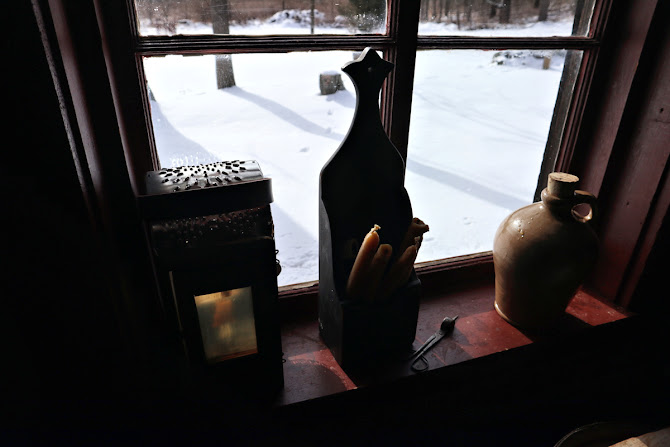
a few of the accessories we brought along:
a lantern  (with cowhorn pane translucence),  candle holder/pipe holder, 
and a jug filled with cyder.
Also,  a candle snuffer.

We never cease to learn something new about the old ways when we come to the cabin.  Knowing how cold it would be,  Brian,  the Waterloo Historical Society president,  made a replicated period footwarmer for the ladies to use.
Larissa and Charlotte try the foot warmer~
The Dutch used the foot warmers in the 1600s.  The use of foot stoves spread
throughout colonial America,  especially in areas like New Amsterdam by
the Dutch customs.  There seem to be very little reference to the use of
foot stoves in inventories because they were not highly valued by the
first American colonists. 

The two paintings here show foot warmers very similar to the one Brian made for Larissa & Charlotte to use.  Foot warmers did not change much from the 17th to the 18th century,  from what I can tell.
This one is from 1654 and is called
"Woman at the Hearth"  by Jacob Vrel.
Both show foot stoves.
Dutch artist Vermeer's painting 
entitled  “Milk Maid in the 
Discourse of Love”  (17th c)

By the eighteenth century,  the use of foot stoves with a pierced tin and 
wood construction was essential in America.  The warmers were usually 
a wooden box with slits or a pierced tin wooden box.  Both kinds had 
an opening on one side with a metal or earthenware pot to hold 
the coals inside.
And do you know what?
It worked beautifully!

"This day Jack Frost bites very hard..."  says a 1772 diary entry.
I could have written that note,  for my toes in the leather buckle shoes I wore felt the stinging bite of Jack Frost from almost as soon as I arrived,  and especially after being in the cold and snow - they had not ached like this in a long time - and because the inside of the cabin wasn't really much warmer than the outside,  it took a while for the  "thaw"  to take place. 
They did,  however,  somewhat come back to life when I defrosted them while at the fireplace.
We spent our first bit of time there warming up before getting started
with our daily activities.
You will notice we kept our outdoor winter wear on pretty much
throughout the day,  just as our colonial ancestors did.
In the attempt to cope with cold,  winter could be anything from inconvenient to challenging to deadly for most American colonists.  We,  just like the forebears we were emulating,  put up with the inconvenience and took up the challenge of keeping warm and busy in a colonial winter.
Anne Eliza Clark thanked her mother for the yarn mitts,  which were of  “great service to me when I sweep my chamber and make my bed.”  Mittens were commonly worn inside as well as outside because,  in many cases,  there was little difference in the temperature.  Much of the heat escaped up chimneys,  and drafts were always a problem.  Without the aid of room screens and fireplace screens,  a person could feel both hot and cold  at the same time standing in front of a fire. 
The time we are representing here was during what we now call  "The Little Ice Age,"  a period when the world saw much harsher winters - a noticeable lowering of temps in comparison to today with higher amounts of snow.  
As horrible as all of this may sound for our colonial ancestors,  we must remember that this was the environment in which they lived.  Yes,  it was still cold,  but they survived for they were used to it and could deal with it much better than we imagine they could,  similar to those of us in the modern age without air-conditioning who are accustomed to the higher temperatures of summer better than those who have that a/c luxury.
For us at the cabin,  our January day was one of the coldest of the 2021 2022 winter season up to that point.  That,  in a historical sense,  pleased us more than if we had a January thaw instead.
We felt the cold,  just like the founding generation!
The ladies began preparing our dinner meal straight away...
...once they warmed up a little.

The creek is frozen solid and water was needed for cooking and for tea.
Out to the clean,  white snow I did go,  scooping it up into a pot.

And filled the pot up high to melt.
Unfortunately,  as you may have learned in your science class, 
a full pot of snow will only leave you with a few inches of water
once melted,  so I repeatedly ventured out to get more.

The bedpan had a light covering of water   (yes,  water!)  which froze into
a thin layer of ice within a very short time inside the cabin.

I've been to Greenfield Village countless times,  watching the ladies prepare
and cook and then eat their meal.  It's wonderful to now be a part of that.
Though not at Greenfield Village.

Now,  you do know that there is no hunting in this area,  right?
But one day I truly will go hunting while in period clothing with my
1760 fusil musket. 
And I will bring the meat here,  to the cabin.
One day...mark me...

Off the grid...hoping I return with some sustenance...

Coming back from the woods...empty handed.
Not even a ground hog...

I'm home!
Sadly,  with no meat.
Perhaps I shall try this evening...
When we are at the cabin,  especially if there are no visitors around,  we do feel as if we are off the grid to some extent.  We feel secluded,  for,  aside from  "quick sketches"  from the camera,  there are few reminders of modern times.

I was very happy that we could use the pipkin I received for Christmas.  I first saw such an unusual looking pot while at the Daggett House inside Greenfield Village but had never seen it in use...or,  to be honest,  even knew what it was or what it was for.  I saw one being used for the first time last summer  (2021)  at the Lac Ste.  Claire Voyageur reenactment when a chocolateer had one for part of his chocolate-making demonstration. 
Upon further research I learned that a pipkin is an earthenware cooking pot used for cooking over direct heat from coals or a wood fire.  However,  they were not held in direct flame which would crack the ceramic.  Instead it was simply put close to the fire - close enough to heat the liquid inside.  It was common for acidic liquids,  such as apple cider,  to be warmed with them.  Post-medieval pipkins had a hollow handle into which a stick might be inserted for manipulation,  which is exactly what I have.
Pouring in the cyder to warm.

This was the first opportunity to use my pipkin,  filled with cyder, 
and in this photo I am setting it on the hearth near the flames.
In the hanging pot,  the stew is cooking.
This will be quite a meal!
Yes,  it's these little things that get me excited.

The hearth worked double-duty,  for it served to help keep us
warm as well as cook our food.  
Warming our toeses I supposes...!

In the 18th century,  when a young girl married,  her mother would
send her off to  "housekeeping"  with numerous 
pots and trivets and other
cooking utensils,  for i
t was the massive fireplace that was the center of it all. 
Swinging iron arms protruding from the surrounding stone or brick
held heavy,  massive pots,  enabling the cook the luxury of moving the pots
closer to or further from the fire.
By the way,  what we call  pot holders here in the 21st century were originally called kettle-holders.  Pot holders  at that time were the metal stand suspension equipment designed to hold pots off of the ground. 
"Soft reflections shone from the pewter porringer hanging from the hearth; 
a sunbeam flecked with bright light the pewter candlesticks which were set on
the mantel."

And finally,  the meal was ready.
This point right here was one of those instances where I had a  "you are really there"  moment.  Sometimes those occurrences just sneak up at the most peculiar times.
It was such a fine traditional meal of stew,  corn bread,  and cyder.
So good---so warm---perfect on such a day.

We ate close to the fireplace - the fire snapped and crackled as it,  too,  ate.
What can grow as it's fed,  needs air to breathe,  and can also die,  but is not alive?
Why,  a fire,  of course!

Ken getting a bit artsy in photographing Charlotte.
Look in the mirror...

Normally I try to bring something  "period"  to do,  usually in somewhat of a physical vein.  Unfortunately I have been battling a serious bout with sciatica - 'tis so painful to do anything! - and due to this matter I kept my activity on the lighter side:  
So,  with quill and ink,  I wrote a journal entry about the day's activities.  
(A Brian Dewey pic)

My quill needs some sharpening or I will have to get a new one,  for I had very blotchy
penmanship  (normally it's not this bad).

Larissa knitted,  I wrote in my journal,  and Charlotte entertained us  (lol).
All by the warmth of the fire,  which seemed to be doing its job, 
for if you notice I had taken off my cloak.

The threesome who braved a 1772 winter's day.
Thank you ladies for spending this day with me.
(Larissa set the timer on her phone for this photo of the three of us)

By late afternoon it was time for us to take our leave.  We had spent from early morning  'til late afternoon - sunset - here at the cabin,  and though I believe the three of us would have enjoyed at least another couple hours there,  we were ready to go back to our 21st century lives.
Perhaps next year we'll remain a bit longer,  providing the high temperatures are not in the bitter degree range.  But one thing you can count on---we will be back.  This is just too special for us.
When the sun goes down,
and the clouds all frown,
night has begun for the sunset.
Shadows on the ground,
never make a sound,
fading away in the sunset.
I can see it all from this great height,
I can feel the sun slipping out of sight.
And the world still goes on through the night
(Thank you,  Larissa,  for taking this awesome shot)
In the meantime,  see you back at the cabin come springtime.

And now for some - - - 
~   ~   ~   ~   ~   ~   ~   ~   ~   ~   ~     ~  ~   ~
~~~~~~Passion for the Past  Extras!~~~~~~
~   ~   ~   ~   ~   ~   ~   ~   ~   ~   ~     ~  ~   ~

Every February 2 we celebrate Groundhog Day.  But,  if you happened to be in the American colonies during the 18th century,  you may had been celebrating Candlemas that same day instead.  Candlemas,  also known as the Feast of the Presentation of Jesus Christ,  the Feast of the Purification of the Blessed Virgin Mary,  or the Feast of the Holy Encounter  (Jesus’  first entry into the temple),  which commemorates the presentation of Jesus at the Temple,  is an ancient Christian holiday celebrated by both Catholics and Protestants.
I took this candle light photo inside the
1780 McGuffey Cabin.
Candlemas,  by the way,  occurs at the time between the December solstice and the March equinox,  so many people traditionally marked that day as winter’s  “halfway point”  while waiting for the spring.  And since many Christians consider Jesus as the “light of the world,” it is fitting that candles are blessed on this day and that a candle-lit procession precedes the religious service,  or mass.  
By at least the seventeenth century a popular superstition had arisen that,  if the sky was clear on Candlemas and the Sun was shining,  there would be more winter to come.  This was before any rodent was brilliant enough to predict when spring would arrive. 
It was also on February 2 that Pagans celebrated Imbalc,  an ancient Celtic festival associated with the goddess Brigid,  to mark the beginning of spring,  and,  as in ancient times,  celebrants would light candles,  make beds for Brigid to visit and bless their house,  make offerings to her,  and engage in weather divination.
As for the groundhog:  in around the eighteenth century,  the idea arose in German-speaking lands that if a badger comes out of his hole on Candlemas and lies out in the sun,  there will be four more weeks of winter.  But,  if the badger comes out of his hole and finds it is too cloudy to sunbathe,  he will go back in his hole and winter will be over soon.  A variant of this was brought over to the English colonies by the Pennsylvania Dutch sometime in the eighteenth century.  Here,  the badger was replaced with a groundhog,  the number of weeks that winter would last was extended to six rather than four,  and the determining factor of how long winter would last became whether or not the groundhog saw his shadow rather than if the badger decided to sunbathe.  It was in 1887 when a newspaper editor in Punxsutawney,  Pennsylvania,  declared a random groundhog who later became known as  “Punxsutawney Phil”  the United States’ official forecasting groundhog as an advertising scheme  (which continues to this day). 
Some still celebrate Candlemas here in 2022,  others Imbalc,  while the media commits itself to the more entertaining Groundhog Day.
I hope this adds to your knowledge of everyday history.  Whichever you celebrate,  it’s nice to know we are at the midway point between Winter Solstice and the Spring Equinox,  and winter will hopefully stay in the winter months and spring will hopefully come when it's supposed to in the spring months.
By the way,  groundhogs are not only edible,  they're tender and delicious if properly cleaned and prepared.  They live on a completely vegetarian diet,  and carry no life threatening diseases for humans.  Groundhogs are similar to rabbit in taste,  and most recipes for groundhog have you prepare them in the same manner.
So why the picture of Colonial Ken with my musket looking like
I'm about to go hunting?
Meat on the table during these last six weeks of winter!
Mmmm....ground hog...
Who knows?
Perhaps next year our winter cabin excursion will also include a Candlemas celebration as well. 

...............................................................................................

Here is,  unfortunately,  bit of sad news...


James Townsend
Founder of Townsend & Son.
Back during a time when finding period items for reenacting was near impossible,  this man began a business making and selling such items:
"It is with deep regret that we inform you that James Townsend has passed away over the weekend after complications from a heart attack.  Many of you were friends with Jim.  He started selling candle lanterns to the historical reenacting community in 1973,  which turned into a catalog mail order company that was run out of his garage,  and eventually turned into the Jas.  Townsend and Son that you know today.  For almost fifty years he enjoyed,  encouraged,  and supported the historical reenacting community.  He will be missed."
My three pair of colonial shoes,  my woolen cloak,  and numerous high quality 18th century replicated accessories I have,  such as my Betty Lamp and a few awesome lanterns,  came from Jas.  Townsend & Son.  In fact,  when I ordered a lantern for my birthday last year,  they put the cow horn translucents in for free as a gift/favor!
God bless James  (Jas)  Townsend for what he started and what his son Jon now carries on.  He had a vision to bring the past to all who needed it.  And that vision,  lucky for us,  came true.

Many  (but not all)  of our period items that we use we purchase from the above mentioned Jas.  Townsend or from Samson Historical.  Both are excellent.


Foot Warmer information came from THIS page

To read about our 2020 autumn excursion at the cabin,  click HERE
To read about our 2021 wintertime excursion at the cabin,  click HERE
To read about our 2021 springtime excursion at the cabin,  click HERE
To read about our 2021 summertime excursion at the cabin,  click HERE
To read about our 2021 autumn excursion making candles at the cabin,  click HERE
To read about harvesting the flax at the cabin in the late summer of 2021,  click HERE
To learn about historic farm tools,  please click HERE
To learn about a year on a colonial farm - living by the seasons - click HERE
To learn about colonial textiles,  click HERE
To learn how colonials survived a winter in the 18th century,  click HERE
To learn how colonials lived with candle light,  click HERE
Adding everyday life to colonial living,  click HERE
To purchase a wonderful DVD about colonial daily life,  including farming,  click HERE


 ~   ~


Tuesday, February 1, 2022

BBC's Historic Farm Series

"For those not familiar with the series,  its about historic farming.  If you don't get excited about the prospect of watching 30 hours worth of historians and archaeologists doing manual labor as it would have been done over the past 500 years in various rural UK locations,  this may not be for you."

~   ~   ~

Initially I had seen snippets of the Victorian Farm on You Tube,  but not in its entirety.  What I saw,  however,  intrigued me greatly,  for I am truly interested in historic farming procedures and of lives as once lived in previous centuries.  And I really liked how the main players wore period-correct clothing,  making it almost like a hardcore living history experience.  Then I learned Victorian Farm was not the only farming adventure the historians had.  
As is written in Wikipedia:  
"BBC Two's historical farm series are five documentary series first broadcast on BBC Two  (in England)   from 2005 to 2013.  They illustrate the life of an everyman:  farmer,  labourer,  fisherman,  etc.  in a variety of historical contexts.  Historians and archaeologists - Ruth Goodman,  Peter Ginn,  and Alex Langlands,  among others,  are the key players - play the parts of ordinary people and live and work immersed in the time specified.  The team perform the everyday crafts such as hunting,  gathering,  sowing and reaping as well as experimenting with more specialised work like blacksmithing,  woodcutting and mining under the eyes of an experienced tutor.  Each series  (save the first)  has taken place at a public living history site that provides external in-period experts,  experience,  and flavour."
Now this sounds like it could be right up my alley - - - - 
However,  when I went to the PBS website,  where shows along these lines are usually broadcast,  I could find nothing on Victorian Farm or any of the others or whether any of them were even shown here in the States  (they weren't),  so I decided to purchase the DVD.  
Well,  it was available,  yes,  but there was a warning connected to it:
Playback Region 2:  This will not play on most DVD players sold in the U. S.
In other words,  it would only play on a Region 2 DVD player  (for European players),  meaning I was screwed  (I still cannot,  for the life of me,  figure out why DVDs and Blue Rays cannot be like CDs and be played anywhere on any player).
It just so happened that in the spring of 2021 I decided I'd had enough of cable prices and began to stream my tv shows.  One of the streaming channels I subscribe to is Prime,  and on the Prime menu was not only Victorian Farm but something called Tudor Farm.
Tudor Farm looked interesting so I began to watch it.
I was hooked from the beginning.  After watching the second episode I decided I wanted to own it.  You see,  I was informed that these streaming channels can get rid of any of their shows at the push of a button and I was not going to take the chance in losing such a great historical show as this.
But,  that whole  region DVD player  thing kept on rearing its ugly head.  
There's gotta be a way to purchase this set on DVD!
The box set from England
(though it's not all Victorian!)

Upon searching Amazon,  I came across something that helped me make up my mind:  I found a box set that not only had Victorian Farm,  but other living history farm docudramas I was not aware of: 
Tales From The Green Valley
Victorian Farm
Victorian Farm Christmas
Victorian Pharmacy
Edwardian Farm
And upon a continued search I also found there were a couple other DVD sets along the same lines:  Tudor Monastery Farm and Secrets of the Castle  (which looked very interesting.  More on that shortly).
And not a single one available for US DVD players.
Okay,  so I decided that I would purchase a region free player,  and found that  Amazon had quite a few at such great prices!
Yep---as you probably have figured out,  I bought the box set as well as the individual ones I mentioned that are not part of the box set...and  the region-free player!  
Happy Birthday to me!!


Now,  before we get started on the reviews,  let's look at the main historians - our historical  "stars" - who travel back in time and live,  oftentimes,  for a complete year in the eras of our ancestors:
First there is Ruth Goodman:  Ruth Goodman  (born October 5,  1963)  is a British freelance historian of the early modern period,  specializing in offering advice to museums and heritage attractions.  She is a specialist in British social history.  She is married to Tudor reenactor and musician Mark Goodman  (who is featured in one episode of Tudor Monastery Farm).  Their daughter,  Eve,  has expertise in historic clothing and has appeared several times with her mother in different episodes of the various Farm series.
Next we have Peter Ginn,  who is a British archaeologist who studied Egyptian archaeology at the Institute of Archaeology,  University College London.  Ginn and Ruth Goodman were the only presenters to appear in every Farm series,  although he did not appear in the related Victorian Pharmacy.
Then we have Alex Langlands,  who is a British archaeologist and historian.  He has degrees in medieval archaeology and world archaeology.  He has appeared in Tales From The Green Valley,  Victorian Farm,  Victorian Farm Christmas,  Edwardian Farm,  and Wartime Farm.
And then there is Tom Pinfold who was with Ruth and Peter for Tudor Monastery Farm and Secrets of the Castle,  and I found him listed as an archeologist.
My English/British reenacting friend met them once or twice at events.  She told me,  "They seem alright.  They make out they stay at the farms 24/7 but they don't.  But the series are very informative..."

So,  upon looking at the collection when the DVD set arrived,  my wife and I decided to watch them in chronological order by era.  In that way we can see the growth of the agricultural occupation beginning with  "Tudor Monastery Farm"  (originally broadcast in 2013),  which shows farming and daily life in England around the year 1500.
Now,  my knowledge of that period is very basic,  so I will have to assume it is historically accurate.  I mean,  considering the details mentioned of the participants I had no doubt how accurate it would be.  As is mentioned on an internet site about  "Tudor Monastery Farm":  
Anachronism Stew / Hollywood History:  Averted,  thankfully.  
Each show is shot in very picturesque and well preserved rural parts of the British Isles,  usually England.  So far,  the shows have been shot in the west,  southwest and southern parts of England and some great panoramas can be witnessed in each show,  though Tudor Monastery Farm was filmed inside the open-air museum.  Though each show has to represent a somewhat general,  broad picture of the era it covers,  the cast and crew usually do their best to point out when exactly did an actual agricultural or industrial practice or certain piece of technology come into wider use.  They also try to tie in the crafts,  industries,  handiwork and recipes shown on screen with the specific region of Britain they're filming a particular show in.  (So,  the shows generally try their best at stressing the importance of regional geography and history in the perspective they offer).
So let's keep this in mind as we go back.
Tudor Monastery Farm - the first one we watched. 
For this series,  the cast enters the early 16th century,  simulating life at a monastery-serving farm during the reign of Henry VII,  just before the beginning of the English monarchy's break with Rome.    Ruth Goodman and Peter Ginn are joined by archaeologist Tom Pinfold,  and together they explore the life of tenant farmers on monastic lands.  This series was shot at Weald and Downland Open Air Museum in West Sussex.  The museum covers 40 acres,  with over 50 historic buildings dating from 950 AD to the 19th century,  along with gardens,  farm animals,  walks and a mill pond.  
There was a separate Christmas Special that aired on New Years' Eve 2013 that focused on Tudor era rural festivities during the Christmastide period  (especially the Twelve Days of Christmas).  I cannot find the DVDs as being available,  but we streamed it on December 23 and,  wow!---it was as good a Christmas show to watch as anything else during the holiday season.  It was,  simply put,  excellent. 
The earliest farm show so far...wouldn't it be cool to go back to an even earlier time?
How about  "Sumer Farm"?
Go on and laugh if you will - I'm being serious here!
The presenters like to emphasize how inventive,  skilled,  and ingenious even the most mundane of commoners had to be in order to solve various technical and farming problems on a daily basis.  Though many craftsmen were illiterate and often had only a basic understanding of mathematics,  they were clever and creative when it came to problem-solving and working around the limitations of period technologies and available resources.
Obviously,  it was all that they knew at the time.
I would love to take part in something like this.
Throughout the series we see the team build a pig enclosure,  plowing the land by way of oxen,  the making of rushlights,  work with sheep:  driving,  milking and shearing them,  and make curds & whey & cheese from the milk;  cultivate wild yeast,  malt barley,  make ale and bread,  cooking,  harvest honey and beeswax,  dip candles,   observe period typesetting,  printing  (including making ink and pens)  and bookbinding,  steam and bend wood,  harvest and stook and store their barley;  extract salt from brine...and that isn't the half of it!
Peter & Tom prepare to plow  (lol)
Actually,  I would say one of my favorite parts was during the 2nd episode when they sheered the sheep,  carded the wool  (by hand),  and wove it on a loom.  The coolest part here was when they then took the woven fabric to the fulling mill to watch that process,  something I've not seen before.
Oh!  To see a working fulling mill in action!  Ahhh...maybe one day...
Hard work at the farms or in industries is not trivialized or romanticized. 
Episode 1:  The team move in,  coppice hazel,  build a pig enclosure,  commission a guild,  plough using oxen,  make rushlights,  make wattle-and-daub barriers,  sow peas and barley using broadcasting,  and celebrate religious festivals.  They take custody of some Tamworth pigs.  They hire workmen to scribe and illuminate documents as well as turn wooden bowls and plates.

Episode 2:  The team work with sheep:  driving,  milking,  and shearing them;  make cheese from the milk;  sort,  grade,  card and spin wool.  Additional they produce a period cold treatment from herbs,  steam-bend wood,  and celebrate Whitsun.  They take custody of geese and drive them to market.  They observe the smelting of iron as well as the weaving,  and visit a fulling mill to demonstrate how wool was traditionally processed.

Episode 3:  The team wean piglets,  cultivate wild yeast,  malt barley,  make ale and bread,  harvest honey and beeswax,  dip candles,  shave their sheep's hooves,  demonstrate period hair care methods,  roast lamb,  and celebrate both a mass and the midsummer festival.  They take custody of a boar to service their sows.  They observe the shaping,  moulding,  and pouring of a bell,  learn about period clock mechanisms and observe a wind-powered grain mill.

Episode 4:  The team mine,  smelt,  and cast ingots of lead;  plait eel baskets and harvest eels;  shape stained glass;  patronize a pub;  pasture their piglets in the forest;  paint cloth and manage their garden.  Tom sits for a camera obscura portrait.

Episode 5:  The team launder bed linen,  serve as cooks and stewards,  calcine and slake lime,  build a lime-ash floor,  churn,  press, and salt butter;  sanitize the dairy,  plait rushes for floormats,  lay and press rag paper;  prepare lye from ash;  harvest tree hay for the animals;  harvest and thresh their pea crop,  cook a feast and make brandy.  They observe period typesetting,  printing,  and bookbinding.

Episode 6:  The team harvest and stook and store their barley;  extract salt from brine,  celebrate Michaelmas,  carve decorative stone,  form and decorate floor tiles,  produce blackpowder for Roman candle fireworks,  a Damson and Bullace Melomel beverage,  and perform a mystery play.

Tudor Monastery Farm Christmas Special:
Ruth,  Peter,  and Tom concentrate on three of the big Christmas feast days:  Christmas Day,  New Year’s Day,  and Twelfth Night.  They make Tudor decorations,  engage in festive revels,  and prepare Christmas feasting delights such as Boar’s Head,  Shred Pies  (the fore-runners of Mince Pies,  made with meat),  and Christmas Pudding.
Along the way,  they’ll turn their hands to falconry and archery;  and make Tudor bagpipes,  before discovering the Tudor origins of Christmas Carols,  the singing of which was known as wassailing and discover the medieval forerunner of Father Christmas,  the Lord of Misrule - traditionally a commoner placed in authority over his social betters for the festive period and tasked with directing the Christmas revelry - a figure so popular that even the King himself had one at Court. 
A Tudor Christmas feast!

~

This was a dream come true to watch,  so when Patty and I completed Tudor Monastery Farm,  in keeping it chronological,  we immediately moved to Tales From the Green Valley,  depicting farming practices from the year 1620. 
I have to admit,  I liked it even better than Monastery Farm,  for though it took place in England,  it was easy for me to  "transfer"  it over to the American colonies.   I could identify with it more,  if that makes sense.  Yes,  it is mostly the same participants as Monastery Farm,  just switch out Tim for Alex,  and each are very well-versed in the jobs and historical knowledge.  They also have two other people who play important roles - a young lady named Chloe,  and another guy  (who's name escapes me).  Both add quite a bit to  "Tales From the Green Valley."  But for this particular series they are farming for themselves rather than for the Monastery landowners. 
Again,  I learned so much!  These are so well done - they presented their well-research 17th century lives without the modern drama that PBS in America tends to  (mistakenly)  think American viewers want to see.  In other words,  "Anachronism Stew / Hollywood History"  has been averted once again,  thankfully.
My favorite out of them all!
Set in the 1620s at a long-abandoned and desolated Welsh grange  (a British country or farm house)  originally built in the early 17th century,  Tales From the Green Valley was actually the first show they did that was focused on the historic farming/living practices of long ago.  The restoration of the centuries old cottage and its surroundings and the cast's struggle to simulate a whole calendar year of farming and handicraft work with nothing but 17th century level technology is shown.  Being this was the first out of them all,  it established most of the elements seen in its later sequels,  including the active participation of the cast in restoring run-down historical farm structures before jumping into the action of recreating a farmer's everyday life in a given historical period.  Besides Peter,  Alex,  and Ruth,  the main cast also included historian Stuart Peachey and archaeologist Chloe Spencer.  This series was filmed at the Grayhill Farm,  part of the Bullace Hill living history grange near Llanvair Discoed,  in Monmouthshire,  Wales.
What I enjoy most about these shows is they make no qualms about showing the
importance of both men's and women's work equally.
A few of the activities we see in this series:  plowing with oxen,  making hay and potash lye,  baking in a hearth,  building a daub and wattle wall,  preparing period medicines,  wood gathering,  hedge laying,  ink-making,  a home pharmacy...
Bringing in the sheaves...
...preparation for lambing,  preparing the garden for sowing,  wheat threshing,  brewing March beer,  summer harvest from the garden  (beans and gooseberries),  clothes washing...again,  slaughtering and butchering a pig  (detail here,  so if you have a queasy stomach for such things)---this is only about half of the activities we see them actually do.
Nothing like roast pig!

They also celebrated a 1620 Christmas here,  and I believe this captured
moment still is from that episode.
By the way,  each episode centers on a single month,  beginning in September and going through the calendar year to the following August.  Though each in the series goes through a year,  I liked that the viewer for Tales From The Green Valley gets to see a full year on the farm specifically chaptered month by month.
So good!
Episode 1 - September:  
Ploughing with oxen,  baking in a hearth,  picking apples.

Episode 2 - October:
Gathering Black Worcester pears,  thatching the cowshed roof with a bracken undercoat and a wheat thatch,  period clothes and boots,  driving pigs to forage.

Episode 3 - November:
Slaughtering and butchering a pig,  building a wattle and daub wall,  harvesting medlars,  salting a table,  combing thatch and pegging it down,  making hog's liver pudding.

Episode 4 - December:
Building a hovel  (a woodshed),  period clothing,  peas,  preparing food  (roast beef,  chicken,  a  "Grand Salad",  a marzipan pig's head,  etc.)  and drink  (Wassail,  "Lambs Wool"  made from heated beer and stewed-apples,  and  "whisky beth"  (made from any distilled spirit and choices of spices,  such as licorice,  anise,  sugar,  etc.)  for a Christmas feast.

Episode 5 - January:
Preparing period medicines,  wood gathering,  hedge laying,  making ink from oak apples,  and rural home pharmacy  (using a small brazier and an alembic).

Episode 6 - February:
A heavy fall of snow,  rebuilding an outdoor lavatory,  checking the sheep in preparation for their health and for their upcoming lambing,  period musical instruments,  preparing a meal of fish and bagged puddings for Lent.

Episode 7 - March:
Preparing the garden for sowing,  wheat threshing,  a trip to the miller  (featuring the Melin Bompren mill,  St Fagans National Museum of History),  brewing March beer,  pig yokes,  fun and games,  egg and pear pie with stewed salt cod.

Episode 8 - April:
Spring cleaning,  rebuilding a dry stone wall,  a new calf.

Episode 9 - May:
Preparing a new field for spring sowing,  making charcoal,  and butter.

Episode 10 - June:
Washing and shearing sheep  (and sampling  "sheep washer's posset"),  cheese making,  and mid-summer revels.

Episode 11 - July:
New harvest from the garden  (beans and gooseberries),  making hay and potash lye,  clothes washing.

Episode 12 - August:
Fattening geese,  goose pie and carrot puree,  wheat and straw harvest,  reed lights.

~

Next up is the ever-popular Victorian Farm.
With this one being from the era of Queen Victoria,  we witness more of the tools and machines from the 19th century Industrial Revolution.  We see bigger changes in farming practices.
And the Victorian-era is very  "in"  these days,  whether in England or in the U.S.
I believe Victorian Farm is the most popular in their series.
Each one,  however,  is loaded with everyday life history.
After a hiatus of a few years,  the concept was revived in 2009 as this particular series was set in the late Victorian era (1880s and 1890s).  It was filmed at Glebe Farm on the Acton Scott Estate in Shropshire,  in England,  and the team of Ruth,  Peter,  and Alex relives history once again,  though this time in a more relatable setting as compared to the earlier shows. 
Many farmers either knew what to do should a cart wheel need repairing...
or they may have had a wheel wright nearby.

In Victorian Farm we get to see the farmers assisting in the threshing of the previous year's crop of wheat by using a steam-powered thresher,  a field being plowed,  harrowed,  and sown with the next year's crop using horse-drawn implements,  apples being picked,  milled,  and pressed to make cider,   a pheasant hunt,  the birth of many chicks and ducklings,   embark on a trip by steam train,  and seeing the team turn to Victorian science in a bid to save their struggling crops.  
This is an interesting photo showing the filming of a portion of Victorian Farm.
Sometimes,  as we watch these shows,  we tend to forget there are cameras
and other film crew all about. 

I have no idea what this machine is...so I cannot comment on it.

If they succeed in their yield,  they will have something to celebrate at the May Day fair,  which is a wonderful recreation of an English May Day holiday.  
If they fail,  all their hard work will have been in vain.
Autumn's Harvest Home!
Episode 1:
The team move into a disused cottage.  This requires much renovation:  replacing the coal-burning range,  cleaning the chimney and refueling from a narrowboat on a nearby canal;  cleaning the bedroom by removing dead birds,  disinfecting against bedbugs with turpentine and salt,  restoring the lime plaster and redecorating.
In accordance with custom,  they assist in the threshing of the previous year's crop of wheat,  using a steam-powered thresher.  A field is ploughed,  harrowed,  and sown with the next year's crop using horse-drawn implements of the era.  Apples are picked,  milled,  and pressed to make cider while other fruits and berries are preserved as a spicy chutney.
A flock of Shropshire ewes is acquired and the first meal is cooked and eaten:  a leg of boiled mutton.

Episode 2:
As winter draws on,  animal fodder and shelter is provided.  Mangelwurzels are stored in a clamp and then chipped with period machinery to feed the cows.  A pigsty is built upon a foundation of bottles to provide insulation and three young Tamworth pigs and a pregnant Gloucestershire Old Spot sow are housed there upon completion.  A ram is added to the sheep flock and marked with a raddle to ensure that he impregnates all the ewes,  so that they will lamb in the spring.  A shire horse,  named Clumper,  is also added to the livestock and training in his use as a draught animal is performed.
Domestically,  the weekly laundry is done in a Victorian style.  Stain removal is first performed,  for example,  using milk to remove an ink stain.  Then the clothes are hand-paddled,  mangled and ironed over a period of several days.
Christmas is celebrated with a church service;  the Victorian novelty of a Christmas tree;  a plum pudding and a roast turkey;  and presents are exchanged such as some hand-made braces.
There is also a separate Christmas series as well - see below~

Episode 3:
New Year arrives and the farm needs emergency repairs,  with the help of the woodsman,  the blacksmith,  and the basket maker.  Ruth has a go at some traditional potions and remedies.  When the wheat crop comes under attack,  it is time for some pest control,  Victorian style,  as Alex and Peter join a pheasant hunt.  Alex goes out catching rabbits with a team of Victorian poachers.  And with spring around the corner,  the first baby animals are ready to be born.

Episode 4:
It is spring and there are lambs and pigs to be delivered,  which means Alex and Peter need to master animal midwifery.  A prized ewe is in danger and a lame horse may jeopardize vital work on the farm.  The team witness the birth of many chicks and ducklings,  along with 8  (originally 9)  piglets from the pig Princess.
The team turns to Victorian science in a bid to save their struggling crops.  If they succeed,  they will have something to celebrate at the May Day fair.  If they fail,  all their hard work will have been in vain.

Episode 5:
In this episode,  the team embarks on a trip by steam train,  Ruth begins a tough task in the dairy,  Alex tries his hand at beekeeping,  the sheep get sheared using the latest time-saving technology,  and the lengthening summer days allow Alex and Peter to try out the new Victorian sport of cricket.  It is also time for the hay harvest,  weather permitting.
Ruth makes cheddar cheese in the dairy with her daughter,  Catherine Goodman,  using milk from the cow Forget Me Not and rennet from a neighbor's male calf.  The sheep shearing is a life saver because it turns out that the sheep have severe fly strike.  It is Alex's birthday and Ruth makes him a cake and a picnic,  while Peter buys him a book about setting up an apiary.  The boys make a predator-proof cover for the landlord's raspberry patch.

Episode 6:
It is the end of their year on the farm.  They sell off the pigs and sheep they successfully bred and raised.  Ruth learns straw plaiting and makes a hat and cooks a Victorian style curry.  Everything is now focused on the wheat harvest.  Peter and Alex get the dray and a reaping and binding machine repaired and brew beer for the harvest.  The harvest is completed just before the rain comes,  with Ruth harvesting the last of the corn.  Once the wheat is dried and stored they ring the church bells,  enjoy a harvest festival and reflect upon their time on the farm.  They hand over the key to their landlord and depart the farm.

Special Victorian Farm Christmas Episode:
The Victorian Farm series was so popular that it received a four hour Christmas Special spinoff of its own due to high demand!  And yet we still see the crew doing farming chores as we lead up to the Christmas holiday.  Besides showcasing Victorian era preparation of decorations,  presents and Christmas recipes,  the cast also work on several more mundane tasks as well such as haying,  brick-making,  and hauling in the yule log,  for a farmer's work is never done.  Another task - the careful restoration of a historical blacksmith workshop - is cleverly tied in with the plotline about the preparation of presents  (with the help of Alex and the blacksmithing instructor guest,  Peter uses the restored worskshop to create a hand-made doorknocker as a present for the owner of the estate where the series was shot).
Merry Victorian Christmas!

~

Edwardian Farm  'twas another very good living history experiment,  though we are now looking at English life in the early 20th century,  centering,  once again,  around farm life and includes seasonal chores,  and,  like the others,  it ventures out into other areas of occupations in the 1910s,  including mining and lace making.
Again,  like Tales From the Green Valley,  this has each
separate episode being a different month,   
beginning in September.

Edwardian Farm was filmed mostly in Devon at the Morwellham Quay Heritage Park and the surrounding Tamar river valley.  Though it is largely similar to Victorian Farm, it generally shows a lot more than just the agricultural life of the British countryside over a century ago.  The show has not only at least twice as many episodes in total,  but also broadens the scope to topics like the importance of industry,  transport,  trade,  and even tourism of the period.  Naturally,  a lot of vanished local industries and crafts are revived by the cast.
Though farm life is the root here,  as with other eras in this series,  we see our historians venturing out into other areas of life from the 1910s:  Ruth pickles apples,  salts a ham,  and smokes bacon,  and even hires herself out for domestic work,  while Alex and Peter press apples to cider,  fish for crabs and salmon,  dry stone wall making,  and work in a copper mine.  They also take part in sheep-shearing and observe sheepdogs at work,  as well as cleaning the  "fresh"  sheared wool in preparation for carding.
And then there's the July harvest of picking cherries...did you know that cherry trees can grow 70 feet high?
I didn't!
Watching the ladder maker make new rungs for the old ladders was pure fascination,  as was the weathervane making process.
Peter,  Alex,  and Ruth

Alex with the cider press.

The Edwardian home of Ruth and the gang for a year.

Celebrating an early 1900s Christmas.
Episode 1 - September:  
The trio establish their domicile,  scrubbing a flagstone floor and cleaning out a clogged chimney.  They build a hayrick to put up hay,  hire a stonemason to make a trough,  learn to thatch,  make a rag rug,  and begin keeping chickens,  and sheep.  Ruth cooks a sheep's head stew.

Episode 2 - October:
Alex and Peter milk goats and train the plough horses.  They begin a market garden of strawberries.  Ruth pickles apples,  salts a ham,  and smokes bacon.  Alex and Peter press apples to cider  (scrumpy),  freighting first the apples,  then the barrel on the river.  They visit a cooper and make lime putty.  They read government agricultural leaflets,  collect eggs,  make chicken stew,  and celebrate Halloween in Edwardian style.

Episode 3 - November:
Ruth prepares for the arrival of the farm's pigs and works on the privy,  while Alex and Peter compare ploughing with horses to ploughing with the world's oldest working tractor.  Peter begins a trout hatchery.  In order to repair the hedgerows,  Alex takes a trip to a water-powered smithy for a billhook.  Ruth makes sloe gin for Christmas and entertains with a gramophone.

Episode 4 - December:
As winter sets in,  the three farm dwellers must look further afield to earn money.  Peter and Alex fish for crabs while Ruth hires herself out for domestic work.  Ruth rides a bicycle and tries period cleaning techniques,  including early vacuum cleaners.  They separate growing calves from their mothers.  Peter finds out how leather is made.  They celebrate Christmas modestly,  as poor farmers might have,  and listen to a Methodist Christmas message.

Episode 5 - January:
The continuing winter forces Alex and Peter down a copper mine,  while Ruth makes lace.  The copper mine is the King Edward Mine,  Camborne, Cornwall,  and the lace-making is at Honiton.

Episode 6 - February:
Six months into their year,  Ruth,  Alex,  and Peter explore the daily lives of Edwardian farmers.  
This episode has a slightly different format to the rest of the series;  instead of covering a whole month's changes it uses a framing device of Ruth writing a letter describing the events of a single day on the farm.

Episode 7 - March:
Spring arrives with the lambs and the potato crop planted with manure.  Daffodils are harvested and sent by train across the country.

Episode 8 - April:
April arrives and time is divided between the land and the sea.

Episode 9 - May:
Summer brings the tourists,  so the farm provides strawberries and clotted cream.

Episode 10 - June:
June arrives so the sheep go up onto the moors of Dartmoor with Alex and Peter guiding  (fortified with biscuits and Mahogany wine,  courtesy of Ruth),  leaving Ruth to run the farm,  including spraying Bordeaux mixture on the potato crop.  Alex and Peter try their hands at sheep-shearing and dry stone walling,  and observe sheepdogs at work.  Ruth makes her own cheese and visits an early wool mill.  Finally,  they have an Edwardian picnic with a vintage car and then go rambling and letterboxing on the moor.

Episode 11 - July:
July brings the harvest,  cherries,  and potatoes.  Ruth goes salmon fishing on the River Tamar with a seine net.  Peter and Alex pick cherries from tall ladders and Ruth prepares cherry preserves.  They try out Edwardian potato digging devices and employ child labor.  The annual day holiday at Lynton and Lynmouth is a welcome distraction.

Episode 12 - August:
August brings to an end the year on the farm;  weather dictates the harvest and the seaside brings much needed fertilizer.

~

Now that we've watched all of the farming shows  (except War Farm,  which depicts WWII in England   - no,  unfortunately I have not seen it yet),  let's take a break to watch the Secrets of the Castle,  which shows a medieval  (1200s)  castle construction project known as Guédelon Castle in Treigny,  France.  It has the same main two historians from the historic farm projects,  Ruth  &  Peter,  plus Tom rather than Alex - and they reveal what kind of skills and crafts were needed to build a castle in the 13th century by using only the techniques,  tools and materials of the era,  as well as showing everyday life for the folks who lived in and around the castles.
This was another good reason I was glad I purchased
 a region-free dvd player.
The team turns the clock back all the way to the High Middle Ages and takes part in the construction and the day-to-day routines of running and supplying a medieval castle.  Shot in France,  at the site of the famous Guédelon Castle project,  we get a wonderful opportunity to see the first and only medieval castle to be constructed from scratch in contemporary times,  by using only period-appropriate methods and technology.
Ruth found medieval food preparation and castle hearth cooking to be different
than how she cooked from shows of a later time period.
In the only filmed-outside-the-UK show,  Secrets of the Castle,  Guédelon Castle is surrounded by a lush lowland forest in the French region of Burgundy.  The team occasionally visit some of the Burgundian landscapes and medieval towns and villages. 
I wasn't sure if I would enjoy Secrets of the Castle show or not,  but - wow - it was excellent!  Seeing just how brilliant our long-ago ancestors were - how they
overcame problems using 1200s technology - just blew me away.
So,  though not about farming  (there is some farming,  however),  this Castle show is another well-done and very interesting snippet on the lives of those who lived in the past,  only this time about 800 years ago.  And we don't see that very often,  aside from Hollywood's version of history  (in which they get most information wrong),  especially in America.  
The cast in each of these shows is usually having genuine fun while working on authentically recreating the housing conditions and farming and laboring methods of the past.  They even tend to rediscover and learn certain facts that have been lost to history,  due to some production methods not being tried for a very long time,  and previously being little documented.  And it adds so much to the show when this occurs.  Also,  given the fact they wear period clothing,  as mentioned before,  adds greatly.  Seeing modernly dressed folk doing period activities just doesn't have the same appeal,  for it becomes,  more or less,  a lecture.  Ah,  but put them in the clothing of the time and the black and white world suddenly becomes color.
And we can't forget the food - - real  "period"  dishes made and cooked in the same way as in the time being represented.  Yes,  we get to see food preparation,  which is more fascinating than the cooking Channel!

Episode 1 - "Why Build A Castle?":
The team arrives at Guédelon,  in the Burgundy region of France,  to join the world’s biggest archaeological experiment - a 25 year project to build a medieval castle from scratch,  using only the tools and materials available in the 13th century.

Episode 2 - "Defending The Castle":
Ruth,  Peter,  and Tom look at the ingenious features medieval castle-builders came up with to withstand attack from an ever more formidable array of siege engines.

Episode 3 - "Inside The Castle":
Ruth,  Peter,  and Tom enter the surprisingly colorful world of medieval interior design.  The castles that we see today are in fact scarred by centuries of decay.  Most of their original roofs,  carpentry,  and interior finishes have long since disappeared,  but in their heyday they were lavishly decorated.

Episode 4 - "The Castle’s Community of  Skills":
The team delve deeper into the secrets of the skilled communities who built medieval castles.  The stonemasons working on the castle walls are dependent on blacksmiths,  whose metalwork was magical to the medieval mind-set.

Episode 5 - "Beyond The Castle Walls":
Ruth,  Peter,  and Tom look at the castle’s place in the wider medieval world.  13th century Europe was a busy,  developing,  connected place,  where work,  trade, pilgrimages,  and Crusades gave people the opportunity to travel across the continent and beyond.

~

This is probably some of the best real history one can watch - they tend to match,  chore by chore,  everything I've read in my farm history books and research.  England does history right by concentrating on history rather than creating controversy in these docu-dramas  (just check out the horrible Colonial House American PBS did some years back),  filming each by utilizing historical research without the agenda-filled 21st century-style drama.  Each disc/series in this farm collection are so good that purchasing the region-free DVD player was well-worth it just to own  'em,  and my wife & I have been watching and enjoying each set immensely,  more than any TV show being broadcast or streamed.
We also spoke about how we are now doing many of the activities and crafts we've seen in these wonderful living history documentaries,  and,  of course,  we wear period clothes while doing them.  However,  I sometimes wish that we were 30 years younger - a bit more able-bodied - so doing some of these chores would not be so hard on us.  But,  we reminded ourselves that folks like us did not have the same living history opportunities thirty years ago as we do today.  In fact,  these shows didn't even exist back then...at least,  not in the same manner.
Not from the series...what you see here are members of Citizens of the American Colonies doing historic farm work.  Yes,  there I am on the left,  planting away.
So now I,  too,  get to enjoy,  first-hand,  living similar days as what is seen here.  I've plowed behind a team of horses,  made candles,  planted/sowed,  harvested,  and processed flax,  threshed grain with a flail,  carried water with a yoke & buckets,  chop down a tree with an axe  (not a saw),  eaten food cooked over the hearth...and there are more historical activities on my bucket list I would like to do.
In due time...

And,  here is some information for the Farm series completists:
Though each show has only one season  (they are documentaries,  after all),  the amount of episodes per series can vary.
Tales from the Green Valley  (2005)  and Edwardian Farm  (2011)  each have 12 episodes in total.  However,  the episodes of  Tales are only half an hour long  (the only one that does this in the series),  while Edwardian has hour-long episodes  (a format all subsequent shows followed).
Victorian Farm  (2009)  and Tudor Monastery Farm  (2013)  each have 6 episodes in total.  If you count the 3 episodes of the Christmas Special for Victorian Farm as a direct part of that show,  then Victorian Farm is the third longest show,  with a total of 9 episodes.  Tudor Monastery Farm had a single episode Christmas special,  and Secrets of the Castle has 5 episodes,  making it probably the second shortest of them all.
In December 2012, Wartime Farm became the second show in the series to receive a Christmas special  (though Alex was,  for once,  absent in that one).  Tudor Monastery Farm also gained one,  which unlike the Tudor Christmas special from a few years prior concentrated on the Christmases of the commoners instead of the nobility and royalty. 
Now,  a bit of information about the sounds of these farming docu-dramas:
The variety of background music for the shows is not only instrumental and period-appropriate,  but greatly affects the quality of the shows.  In Tales from the Green Valley we hear Local 17th century folk music,  and then mostly orchestral score in the 19th and early 20th century shows,  wonderfully fitting 16th century folk music and religious music in Tudor Monastery Farm,  French medieval lay music and orchestral music in Secrets of the Castle.... David Poore composed the music for Tales from the Green Valley,  while most of the music from the later shows was created by Matthew Winch and Andy Hamilton. 
So...want to know my favorite one?
As good/great as each one is,  Tales From The Green Valley,  in my opinion,  is my favorite.

I can't get enough of the historic farming done  (live & in color!)  at Greenfield Village open-air museum.  Different parts of agrarian society are shown throughout,  from the 18th century  (Daggett showing daily home life), 19th century  (Ford Home and Firestone Farm),  and 20th century  (Mattox House).  
Farming - world history and American history.
1885 Firestone Farm at Greenfield Village - a real 19th century working farm
just a half hour from my house!

Well,  I do hope you enjoyed this bit of a means to enjoy history and historic farming from the comfort of your own home.  This is the way history should be shown.
Much of what is written here came directly - word-for-word in most cases - from THIS site  (TV Tropes),  and the episode synopsis came from Wikipedia.


To read about our 2020 autumn excursion at the cabin,  click HERE
To read about our 2021 wintertime excursion at the cabin,  click HERE
To read about our 2021 springtime excursion at the cabin,  click HERE
To read about our 2021 summertime excursion at the cabin,  click HERE
To read about our 2021 summer harvesting of the flax at the cabin,  click HERE
To read about our 2021 autumn excursion making candles at the cabin,  click HERE
To read about our 2022 winter excursion at the cabin,  please click HERE
To read about our 2022 spring excursion at the cabin,  please click HERE
To read about our 2022 summer excursion at the cabin,  please click HERE
To read about our 2022 autumn excursion at the cabin  (Pioneer Day),  please click HERE
To read about our 2023 winter excursion at the cabin - Candlemas,  please click HERE
To read about our 2023 spring excursion at the cabin - Rogation Sunday,  please click HERE
To read about our 2023 late spring - more planting at the cabin  (& early farming history),  click HERE
To read about the 2023 early summer weeding at the cabin  (and a timeline event),  please click HERE
To read about our 2023 summer excursion at the cabin  (Lammas Day),  please click HERE
To learn about historic farm tools,  please click HERE
To learn about a year on a colonial farm - living by the seasons,  click HERE
To learn about colonial daily life,  including farming,  click HERE


Until next time,  see you in time.


 ~   ~