|
| An autumn scene right out of 1760. Yeah, I was there... |
Even though nostalgia is defined by Mr. Webster as
"a wistful desire to return in thought or in fact to a former time in one's life," I once read that nostalgia is also
portable, meaning that it
is possible to feel a sentimental attachment to a time period one
didn't personally live through.
It's pretty obvious that I was not
around during the horse-and-carriage days in which I purport to live
during reenactments, and yet I still have a sort of nostalgic feeling
for those times.
Maybe it's because, besides actively
participating for over a decade in the world of mid-19th century living history, I have also
been around the historical open-air museum of
Greenfield Village (and, to a lesser extent,
Crossroads Village)
so much for most of my life, witnessing daily life of the 18th and 19th
centuries, that I can actually have a sort of Webster definition of
nostalgia for times
long past - even before my great grandparent's time.
 |
| I was also in 1882... |
Another example of this situation that many readers
my age might relate to concerns our own upbringing. You see, my parents
were both born in the 1920's and my dad fought in WWII; for me growing
up in the 1960's wasn't that far off from growing up in the 1940's, for
my parents both would speak of that time often and play popular music of their era (Glenn Miller, Benny
Goodman, Tommy Dorsey, etc.), and television shows during the 1960's
like Ed Sullivan frequently featured performers such as Goodman and
Dorsey, as well as Bing Crosby, Louis Armstrong, Duke Ellington, and
Frank Sinatra. And who among you over the age of 50 did not grow up
watching the classic movies of the '30's and '40's on a Sunday
afternoon? Not very many I'm sure. So, in other words, we had a sort of
1940's upbringing, didn't we? Even though most of us never saw the
decade, we may still have a sort of nostalgia for it because of the
memories of our parent's memories.
But it can also be the traditions that so many in the modern world take
part in that can give a nostalgic feeling for times before our own.
And that's where the season of autumn comes into play.
To me, fall just exudes history. From the city dwellers traveling down
the country roads for
cider, donuts, hay rides, and farmer's markets, to the
hunters who go off to practice that most basic of human sport, to the
sight and smell of autumn leaves - either on or falling off the trees
or even burning in a yard. All of this tells me that late September, October, and November are
probably the three most traditional/historical months of the calendar.
Name me another time of year here in the 21st century that so many folks
will visit a mill -
that backbone of 19th century life - of any kind.
Which leads me to autumn and its association to historical Greenfield Village.
They seem to go hand in hand, don't you think?
Yep,
my family and I spent a day enjoying most of the pleasures and
traditions of the fall season while visiting our favorite historical
place.
For two weekends in the early autumn the Village celebrates
the harvest by holding a Fall Flavors Weekend where one can "experience
cooking demonstrations, a farmers market, special themed dinners, local
product samplings, tastings, and more" (from their brochure).
But
it's more than just about food; it's a feeling one gets when surrounded
by historic structures, period-dressed presenters, changing leaves, and
a cool breeze.
And, yes, the food.
The kind of food found cooking in
wood stoves or hearths in the autumns of long ago. At Greenfield Village, six houses were being
used for cooking demonstrations, each one from a different era in our
nation's history. Won't you join me as we travel into the past to visit each house by the year of its
presentation, beginning way back in the colonial times:
 |
| Daggett House from 1760 |
 |
| Preparing roast beef, johnnycakes, rice custard, and potato pudding inside colonial Daggett House |
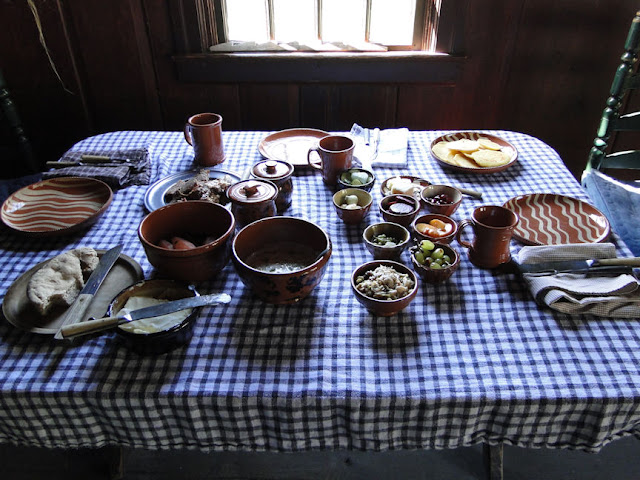 |
| A colonial feast! |
Now onto the 1860 Susquehanna Plantation:
Oh! The smells that greet you as you walk inside these historic homes!
 |
| The
ladies of the Susquehanna Plantation from 1860, like the ladies of
Daggett a hundred years earlier, cook on the open hearth. Here they |
 |
| The poor Susquehanna ladies are plum tired, and the day is not over yet! |
Next we'll head to the Adams House from the 1870's:
The
Adams home, built around 1840, is one that I have imagined that I would live in had I lived back then. I'm not
sure why, but it just seems to say to me, "Come in. Welcome home!"
 |
| In this woodstove is baking a savory rabbit pie. |
 |
| A table decked out with autumn vegetables, including Heidelberg cabbage |
At the Ford Farm it's 1876...
 |
| ...and
the ladies of the Ford home are quite busy this autumn day preparing
beef hotch-potch, fried cabbage, apple brown betty, and pumpkin fritters |
 |
| Every ingredient was homegrown on their farm, though... |
 |
| ...they
could have gone to their "local" general store (only a few miles walk
from their home!) and purchased whatever they needed. It was cheaper to
grow your own! |
And now we travel a few years into the future, to the farm owned by the Firestones in 1882.
 |
| A beautiful fall setting greets us as we make our way to Firestone Farm. Can you see the farm workers in the field? |
 |
| Besides the macaroni noodles, the ladies of the farm are making baked chicken pie, stuffed squash, and potato bread. |
 |
| Like the Ford Farm, all of their ingredients are homegrown and readily available just by stepping down into the cellar. |
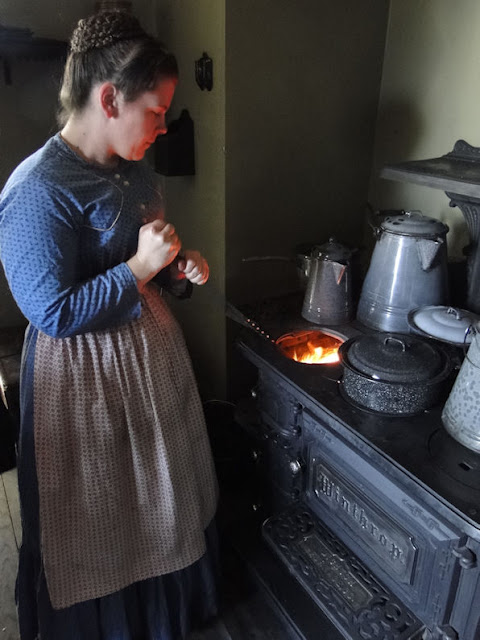 |
| It takes a while and quite a bit of stoking to get the stove at a good baking temperature. |
From 1882 we jump a few decades into the future to the homestead of Thomas Edison's grandparents, set for 1915.
 |
| Early signs of autumn are beginning to show. |
 |
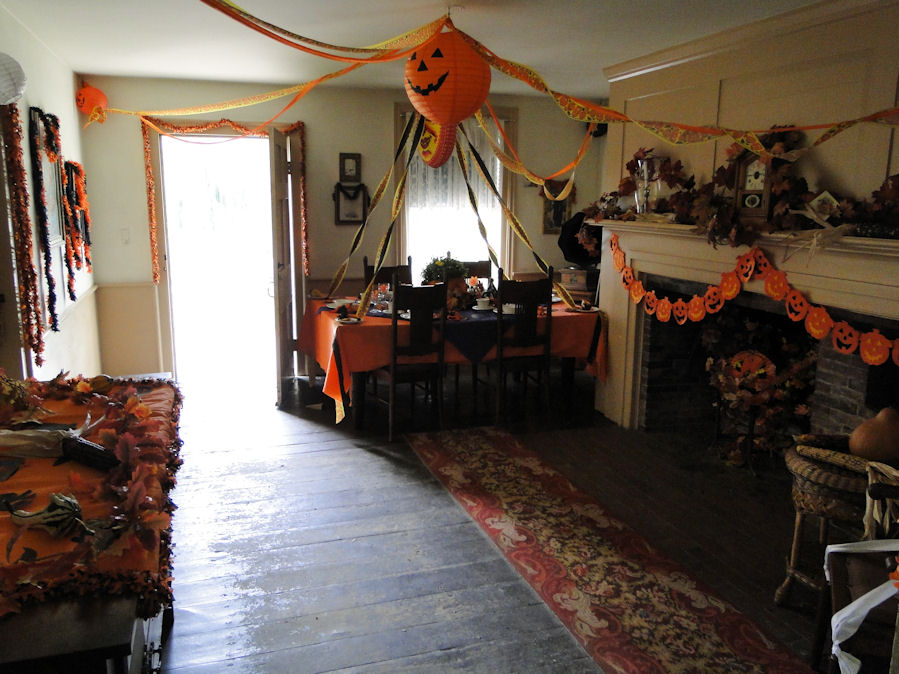
| Yes, Hallowe'en was celebrated quite extravagantly in many houses in 1915. |
 |
| I see a roast chicken, pumpkin pie, and other delectable delights on the thoroughly modern (for 1915) stove |
 |
| A fine fall greeting at the kitchen doorway |
And finally we have the Mattox Home from the 1930's:
 |
| Such a tiny stove for a family, even during the Great Depression. |
 |
| Simmering
pork chops, fried sweet potatoes, baked corn muffins, and spicy
gingerbread is what the lady of the house has planned for her family. |
As you can see the houses are showing the different
styles and foodstuffs from their original region and era in history.
Seeing just how the food would have been cooked during the year
represented, whether it be the era of the hearth or of the wood
cookstove. What was pretty neat was the visitors could pick up a recipe
card of what was being cooked at each home.
The Firestone Farm
also had a threshing machine from 1904 that was in fine working order,
showing the many visitors how it could separate the grain from the
stalks. Something I did not know until the day we visited (September 29)
was that it was rare for a farmer to own his own threshing machine, for
it was much too expensive. However, many times local farmers who lived
near each other would pool their money and "rent" the machine by having
its owner take it from farm to farm to have their grain threshed.
 |
| The
1904 threshing machine in action. Can you imagine how thrilled farmers
were to have such a machine do this back-breaking labor for them? . |
Throughout the farm acreage the
visitors could watch and question the men of Firestone Farm, who were
busy working in the fields, gathering stalks, harvesting vegetables, and
"winterizing" the land.
Fascinating.

By
the way, normally we are able to learn about and even taste the
heirloom apples growing in the Firestone orchards, brands such as Rambo,
Baldwin, Belmont, Roxbury Russet, and Hubbardston
Nonesuch can normally be found there, all having different
characteristics, flavors, and ultimately were used in different ways,
either for sale, or for the family’s own use. Unfortunately, we here
in Michigan had quite an unusual spring in 2012 with a week-long string
of 70 and 80 degree temperatures in mid-March when it should have still
been in the 30's and 40's, and then suddenly dropping down into the 20's
and 30's. That sealed the fate of our fall apple season, including the
heirloom apples at the Village.
Ah well, nature has its own ways, doesn't it?

Another
neat thing that Greenfield Village had was a farmer's market, a place
where one could purchase nearly anything MADE or GROWN IN MICHIGAN from
vegetables to maple syrup to broomsticks to homemade soap to honey to
fruit not affected by the spring weather to ground flour to pumpkins,
gourds, & squash to, well, you name it.
 |
| This young lady makes and sells her own soap |
This year it seems that Greenfield Village is getting so much closer to its now long-defunct Fall
Harvest Weekend
from the 1990's where, besides what I mentioned above, they used to also show
the process of winnowing, giving hay rides, live old-time music from a
string band, cider & doughnuts, and the procedure of 19th
century corn shucking. I certainly hope they do bring some of this back, for I would gladly
forgo the overly expensive cider mill and its animated hillbilly bears
and haunted houses to visit a real authentic harvest weekend.
 |
| A broom maker's wares at the farmer's market |
Spending an autumn day at Greenfield Village is
something almost magical...and definitely nostalgic to me for times gone
by - even if those times are from long before I was born.
If you would like to read more about how harvest time was celebrated in the 18th and 19th centuries please click
HERE.
.