Thursday, June 1, 2023

Historic Buildings Brought To Life: The Loranger Gristmill

As I drive down the busy thoroughfare of Gratiot Avenue or any of our  "main drags"  here in metro-Detroit,  I quite often think of how it once looked 150+ years ago---what type of businesses were here...and also imagining the surrounding farmland.  Because of my research,  including local research,  I do have a very fair idea of the lay of the land as it looked in centuries past,  so knowing about the differing occupations,  I can almost  "see"  the past  (and my  "Images of America"  books certainly help!).
Gotta love the research!
Like the Eagle Tavern,  I had written about the Loranger Gristmill of Monroe, Michigan numerous times before,  but it was always in a posting either with other mills or about its importance during the fall harvest.  Well,  like  "The Eagle,"  the Loranger Gristmill deserves its own post as well.
And here  'tis!

...............................

So,  we were driving along Telegraph Road in Monroe,  Michigan,  and,  as I looked to my right,  through the passenger window,  I said,  "I think that's it."  I turned onto South Stony Creek Road.  I crept the car up and pulled into a parking lot of a business that didn't seem to be too busy.  My friend was with me and we both exited my vehicle.  I said,  "Over there is where it used to be."  and we crossed South Stony Creek Road.  I could hear the creek running,  and soon I could see it.  Then,  through information given to me by a friend who has worked at Greenfield Village for close to 40 years,  I stepped up to the old bridge there,  and I glanced again at that information written on a piece of paper:  You can see the old bridge to the West of Telegraph.  They moved the Gristmill because that bridge was being built.  
We're here!
This is the very spot that the Loranger Gristmill once stood before Henry Ford had it brought over to his Greenfield Village!
Where you see this bridge over Stoney Creek,  all covered in leaves and a bit of snow,  is the original location of the Loranger Gristmill that Edward Loranger built in 1832 and is now inside the brick walls of Greenfield Village.
Edward Loranger was born in Three Rivers,  Quebec,  in 1796.  A brick mason,  he moved to Frenchtown in the territory of Michigan in 1816  to help build a church  (Frenchtown became Monroe in 1817,  named after the then current President,  James Monroe).
Loranger remained in the Michigan territory and,  in 1822,  purchased the land on which his house is still located.  He became one of the most prominent landowners and architects in early Monroe,  and constructed many buildings in the area,  including houses and stores.  He built his own house in 1826,  which still stands in its original spot.
On the left we have the house that Mr.  Loranger built in 1826.  Directly across the street,  where you see that little patch of snow on the right,  was where he built his gristmill...
The house fell into disrepair over the years but was restored in 1941.  It was during this restoration that the dormers were added to the roof.  The house remains privately owned.
Here is the restored 1832 Loranger Gristmill as it now sits inside Greenfield Village.
So,  just what is a gristmill?
It is usually a fairly large building in which grain would be ground into flour used for baking bread and cakes and the like.  There were two types of flour-making mills:  a gristmill was a mill used exclusively for grinding grain for local consumption,  while a merchant mill was a mill in which flour was ground and packed for sale.
We'll concentrate mainly on gristmills rather than merchant mills for today's post,  since that was what the Loranger Gristmill was.
From colonial times and into the first half of the nineteenth century,  gristmills flourished in America by meeting an important local need in agricultural communities:  grinding the farmers'  grain into flour.  
What do you see when you look upon this field of wheat?
I see bread,  cakes,  pie crusts...
There are records of gristmills dating back to the 17th and 18th centuries here in North America,  though not all people used them.  
Here is an ancient hand mill or quern stone, 
grinding the grain by hand into flour.

(Pic courtesy of Getty Images)
Even with the availability of gristmills,  there were many farmers who would take to the grinding of grain into flour by hand by using a hand quern,  which would have been used when no other means of grinding wheat into flour was available.  The quern,  a tool from the iron age,  was like a mini-gristmill and might be used when one moved into a new settlement where no gristmill had been built yet.  Of course,  the manner of using a quern was not only a tedious task,  but it took an excessive amount of time to get enough flour worth baking.
So if one settled where there was a gristmill somewhat in the general vicinity,  (even within a day's journey),  it was a welcome sight.

Shortly we will get into the inner workings of the mill,  but before that...without growing and preparing the wheat,  there would be no reason to even visit the miller,  unless it was a merchant miller.
The farmer would grow the wheat,  and from the time of the earliest agriculture up until well into the 19th century  (and even into the 20th century),  cutting down the wheat was done by hand,  most often with a scythe:
The use of a scythe is traditionally called mowing,  but now it is often called scything to distinguish it from machine mowing. 
According to the Colonial Williamsburg Foundation,  wheat was harvested by cutting the straw near the ground with a hooked hand  “sickle”  or  “reaphook;”  or mown with a  “cradle scythe.”  The cut wheat was gathered in bundles and tied into  “sheaves.”  Sheaves were then stacked upright into small stands called  “shocks.”  These temporary stacks were soon transferred out of the field to larger outdoor stacks,  or housed if possible,  to await threshing.  Threshing is the way to knock the wheat kernels off of the rest of  the plant...
That was then:  threshing with a flail~
A flail is an agricultural tool that was used to thresh the wheat,  separating the grains from the husks manually,  which needed strong arms and backs and persistence.  The flail was the way it was done until threshing machines took over in the later 19th century.
Threshing was conducted by beating the wheat heads,  thereby separating the wheat berries from their  “chaff”  (or husk)  and supporting straw.  To flail,  one stick is held and swung,  causing the other to strike a pile of grain,  loosening the husks.  Cleaning the wheat commenced with removal of the long straw.  This process could occur throughout the late summer,  fall,  and winter months.
But the times they would soon be a-changing,  for by the mid-19th century there were threshing machines.
A  'modern'  late 19th-century threshing machine...

~Winnowing Basket~
To catch the grain.
Once the wheat was threshed,  the remaining wheat,  chaff,  and dust mix were put into a basket and tossed up into the air where the wind would catch the husks and blow them away,  leaving cleaned grain behind to fall back into the basket.  This process was known as winnowing. 
Winnowing also separated weevils or other pests stored in the grain.  The cleaned wheat was stored in a granary and then taken to a local mill.
Fortunately,  most settlements had a gristmill not too distant away.
It was the water-powered gristmills housed in great two or three story structures situated near a stream that tended to be the most popular means of making flour from the wheat.  And it's the water-wheel mill that this post concentrates on.
Folks would haul their yield miles to go to the nearest water wheel mill,  sometimes taking a day or more for travel time.  But their return - flour for baking - could carry them over for months as bread,  pie crusts,  cakes,  biscuits,  and so on.
My horse and cart hold the bags of grain as I move up to the 
Loranger Gristmill to work out the cost of having my wheat ground.
However,  my manner of colonial dress would have been considered quite old-fashioned by 1832,  when Edward Loranger built this mill.  

As described by David Larkin in the book,  Mill:
(The miller)  knew the intricacies of the mill and carried repairs when needed,  if necessary remaking parts himself;  he was a good judge of  the density and content of the grain,  which varied with a wet or dry harvest and the skill used in threshing and winnowing,  and had many opportunities for sharp practice.  He would run through a sample with his finger and thumb,  calculate its value,  and made his wealth that way.
Click to enlarge the drawing,
which points out the parts of a mill.
There are no quick starts or stops in an old mill.  In starting the mill,  usually with a wooden lever,  water would be released gradually until the wheel,  which runs the entire mill,  was running at the desired speed.  In doing this,  the entire building would shudder,  for each part of the mechanism would begin to do its job,  including the spiked wooden wheels inside the mill,  which were made of oak mesh and the spiked teeth made of apple or hickory wood,  which controlled the rest of the mechanism.
The sacks of grain to be ground had to be taken up to the third floor of the mill where it will be emptied into the grain storage bin.  On the second floor is where the miller will ensure the grain is sliding down the chute to the hopper,  which has a funnel-like appearance.  Its flow is controlled by an angled wooden shoe and by the action of the dansil,  most often called the damsel,  a device attached atop the spindle that taps the shoe and will shake an even amount into the millstones at every revolution.  On the first floor,  the hopper disperses the grain to two large burr stones assembled from hard granite.  The capstone,  which is movable,  revolves barely above the lower stone,  which remains stationary.  It is this lower stone which has furrows carefully carved into it to help guide the flour to the waiting bins ready to be sacked for the customer.
The Sluice is like a trough on the side of the building, which takes its water from the mill pond and stores it until the lever to begin the milling procedure is pulled.  I was at a working gristmill in another location,  and the entire building truly did shake as the water power from the sluice turned the large stone wheels used for grinding.  (Unfortunately,  since that visit,  they changed it over from sluice and water power to,  instead,  flipping a switch for electric power,  which changed the entire dynamics.  It was no longer the same,  which is a great shame) 
You can make out the sluice in this photograph.

The turning wheels could grind one barrel of flour  (whole wheat or buckwheat)  or corn meal an hour.  
You can easily see the furrows in the Loranger grindstones.

The Loranger  "hopper,"  from which the grain slides down into from the chute,  has a funnel-like appearance.  The hopper disperses the grain to the stones to be ground and emptied out into the flour bin, ready to be sacked for the customer,  which would help to sustain them for months to come.

So now let's learn a little on this particular historical building of which played its own part in the building of America:  
This mill was constructed by Edward Loranger,  a brick mason from Quebec,  who originally came down to the southeast corner of Michigan to help erect a church.  Loranger stayed on in the new country,  feeling the new settlement needed a grist and saw mill  (of which he also built).  Loranger himself hewed oak timbers for beams,  he cut whitewood siding with a broad axe,  and cut logs for a dam in the river to impound the water for power to turn the wheels.  And he worked the mill as described above,  staying long hours in the autumn days as the main harvest came in.  Loranger also would run his saw mill as needed,  so I would imagine he employed numerous locals to help him out.
According to The History of Monroe County Michigan,  Edward Loranger was very popular and well-respected by all who knew him.
Loranger died in 1887.
Henry Ford purchased the 1832 Loranger Gristmill,  located on Sunny Creek near
Monroe,  Michigan,  in January of 1928.  It was one of the few structures moved to
his newly created Greenfield Village in Dearborn,  Michigan without prior disassembly.
After Greenfield Village opened to the general public in 1933,  the interest and activity around the Loranger Gristmill grew as the sights and sounds of the spinning,  grinding wheels gave the public a first-hand glimpse of an earlier age.  
The mill sits now as a museum piece:  the grinding wheels are there,  but they no longer grind;  the water wheel spins,  but just for show;  the store no longer sells the flour or corn meal once ground here at the gristmill as it once did when Greenfield Village was new.
But,  visiting the mill in person,  if the opportunity arises,  is a good way to help keep,  at least,  the vision alive,  for all of the inner workings are still there,  and are also here through words and photographs.
By 1832 his mill was up and running,  sitting on the Stoney Creek near US 24 
(Telegraph Rd),  looking much as we can see in this photo.
It is one of my favorite structures inside Greenfield Village - that old Loranger Gristmill we've been talking about,  now nearly 200 years old.
What Edward Loranger erected on that original site was a true necessity for the surrounding community,  and was popular until the modern age took over,  and the electric and much faster mills took precedence and left these old mills in the dust,  so to speak.   Modern mills typically use electricity or fossil fuels to spin the heavy steel,  cast iron,  serrated,  and flat rollers.  Stone-ground flour,  however,  is still preferred by many bakers and natural food advocates because of its texture,  nutty flavor,  and the belief that it is nutritionally superior and has a better baking quality than the modern steel-roller-milled flour.
I wonder if my grain has been processed yet...?
You can imagine that I was pretty ecstatic to find,  on that late winter day in 2022,  the very location where the Loranger Gristmill was originally built.  And I laughed at myself knowing that I passed that very spot numerous times before without realizing!  But when I learned the original location,  I made sure to make a point to visit;  there's just something special when one walks on such  "hallowed"  ground.
Here is an actual photograph taken at the turn of the 20th century,  and in it we can
see the Loranger Gristmill there 
on the left in its original location.

In this photo I am standing where the gristmill once stood and looking toward the
Loranger House,  where the miller,  Edward Loranger,  lived.
The Loranger Gristmill is a wonderfully important piece of our past,  showing a slice of  Michigan's 19th century history of which most modern folks hardly ever give a second thought.
My own recreation of the Loranger Gristmill in its original location
using a little computer magic.

~

Greenfield Village is Americana past at its finest.  Of all the historic structures placed inside that long serpentine wall,  only two building did not originate in this country:  The Edison Homestead  (belonged to the Canadian grandparents of  Thomas Edison),  and the Cotswold Cottage collection - cottage,  dovecote,  and forge  (all of  which came from England).  Otherwise you are strolling through over 400 years of American history.  The oldest American structure is the Plympton House,  built in Massachusetts in the early 1700s.  The Mattox House is presented as it was in the 1930s,  so its presentation is the newest at this time.
And then there's everything in between,  from farming to city life,  from the unknowns to the well-knowns,  from artisans to store owners...Greenfield Village is truly a magical place representing our great American history.

Until next time,  see you in time.


To read about the structures I've located from before Michigan became a state,  please click HERE
To read on other Greenfield Village homes and structures I researched,  please click the following links:

Ackley Covered Bridge 1832
At one time, covered bridges were commonplace. Not so much anymore. But Greenfield Village has one from 1832.

Daggett House  (part one)
Learn about the 18th century house and the family who lived there.

Daggett House  (part two)
This concentrates more on the everyday life of the 18th century Daggett family,  including ledger entries.

Doc Howard's Office - The World of a 19th century Doctor
It's 1850 and you're sick.  Who are you going to call on?  Why,  good ol'  Doc Howard,  of course!

Taverns were the heart and soul and pipeline of early America.  The Eagle Tavern,  built in 1831,  is one of the most famous of its time on Old US 12,  and still is today at Greenfield Village.
Here's why.

~Edison Posts:
Tales of Everyday Life in Menlo Park (or Francis Jehl: A Young Boy's Experience Working at Menlo Park)
Menlo Park is brought to life by one who was there. First-hand accounts.

Follow the route that Thomas Edison took as he rode and worked on the rails in the early 1860s,  including the Smiths Creek Depot.
 
The oldest windmill on Cape Cod is not on cape Cod - - it's in Michigan!
Lots of interesting things about this wonderful piece of Americana from 1633.

Firestone Farm at Greenfield Village
Learn about the boyhood home of Harvey Firestone, the tire magnate.

The Giddings House
Revolutionary War and possible George Washington ties are within the hallowed walls of this beautiful stately colonial home.

Recreating this store to its 1880s appearance was extremely important as the overall goal,  and so accurately reproduced items were needed to accomplish the end result,  for many original objects were rare or too fragile,  with some being in too poor condition.  

Research has shown that,  as a young attorney,  Abraham Lincoln once practiced law in this walnut clapboard building.  I think this post will make you realize just how close to history you actually are when you step inside.

Built in the late 18th century,  with some slight modifications from its original style,  this is one of the oldest original American log cabins still in existence.  

Mills  
General overview.
These buildings were once a part of everyday life in American villages and towns and cities - including the Gunsolly Carding Mill,  the Loranger Gristmill,  Farris Windmill,  Hanks Silk Mill,  Cider Mill,  and the Spofford and the Tripps Saw Mills,  all in one post!

Noah Webster House
A quick overview of the life of this fascinating but forgotten Founding Father whose home, which was nearly razed for a parking lot, is now located in Greenfield Village.

The Plympton House
This house,  with its long history  (including American Indians)  has close ties to Paul Revere himself!

Preserving History
Henry Ford did more for preserving everyday life of the 18th and 19th centuries than anyone else! Here's proof.

Richart Carriage Shop
This building was much more than a carriage shop in the 19th century!

And for some haunted fun, 
Ghosts of Greenfield Village
Yep - real hauntings take place in this historic Village.

Yes,  some of the structures that now sit inside Greenfield Village have connections to America's fight for Independence.

Virtually each structure inside Greenfield Village has come from another location,  I took on a project to seek out the original locations of many of the more localized buildings and visited where they first were built and walked that hallowed ground.

Homes that played a role in our country's fight for Independence.

This post is part history and part family history:  a blending of the two.  And one way to show how you can place your ancestors in their time.

Saving Americana - that's what Henry Ford did - and in doing so he showed everyone the importance of  everyday life history.  This is how it all began.   

Nothing is placed randomly inside the structures at Greenfield Village.  The curators carefully consider each and every object before allowing it to become part of the site. 
And the Clothing Studio at The Henry Ford covers over 250 years of fashion  (from 1760 onward)  and is the  premier museum costume shop in the country.

Pictures with circles and arrows and a paragraph under each one  (lol).
My most popular posting ever!


~   ~   ~

Wednesday, May 24, 2023

1773 Gardening at Waterloo Farm

Do you think you could live  "back then"?  
Lots of people believe they could,  but I know for a fact it would be extremely difficult for most modern persons to attempt to survive in the past.
~~~
Here are photos and commentary on the 18th century gardening that my wife Patty and I did at the cabin located at Waterloo Farm.

..................................................


For this we have a sort of  "part 2"  of  the posting immediately previous to this one  (click HERE if that will help),  for you will see us at the frontier cabin doing spring chores,  including planting.  Unfortunately,  we don't really live at the cabin and therefore are not there daily to ensure all the work that needs doing gets done!  So here we are a week later,  my wife Patty & I,  back at the Waterloo cabin,  completing what was not able to get completed the previous week!
This posting fits in with ancient farming,  for pretty much the same tools and techniques are being utilized.
Back to 1773 we go - - - - - - - - - - - - - 
My hay rake  (which I also use in the garden)  and my regular
wood rake,  which does a very good job in clearing & cleaning
up the garden bed.

Here's Patty and I doing a sort of imitation of American Gothic.
Yes,  we plan to dress in our period clothing anytime we go out to work in this garden.
  For the first time,  I am wearing and working in my new farmer's linen work smock
I purchased from Townsends.
But,  to me it just keeps the whole thing period authentic.
Yes,  I suppose I am a bit off center!  lol

The wood bucket and the water jug are ready to go.

Patty & Charlotte did a fine job planting the week before.
But there was a couple patches they were not able to get to.

The work smock I am wearing is an oversized heavy natural linen outer shirt often worn by the 18th century workmen,  farmers,  hunters,  etc.,  as an outer garment to cover and protect clothing from being soiled while working.
Friends,  I gotta tell you,  I have back problems,  including  (but not limited to)  sciatica. 
It isn't fun.
In fact,  it is extremely painful.
Unfortunately,  I could not do nearly as much work as I would've liked to. 
I did,  however,  surprise myself at what I was able to accomplish.
I did prepare about a third of the garden patch in total,  including
raking and hoeing,  and then I did some sowing  (beans!) as I continued
getting rid of  hiding clumps of rooted grass and weeds as I dropped
the seeds into the holes.
Not bad for being in pain,  eh?

When Patty and I first began to date,  way back in 1982,  we spoke on gardening, 
on farming,  on how people lived in the old days,  and how we would had loved to live 
"back then."  Well,  in a way,  this is that dream come true - with 
(hopefully)  more to come.

Meanwhile,  Patty sowed a variety of items,  adding to what was
already planted there the week before.

Besides the beans,  we have beets,  onions,  squash,  beans, 
cucumbers,  turnips,  carrots,  and even a few pumpkins.

Patty using the replicated 18th century watering jug for watering the seeds.  They've
been using this watering jug for years at the Daggett House at Greenfield Village. 
I then saw one very similar to what I have here being used on one of the British-made
farm documentaries - either Tudor Farm or Tales From the Green Valley  (1620)  farm. 
So...I had to have one as well! 
God willing,  we shall have a fine harvest in 70 to 90 or so days.
And there are a few that will be ready come fall.
 

You'll note my  "broken in"  smock.
Kneeling in the dirt to sow.
My wife's apron,  which was also worn,  in part,  to keep her skirt clean,
has seen cleaner days as well.
Patty & I plan to try to come out two to three times a month on our own to
weed and to make sure all is well.  My wife has been getting into gardening
big time this year and can't seem to get enough. 
She certainly does have a green thumb!

Because of my ache-r  (back)  I did go inside the cabin for
a short while to get off my feet to let the nerves in my back relax.
I've often wondered:  had I actually been living as a farmer back in 1773,  and being the age I am now  (retirement age - you  guess what that is!),  would I had still been active in the garden and in the fields?  My grandpa,  born in 1895,  was a farmer - he was an extremely strong man - and he maintained large gardens  (yes,  plural) - some which were larger than our pretty big Waterloo patch until the day he died at age 76.  He was able to get on his hands and knees,  digging and planting with his hands.  He was able to till the soil on his own with a shovel and rake.  And he weeded daily.
He also reaped the harvest,  and as his grandson,  so did I...when I was younger...
But now?
Back problems.
When I was a school custodian back in the day,  I did a lot of moving,  lifting,  shifting,  carrying,  and all other custodial matters,  sometimes on a daily basis!  I'm sure that was where the root of my back issues began.  Yes,  I go to physical therapy.  Yes,  I've been to back doctors  (no thanks - no surgery for me!).  I've even gone to chiropractors  (it's so hard to find a good and trusting one).  And,  yes,  I do the exercises given to me.  I'm managing the best I can. 
As far as gardening goes,  not much has changed from those B.C. and early A.D. eras to the 1770s.  Oh,  things had certainly improved,  but the basics were still the same.  However,  something that I,  as an 18th century farmer/planter should look into:  the seed drill invented by none other than Jethro Tull!  Though it wasn't until the late 18th century and into the 19th century that it's popularity grew,  it was Jethro Tull,  an English agriculturalist,  who is credited with inventing the first practical seed drill back in 1701,  allowing farmers to plant their crop much easier,  more uniform,  and in tighter rows.  
So Mr.  Tull did more than sit on a park bench,  eh?  lol
It wasn't until the later part of the 19th century,  after the industrial revolution showed its might,  that the real noticeable changes in farming came about.  For instance,  the reaper:  for several centuries,  small grains were harvested by hand.  But with improvements on the reaper it increased food production as well as made harvesting easier.  Farmers could now process more wheat much quicker and with less labor force.
That was then---this is now~
Me in my 1860s clothing with my flail / hand thresher.
I have no idea of the age of the threshing machine 
behind me...and neither did the guy 
who was running it.  Definitely new.
But my hand-thresher - yeah...that's the old way.
Thresher.  At one time,  in order to remove kernels from the straw,  grain had to be spread out on a threshing floor where it was beaten by hand.  In some cases,  animals trampled on the grain to separate it.  The invention of the threshing machine made this process much easier.
However,  not everyone enjoyed its benefits,  for some thought of the threshing machine as  "a lazy man's way to thresh.  Haste makes waste,  but a lazy man'd rather get his work done fast than do it himself.  That machine chews up the straw till it's not fit to feed stock,  and it scatters grain around and wastes it.  All's it saves is time,  and what good is time with nothing to do?"
(From Laura Ingalls Wilder book,  Farmer Boy)
Steam Engine.  The introduction of steam engines improved productivity and technology greatly.
Combine.  Reaping,  threshing,  winnowing – combining all three operations into one led to the invention of the combine harvester,  simply known as the combine.  Considered one of the most important inventions in agriculture,  the combine significantly reduced manpower and sped up the harvesting process.
Tractor.  The general-purpose tractor proved to be an excellent replacement for the horse in plowing, soil preparation, planting, and cultivating tasks for a wide variety of field crops. In addition, the tractor was fully capable of providing power for mowing hay and for harvesting of wheat and other small grains.
Hydraulics - moving water through pipes and channels,  especially as a source of mechanical force or control..  Hydraulic systems made agricultural production faster and more efficient,  while reducing labor costs. 

Your farming family plus the preacher.
Farming has changed far more over the last 150 to 175 years than since the beginning of agriculture revolution around 10,000 to 12,000 years before.  But it's still the same job...only there's machines doing it now.
As far as what our colonial group - Citizens of the American Colonies - are doing:  we are making as gallant an attempt to show daily life  (and to some extent,  live the life)  in the same manner as was done 250 years ago.  We work.  We get dirty.  No fancy silks or fear of stains for us,  for we are wearing work clothing.  That's why I also purchased a linen work smock - to help keep my clothing in better condition,  just as a farmer would have done back in the 18th century.  But that's why I wear work clothes when I head out to the cabin,  with no fear of getting them dirty.  And that's why I purchased work clothes for my wife.  In fact,  all of us wear our work clothes when we are at the cabin.  
A real quick aside here:
I purchased the clothing you see my wife in  (blue skirt)  during the covid break,  and she was,  like,  "okay" - with no excitement in her tone,  wondering why I spent the money in this manner,  for she was finding herself less and less enchanted with living history.  But since we've gotten into this whole period gardening/farming thing,  she has thoroughly enjoyed it and has thanked me more than once for purchasing the garments for her.
I love it!
I also love that they are historically accurate!  Thank you Samson Historical!
We're often asked where we get our historic clothing from,  and,  though many of our garments are made by those who can sew or those who can afford a seamstress or tailor,  there are a few sutlers where we can purchase what's known as  "off-the-rack"  clothes.  There are two in particular used most often from our members  (including my wife's clothes and my smock),  and they would be Samson Historical and Townsends,  both are highly recommended for purchasing your ready-made items.  Plus both have hats,  shoes,  and  "home"  accessories,  including plates,  bowls,  silverware,  lighting accessories, and so on.
Now,  if you prefer to sew your own attire,  check out Wm.  Booth Draper,  as well as Smoke & Fire.
...last week.
I can recommend each of the four listed here highly.

This week and...
It is our plan,  Patty & I,  to head out to the cabin and the garden two to three times per month,  mostly for weeding.  We live quite the distance away and it is a 90 minute drive one way,  so we are unable to get out much more than that.  If things work right,  we should have a decent summer harvest in late July or early August - perhaps in time for Lammas Day!

Until next time,  see you in time!


To read more about farming and tools,  click HERE
To read more about A Year on a Colonial Farm,  click HERE
To read more about our own living history 19th century harvest,  click HERE
To read more about our own living history 18th century harvest,  click HERE 
To read more about the Time-Life books I mentioned,  click HERE
To read an interesting and biblical take on history,  please read Discoveries and Inventions: A Biblical History of Man's Developments from Ancient Times

Period Clothing and accessories:
Samson Historical 
and


                                                                                                                 ~   ~
~   ~   ~

Monday, May 15, 2023

Experiencing Our Research - Spring Cabin 1773: Rogation Sunday

We portray a frontier farm family,  so therefore we deal a lot with planting crops.
Unfortunately,  we don't have the space  (nor the time)  to run a farm,  though that would be about as wonderful as it could get.  But the patch of ground given to us to plant whatever we like is such a gift.  
Even though we all live quite a ways away from Waterloo,  Patty and I hope to make numerous treks out there to weed and water as best we can.
In period clothing.
Remember:  as soon as you start to think of the past as happening  (as opposed to it having happened),  a new way of conceiving history becomes possible.
Here we conceive spring 1773~
.     .     .

The Colonial Crew are at it again - 
this time we're in Spring 1773!
Since this wonderful historic cabin experience began back in the fall of 2020  (1770 for us),  we have enjoyed twelve 18th century outings,  including this one I am writing about today.  That's twelve times we've been blessed to have such time-travel experiences - each one different but historically accurate - at least,  as much as we are able to.  No,  we do not do first person,  though we do our best to be immersive.  In other words,  we try not to bring up modern talk or issues such as social matters,  current politics,  or pretty much any technology beyond what we would have had before 1800.  We don't  "act 18th century"  necessarily,  for that would be...um...acting  and we'd probably come off as too dramatic.  Too Hollywood.  No,  we're not that at all - we are simply ourselves.  
And our conversations reflect that,  for we do speak of  current events as we know them to be in the early 1770s,  oftentimes eking up to the coming war.  For instance,  Jackie,  ever the woman to keep her ear to the ground,  brought up The Tea Act,  passed by Parliament on May 10,  1773, which granted the British East India Company Tea a monopoly on tea sales in the American colonies.
Now,  being that we were at the cabin on May 13,  the chances of us even being aware of such an act was pretty much nil,  but for discussion's sake with many of the patrons  (and historical purposes),  it was brought up.  We had concerns of what such an act might do - the anger it might stir up in Boston - and were thankful we moved out to the frontier.  We even brought up the future for a few visitors and mentioned the Boston Tea Party that would occur in the coming December.
This was done for a historical timeframe more than anything else.
But mostly we kept our conversations centered on the day and our activities and sharing our knowledge of the period with each other and with the visiting public.
The patrons truly seemed to be excited to be among the founding generation. 
We do look a bit like frontier colonials,  don't we?
We are not fancy,  silk wearing folk,  only simple farmers.
We may not be perfect in what we do,  but we do our very best,  and we share information with each other...I mean,  each of us has a historical library in our heads,  though oftentimes different chapters of the same book,  and therefore we are able to share and teach of the different bits of knowledge we have.  And we so enjoy it.
So on this fine mid-May day,  planting crops was first and foremost on our minds.
Charlotte made her way first to where the garden will be with a pot of ash to spread. 
Wood ash contains nutrients that can be beneficial for plant growth,  for using wood ash in gardens can increase soil fertility.  In fact,  North America exported wood ash to Britain in the 18th century as a fertilizer.
Our ancestors were right-smart people!

The wonderful people at Waterloo tilled the soil for us.

Patty & Charlotte spent a chunk of the day planting in our garden.
Yes,  as you may know,  the wonderfully kind folks at Waterloo allow us a plot of land to plant upon,  which we do.  We've planted flax in previous years.  This year we had seeds for onions,  squash,  beans,  cucumbers,  turnips,  and even a few pumpkins.
We hope to enjoy a nice bountiful harvest come fall.

Spreading the ashes...

Patty & Charlotte did most of the planting.
But Patty & I have a few items we plan to plant as well - a few
more crops on our own that did not get done on this day.
But the ladies here did a marvelous job.

A young volunteer brings the water by way of yoke and wood buckets.

Always keep your eyes and ears to the ground,  for you may never know what you might miss:
Fresh Asparagus!!
Asparagus growing in the brush.
Asparagus growing in the rocks!


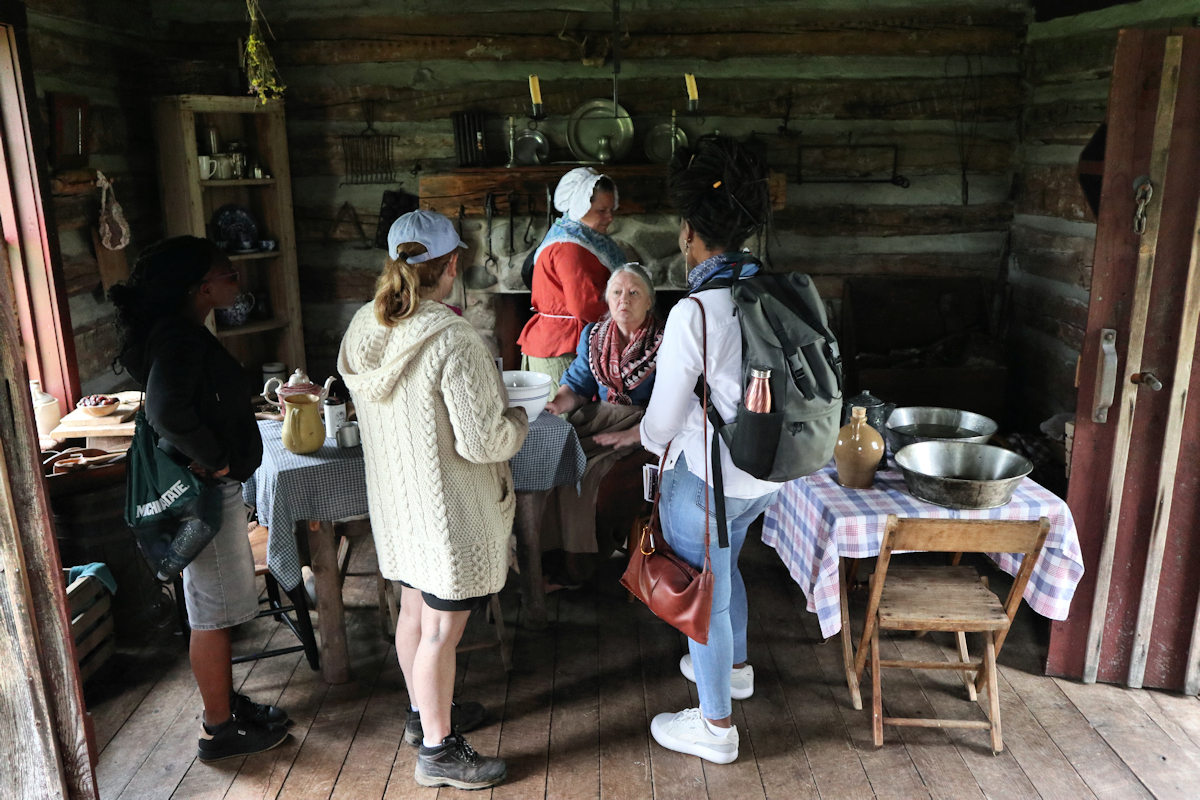
Being that this was Jackson County's  "Free Museum" Day"  where folks can visit any museum countywide for free admission,  we had a good crowd throughout the day,  such as these three ladies,  two of which came all the way from Africa!  They were very interested in the agriculture of the past,  which just happens to be Larissa's specialty,  since she's worked at 1880s Firestone Farm and 1760s Daggett Farm  (both located at Greenfield Village)  for nearly 30 years!
On Free Museum Day,  not everyone who comes out is a history person.  There are those who come because their other  (better?)  half drags them,  maybe kicking and screaming,  for it only costs a little gas and perhaps a donation.  But these non-history people are sometimes my favorite because I consider gaining their interest to be a challenge.  I do believe that what they saw here  (and I'm sure in the 1850s farm house right next to us)  won many over,  at least,  to some extent.

Inside the cabin was a busy place with the ladies preparing our dinner meal.
Jackie brought along her table-top butter churn.  It was perfect for this day,  for we did not need the scads of butter made with the more popular floor churns often seen.  We would have had way too much butter for what we were using it for.  However,  it would be great to use the larger one sometime and actually make cheese as well as butter!
Visitors loved giving the churn a turn,  and Jackie very much encouraged them to give it a try.  I look at it this way:  how often to most people today ever get a chance to churn butter?  What I wouldn't have done back in the day for such an opportunity.

My wife,  Patty,  also helped in the butter department.

Is it butter yet?

Washing your butter:
Yes,  you read this correctly!
To finish the butter,  rinse it under cool water,  gently moving it around the sieve with a mixing spoon.  You're rinsing off the residual buttermilk,  and this is important because the more thoroughly you rinse,  the longer your butter will last.

And into the butter holder it goes,  ready to be spread.
Next up,  our main meal.
Well,  actually,  aside from making butter,  the ladies were also preparing the main meal,  beginning with:
ooooooo-------pork roast!

Pork roast prepared on a reflector oven/tin kitchen!
Ready for the hearth - - - - 

A reflector oven  (sometimes known in older cooking literature as a tin kitchen,  according to the Old Sturbridge Village Cookbook),   is a polished metal container,  often made of tin.  It is designed to enclose an article of food on all but one side,  to cause it to bake by capturing radiant heat from an open fire,  and reflecting the heat towards the food,  avoiding smoke flavoring the food.  In its simplest form,  a reflector oven is simply a box or collar that partially surrounds the food,  with an open side that faces the hearth fire.  In Colonial America this method of baking meat,  fowl,  quick bread,  or pastries,  was a very popular method for hearth cooking.
In our case:  a pork roast!

The pork roast did not take very long to cook with the tin kitchen. 
Quicker than anticipated,  in fact.

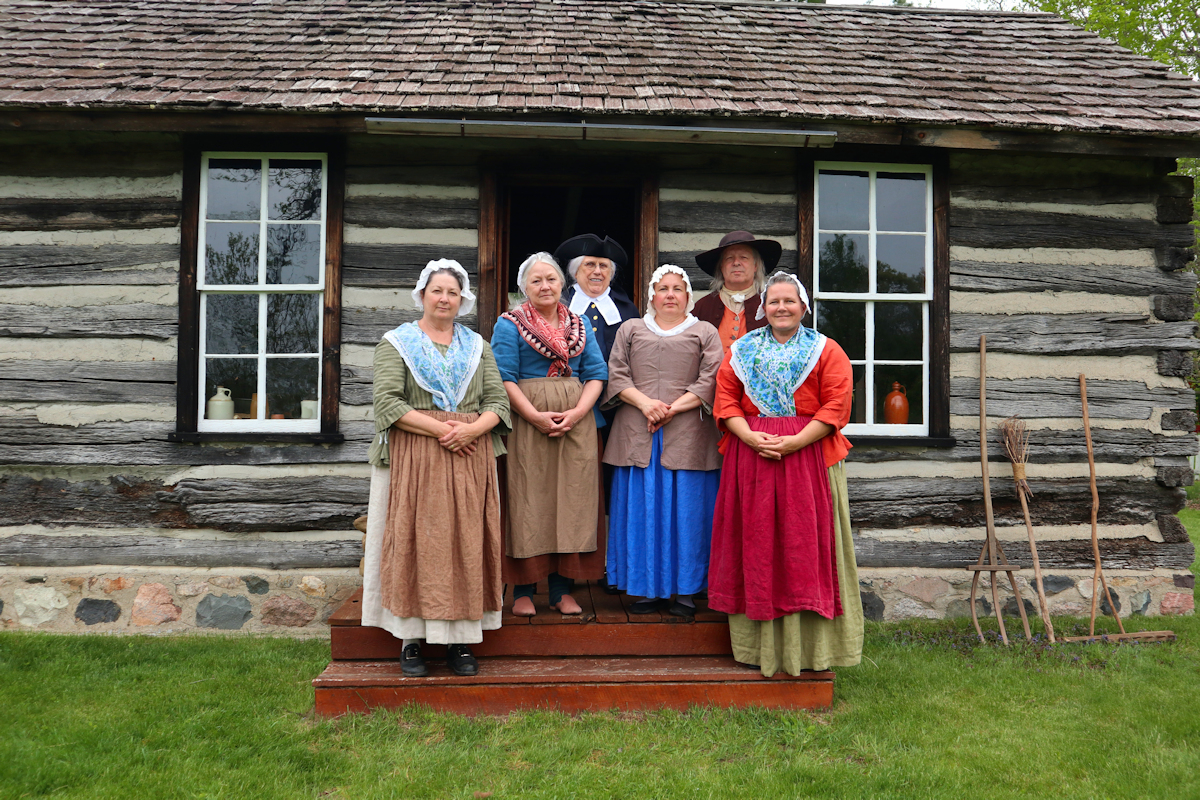
Larissa,  Jackie,  Patty,  and Charlotte~
All contributed to our day and meal in some form or another.
Jackie shows off her  "Egg Pye,"  another 18th century dish.
I asked Jackie how she came up with such an addition to our meal.  She responded with,  "I was reading a post on an Historic Cooking site.  They were talking about making a Hearty Quiche at an event.  I love quiche & wanted to make it at our event.  I mentioned this & someone,  maybe Larissa,  said it wasn’t a thing.  So I started looking up recipes for Colonial quiche.  Egg Pye kept coming up.  I watched some videos & searched egg pie.  You ate the result.  I used Townsends recipe,  using eggs,  cream,  salt,  paprika,  mushrooms,  bacon,  green onions,  and pie crust.  The ratio of cream to eggs is definitely more than scrambled eggs.  I used all of you as my Guinea pigs as usual.  It turned out pretty well  ("Yes it did,"  agrees Ken).  It gave me an opportunity to discuss the whole idea of using seasonal food items and lots of egg dishes at this time of year.  Still wish I could have made a quiche. Quiche actually goes back to the 1500’s in Germany.  (But)  it wasn’t popular here till the 1800’s."
I love being a Guinea pig!  lolol
The visitors who came through,  and there were many,  not only got a basic,  general history lesson of colonial life from me,  but a food history lesson from the ladies.  And  they enjoyed the enticing odors coming from the hearth - quite a few commented on how wonderful the smell was inside our cabin!

And even when there was an opportunity to sit for a few moments,  there were still
other jobs to be done,  including preparing yarn for knitting.

An expected guest knocked upon our door...
the Reverend Gerring.

One of the best images captured this day
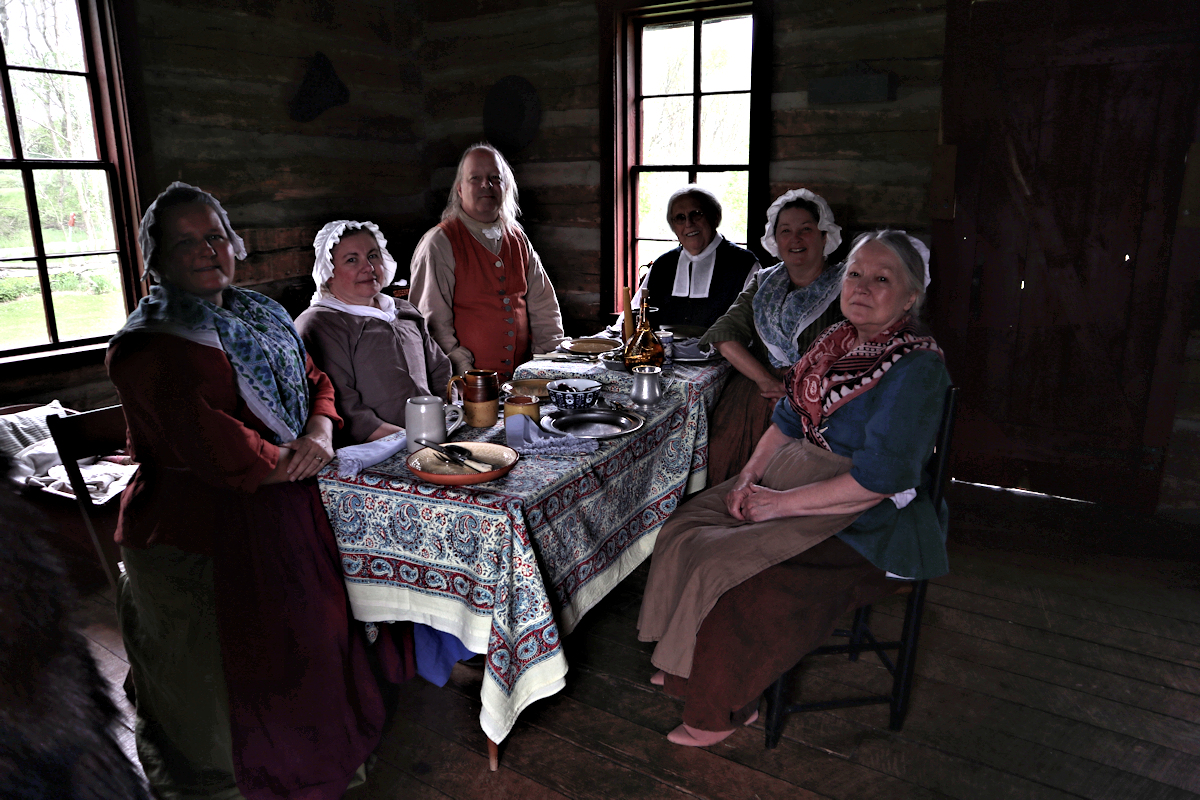
grace before our bountiful spring meal.

And just look at what we ate:
(from upper left):  egg pye,  cheese,  asparagus,  beets 
(not quite in season,  but we love beets!),  pork roast, 
a pickle  (more of a process of food preservation rather
than eating them in the manner we know them to be today), 
and bread with fresh churned butter.  

Our  "Family"  picture - - along with our minister.
Now,  I mentioned that our minister came by expectedly.
Well,  there was a reason for that:
it's Rogation Sunday.
You see,  our springtime in 1773 at the cabin took place on Saturday May 13.  The following day was Sunday May 14 - Rogation Sunday.
In the 18th and into the 19th centuries,  this was the day when farmers looked to their land and crops and prayed for a bountiful harvest.  On this day the clergyman and his flock walked through the village and out into the farm fields to bless the planted ground.
Blessing our crops~
We did not walk through what could be considered a makeshift village there on the Waterloo grounds,  for they had a blacksmith on hand,  a general/souvenir store,  and all kinds of crafters of fiber arts.
Perhaps next year we'll all follow the pastor though the area,  announcing the day.
Rogation is an ancient church festival to seek blessing for a community and its sustenance.  The word rogation comes from the Latin verb rogare,  meaning  "to ask",  which reflects the beseeching of God for protection from calamities.
Pastor Gerring found a prayer for this day and even read it in the old King James language.
This is the blessing that was read~

Another idea would be perhaps to have the blessing as part of the schedule of events
so others can see and learn another part of our history.
I thank Mr.  Gerring for his portrayal as an 18th century minister.  He is a Christian man who has the ministry in his soul,  and one could never tell he was not the  "real deal." 
To us it was real - his portrayal is that good.
In the evening of Rogation Sunday,  farmers and their families walked the boundaries of their property;  it was both inventory and time for giving thanks for their land.  Again,  maybe next year we can do this.
You know,  back in February we celebrated Candlemas,  the day when the blessing of the year’s supply of candles would take place,  and now we celebrated Rogation Sunday on this day at Waterloo  (even though it was Saturday),  where our clergyman blessed our crop.
Sometimes it's these little things - daily life - that can bring the past to life in stronger ways than what we often see.  That's what research can do.

My dear wife and I.
I'm glad she enjoys being a colonial with me.
"Experiencing our research" - I am proud that I came up with that sort of aphorism.  It happened this past winter while Larissa & I were having a discussion about living history,  memories,  and nostalgia while dipping candles at the frontier cabin.  I was attempting to give  "deep thoughts"  on what we -  Larissa,  Charlotte,  and I  (Jackie couldn't make it on that February day)  - were doing out there on our own,  with no modern visitors in attendance  (though we did have a few other living historians visit us that day).  While most in this hobby will only dress for bonafide reenactments,  more often than not,  we four  (and sometimes a couple more)  do this whole cabin scene for ourselves without the public;  in this way we are,  instead,  experiencing our research.  We are such history geeks that this is what we enjoy doing as our hobby and,  sometimes,  as a lifestyle.  And by experiencing our research,  this can only help us to improve our impressions when we do speak to the modern visitors at actual reenactments.  
As far back as I can remember,  the past has enthralled me - I've always wanted to experience life in the colonies  (or in some parts of  the past in general);  I wanted to be there  and explore this foreign time,  with all  five senses,  and the lives of those who lived  "back then."
So,  as far as bringing the past to life,  only by way of living history can one remotely experience a touch of the world of long ago in that manner.  And I have never,  in all my years in this hobby,  truly experienced life in the past as I have at our frontier cabin excursions. 
And when you have such co-living historians as Larissa,  Charlotte,  and Jackie along for the ride  (and more & more Patty),  why...it does not get any better!
Or any more real...
I am so very proud of what we accomplish - on how we experience our research.
This is living history.
So from all of us to all of you,  may you enjoy God's blessings and bounty.
Until next time,  see you in time.

To visit the Waterloo web site,  click HERE

If you are interested in our other cabin excursions,  please click the links below:
To read about our 2020 autumn excursion at the cabin,  click HERE
To read about our 2021 wintertime excursion at the cabin,  click HERE
To read about our 2021 springtime excursion at the cabin,  click HERE
To read about our 2021 summertime excursion at the cabin,  click HERE
To read about our 2021 summer harvesting of the flax at the cabin,  click HERE
To read about our 2021 autumn excursion making candles at the cabin,  click HERE
To read about our 2022 winter excursion at the cabin,  please click HERE
To read about our 2022 spring excursion at the cabin,  please click HERE
To read about our 2022 summer excursion at the cabin,  please click HERE
To read about our 2022 autumn excursion at the cabin  (Pioneer Day),  please click HERE
To read about our 2023 winter excursion at the cabin,  please click HERE

Postscript:
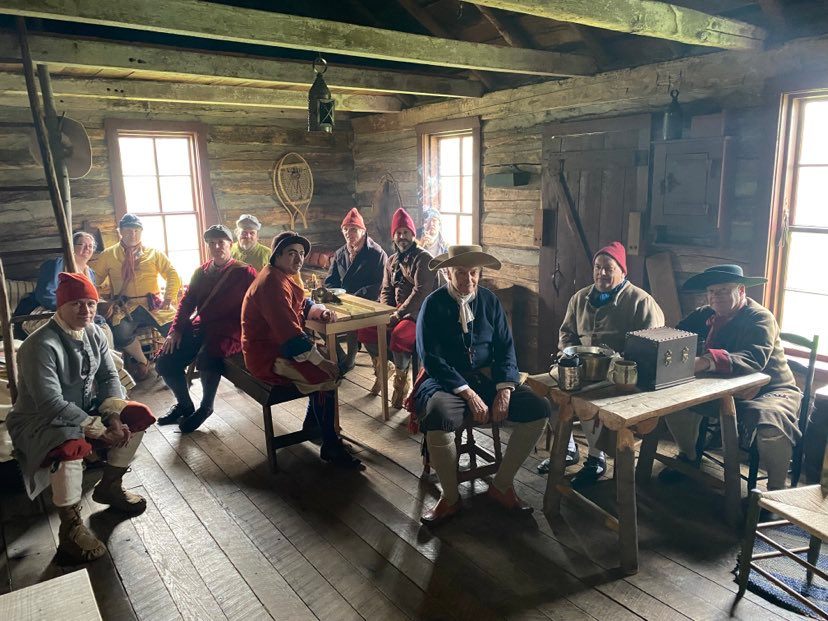
The cabin we use as our colonial frontier home was originally built in a different Michigan location in 1840 and was brought to Waterloo about 50 years ago.  I say this because we let the visitors know we were not from the 1840s but from the 1770s,  and that cabins,  in general,  had not changed very much at all from the 18th century to the 19th century.  In fact,  the President of the Waterloo Historical Society,  Brian Dewey,  reenacts the 17th century.  He recently wrote me:
"(I)  hosted a 1680s event here,  (and)  all the guys do LaSalle time  (René-Robert Cavelier,  Sieur de La Salle).  And since LaSalle camped on the grounds,  this is our holy spot!" 


Looks like they had a great time. 
Gotta love living history!

Thanks must go out to all who took the pictures herein:
Patty,  Larissa,  Brian Dewey  (the 1680 pictures),  Norman Gerring,  and even I took a few!


~   ~   ~