|
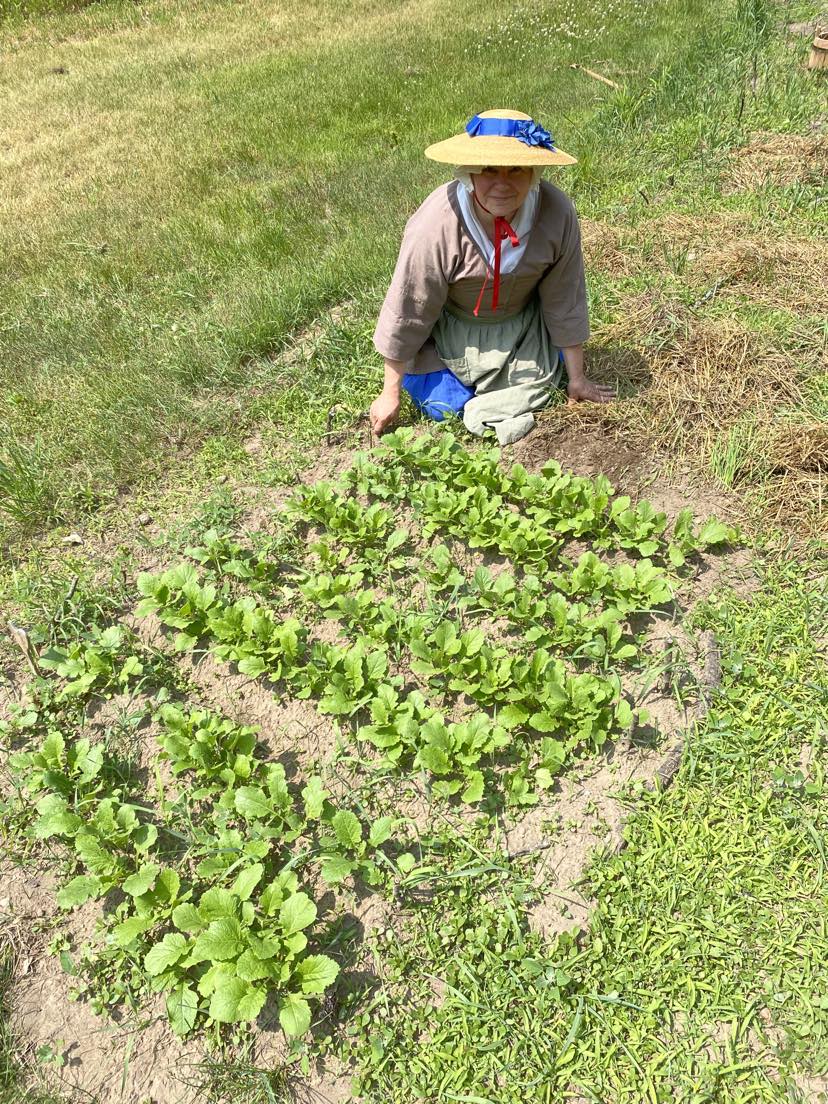
| My Bicentennial shirt |
 |
| My semiquincentennial shirt |
I remember the Bicentennial so well, and I loved every second of that historic year of 1976 when we celebrated, as a Nation, the 200th anniversary of the Declaration of Independence!
Well, the 250th anniversary of the Declaration draws nigh - only three years away as of this writing - and the United States Sestercentennial (as I've known it to be), is now "officially" called the Semiquincentennial (or Quarter Millennial) by Congress, and the objective will be to celebrate and commemorate the 250th anniversary of the Declaration of Independence. And that will take place on Saturday, July 4, 2026. I am already making my own plans for that date, as well as on the 4th of July's leading up to this Semiquincentennial. In fact, since 2012, I have been celebrating Independence Day dressed in my period clothing either at Greenfield Village in Dearborn, Michigan or at Mill Race Village, located in Northville, Michigan, and even other locations here and there, almost always with a few of my living history friends (and sometimes more than just a few), whether Civil War or Revolutionary War era. As long as the weather is with us, I expect the same this year of 2023!
............~~~...........
I very much enjoy spending our Nation's birthday wearing period clothing at Greenfield Village and, in more recent years, at Mill Race Village, for there is a feeling I get when I am dressed of the past, nestled amongst historic buildings, even while throngs of Americans stroll about, smiling, looking & feeling patriotic. I've been celebrating in this manner for over a decade.
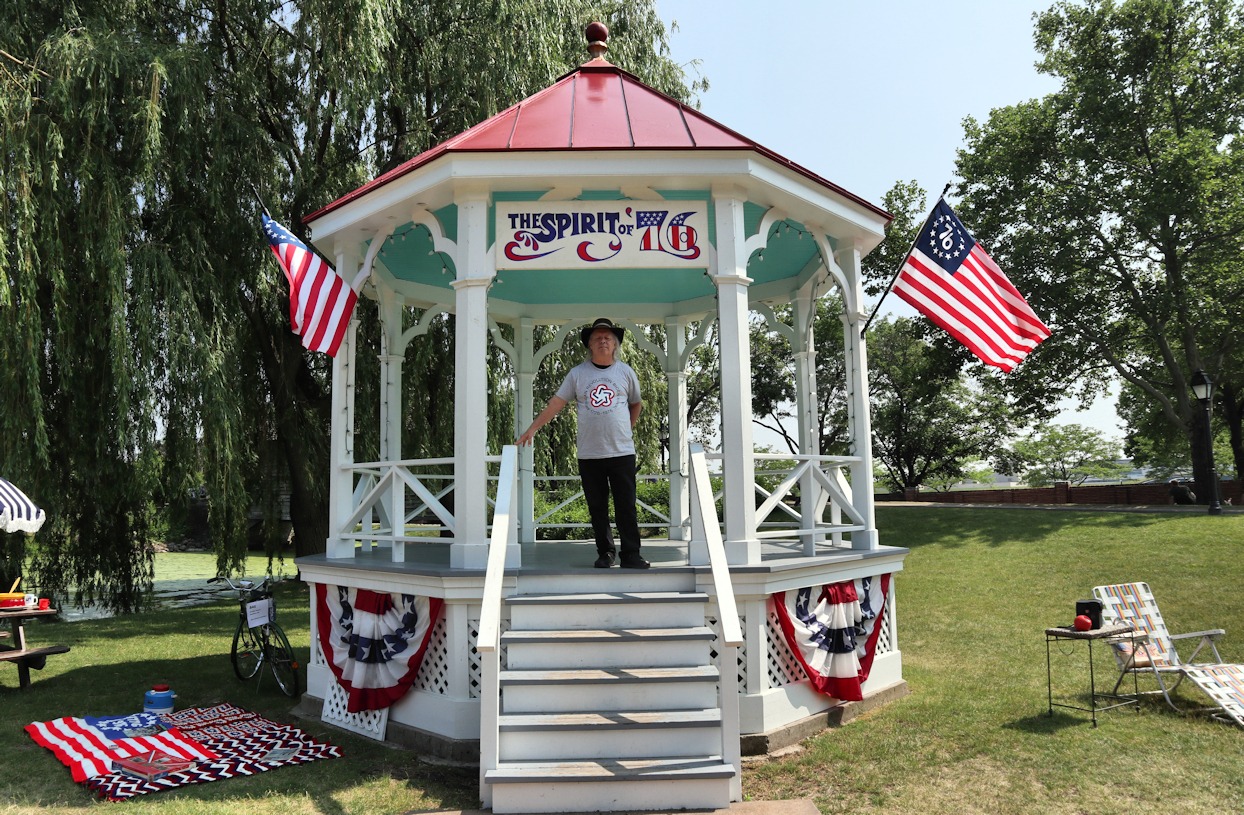 |
If I'm not in 1776, then I might be in 1976 celebrating the Bicentennial! (Yep---I'm wearing a replication Bicentennial t-shirt, too!) This pic was taken in 2023. |
And it's been since 2015 that I have had an annual 4th of July posting here on Passion for the Past, published right on July 4th itself, just like today's posting, and I've covered numerous different subjects pertaining to our wonderful American Holiday, including articles about those who originally printed the Declaration of Independence, reactions of those who heard it read for the first time back in 1776, and even how America celebrated the Bicentennial in 1976.
So this year I'm keeping it somewhat simple..
Am I patriotic?
Oh, you bet I am.
Ever since my posting from July of 2022 about the 1776-1976 Bicentennial celebrations of our nation's 200th birthday (click HERE), as well as my own experiences of that great Spirit of (19)76 year, I have spent lots of effort (and a bit of money) collecting and recollecting souvenir items from that time, and really enjoying it. Please understand, I'm not just collecting anything from the Bicentennial - just items that are appealing to me or things I personally may have had (but gotten rid of in the meantime), or just items that I remember from that period and never thought to keep.
And even a few that are just plain different...a bit unusual.
I'm letting the images here do the talking for the most part, though I do have lite explanations in the comments.
And I tried not to have a repeat of the same collectibles from my original Bicentennial post.
So let's get started - - - - and as you can see, I collected Bicentennial items of all kinds:
 |
| SPIRAL NOTEBOOKS! How cool to have had these back when I was in Jr High and High School! Well...I got 'em now, but they won't be used! |
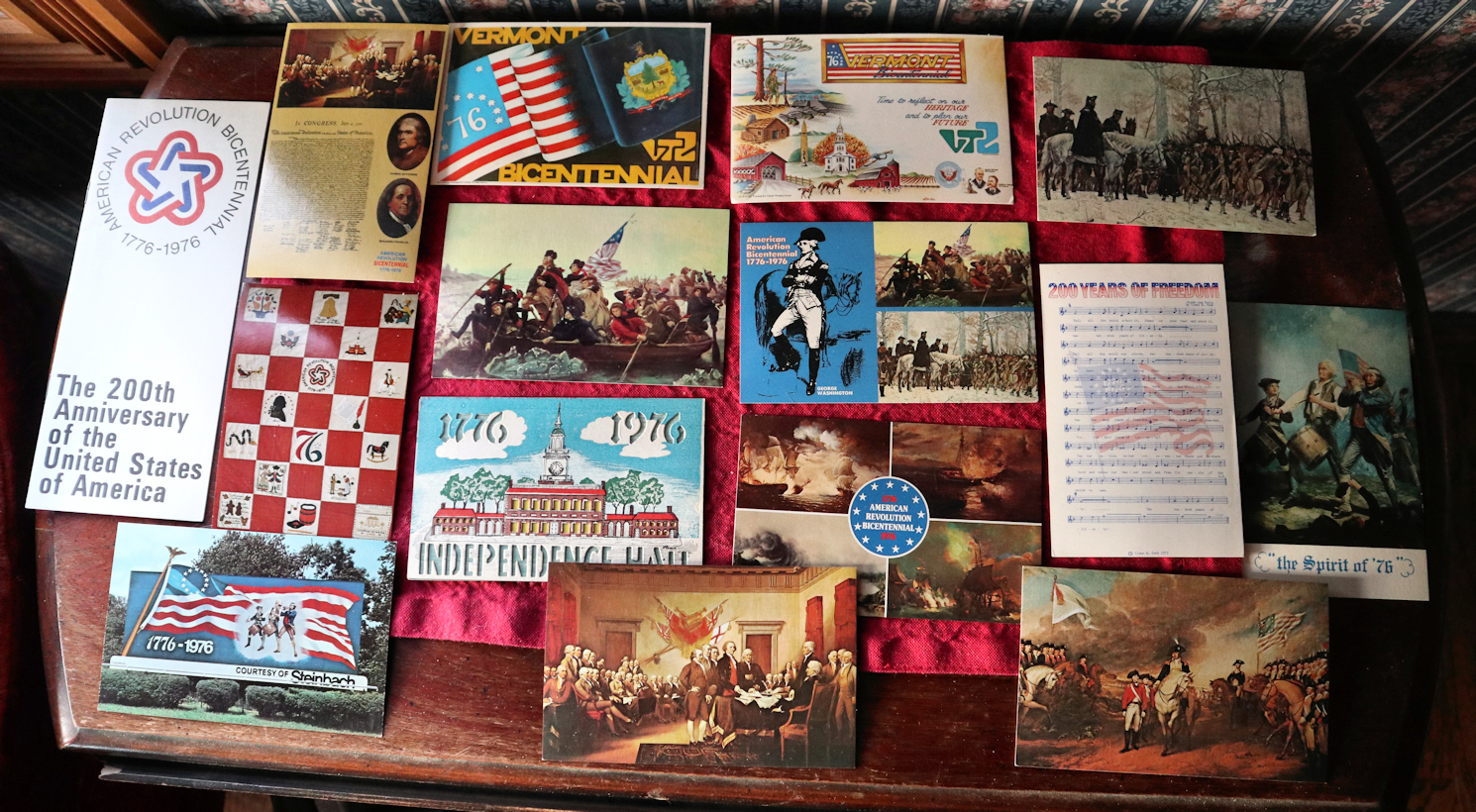 |
| Oodles of postcards never meaning to send - just to have because they are pretty awesome. |
A U.S. First Day Cover, or FDC, is an envelope or sometimes a post card bearing a stamp cancelled on the date the stamp was first available for postal use. In the United States, stamps are traditionally placed on sale at a site designated as the official First Day post office, where there is usually a ceremony dedicating the new stamp. The stamp or stamps then go on general nationwide sale the following day.
I did not purchase the following First Day Covers for the Bicentennial first-hand. I didn't even know what a First Day Cover was at that time!
But look at what I was able to find on eBay at a reasonable price:
 |
| ~Postmarked Boston - July 4, 1973~ |
 |
| And the coin that came with it! |
 |
| ~Postmarked Philadelphia - July 4, 1974~ |
 |
| Another cool coin! |
 |
| ~Postmarked Washington D.C. - July 4, 1975~ |
 |
| Why, look who is on this coin! |
 |
| ~Postmarked Boston - July 4, 1976...Bicentennial Day~ |
 |
| The Man of the Hour - Thomas Jefferson! |
 |
| A pewter tray with all of the colonies and most of the 1776 delegates. This is a very neat item that I've not seen before. I have to wonder, who would buy something like this? I mean that in a good way because it is such a cool item. I would. |
I remember seeing red, white, and blue striped Bicentennial glasses at my house, but I've no idea what happened to them. When I saw the following, I figured they would fit well into my collection.
 | ||
| Each of the six glasses depicts a famous person or event or building: The Old State House Boston Tea Party Paul Revere
|

Next up - - a wooden playing card box inlaid with two Bicentennial coins:
 |
| I'm not much of a card player, but this I couldn't pass up. I think it was the two coins that sold me on it: (left): Spirit of '76 (right): American Eagle Below: the pictures on the two card decks.  |
I took three pictures of this one because there are three scenes etched into it:
You may recall from the previous Bicentennial post I did, along with numerous others, where I've told of my very fortunate purchase of a replicated Old North Church lantern put out by the Concord Antiquarian Society in 1975. They were expensive then, and, as collectibles, still are today. But I have one and it holds a place of honor in my home. (I did a blog post about my lantern - click HERE to check it out)
 |
| Liberty Bell |
 |
| The Spirit of '76 |
 |
| and the American Flag crossed with the Betsy Ross flag. |
I went to a reenactor's shop & swap this spring and saw this.
 |
| It was in such good condition. Surprisingly, I've found only a very few of these nearly 50 year old items in rough condition. |
The man who sold it to me surprised me shortly after with this bell - no charge! He just felt he wanted his history collectibles to go to a good home.
Well, sir, they have!
 |
| "We hold these truths to be self-evident..." |
When I was searching for the lantern in 2015, and then finally found it at such a good price, I contacted the person selling it and he told me that he was now in his 80's, and since his children were uninterested he thought he'd sell it off and make a little money.
I asked him why he was willing to part with the lantern after 40 years and he replied with, "My last birthday brought me to 83 and the realization that it's time to find new homes for some of my life's impulsive acquisitions. My children's interests lie elsewhere, negating them as the willful beneficiaries."
Lucky for me, I suppose, but also kind of sad in a way. I certainly wish I had more of my own father's "impulsive acquisitions."
But, to me, it was their loss, and now it is my unbelievable gain, and for that I'm thankful. Very much so, for I remembered the advertisements and thinking back then how great it would be to have something like this.
So here I am now nearly 50 years later...
I often wonder if this man is still with us, for my heartfelt thanks goes to him, for the lantern, yes, but also for this bell~
I often wonder if this man is still with us, for my heartfelt thanks goes to him, for the lantern, yes, but also for this bell~
I love this tray for one reason alone:
 |
| ...I can see each day and date from both special years! |
A good friend of mine popped to me a picture of the following three plates and asked if I was interested in them.
They were made for the Bicentennial in 1975 and '76.
 |
| Signing the Declaration of Independence |
 |
| The Spirit of '76 |
 |
| Washington Crossing the Delaware |
 |
| The back of one of the plates. |
Here is something I remember and had in my teenaged hands, but tossed away.
In fact, they were made right here in Detroit:
Faygo celebrates the Bicentennial!
A quick history: In 1907, Ben and Perry Feigenson started bottling lager beer, mineral water and soda water. Recent Russian immigrants to Detroit, the brothers were trained as bakers. While packaging their soda water, they began playing around with the idea of creating soft drinks based on their frosting flavors.
The brothers formed the Feigenson Brothers Bottling Works, and in 1920 changed the name to Feigenson Brothers Company. In a clever marketing move, “Faygo” was adopted as the brand name in 1921 since Feigenson didn't fit on the labels very well.. They moved their growing bottle works to Gratiot Avenue (yes, still in Detroit) in 1935, where Faygo pop is still made today.
 |
| And Faygo joined in on the Bicentennial celebrations as well, for on the label was included a sketched likeness and short biography of members of the founding generation. The cans, from left: Daniel Boone, Patrick Henry, John Paul Jones, Lydia Darragh (female spy), and Crispus Attucks (shot and killed during the Boston Massacre). In between the cans we see fife & drum corps figurines, graciously given to me by a friend. I also have a silk banner hanging in the background. All from the same period - what a great time to be alive if you loved American History! |
 |
| Similar to the other one, though this has the Liberty Bell. |
As one who collects historic flags, I was ecstatic to receive this as a gift from a friend:
 |
| The official Bicentennial symbol on a cotton flag! From the same friend who gave me the pewter tray and the above silk banner. |
Now for something a little different...unique...and yet, is very historic:
without even trying I have a historic brick collection!
I know, I know...bricks?
Yes, bricks!
Yes, bricks!
 |
The first two bricks in the first row (left going down) once were part of the road/street in the tiny city of Croswell (Michigan), from back in the horse and buggy days when they had brick streets; they were in a pile and some were beaten up pretty bad, but we were allowed to grab some, and at the bottom of that 1st row I decided to include a leftover paver from our own back patio my brother Tom and I built about twenty years ago. It is a piece of my own personal home history of my wife & our kids. The brick top middle is from "old Greenfield Village." At one time it was a part of the walk in front of the Henry Ford Birthplace after the house was brought to Greenfield Village - yes, it was once a part of that wonderful place of history. When the Village "updated" its infrastructure in the late 20th and early 21st century, many of the employees at that time were able to collect these bricks as they were removed from the walkways - - and a friend, knowing what a fan I am of the Village, was so very kind and gifted one to me. My sincerest thanks...! Now, this Greenfield Village brick is directly above my bicentennial brick from Massachusetts (can you guess which one that is?) that I found on eBay. What a cool and unique souvenir. The bottom brick in the center row was given to me as a retirement gift by a co-worker who knows how much I love history, and so she got me a brick from the Willow Run Bomber Plant (located a bit west of Detroit) that she was able to grab during the remodel. Construction of the Willow Run Bomber Plant began in 1940 and was completed in 1942, to manufacture aircraft, especially the B-24 Liberator heavy bomber (WWII). Willow Run was also the "Birthplace" of Rosie the Riveter - and now I have a historic brick from that plant! How cool! The top brick in the third row (on the right going down with the 10 holes) is from Oakwood Junior High School (Oakwood Middle School), the school that I attended back in the early-to-mid 70s, which was torn down about 15 years ago. I asked one of the workers for a brick and he grabbed one for me. The two bricks below are from the chimney of our former family cottage built in the early 1930s. For more brick details, see below: |
Who would have ever thought bricks could be historic?
Certainly not me, though my mind has been opened, for old bricks can be very historical. And I never thought I'd ever have such a collection.
Well, not an intentional collection.
But each one has a history and helps to tell a story. I mean, those bricks on the upper left that once paved the streets and walks of Croswell, Michigan are simply a part of American history, aren't they? Bricks were commonly used to pave streets and walks, going back, as far as research shows, to the early 19th century (some say bricks were used in the colonies, along with cobblestone), and the idea carried on westward as America grew. Croswell was founded in 1845 (under a different name), and was incorporated as a city in 1881. This was more than likely around the time the brick were laid on the streets - perhaps maybe a little later, in the 1890s or the early 20th century, once automobiles became more popular. Some cement still sticks to them from when they were paved over with concrete.
Then there's the paver directly below the two Croswell bricks. My brother Tom and I worked together on making the patio that is still there at the back of my house. My brother is no longer with us, for he passed away in 2014, so this is an important part of my life, my history, which is why it is included here.
Now we go to the second row (center going down); you all know how much I love Greenfield Village, so to have a brick that I am sure I trod upon (along with millions of others) that was once a part of that favorite of all historical places is, well, let's just say "goosebumps."
As for the Bicentennial brick in the center:
tell me this isn't one of the coolest, most unique, and even most unusual Bicentennial collectibles you've ever seen: a 1776-1976 brick! It was advertised as a door stop (lolol)! I didn't hesitate to "Buy It Now" when I saw it. With me it'll have a quiet, more gentle (haha) life, sitting on a shelf with other collectibles.
As far as the Willow Run brick center bottom, well, from what my friend (and giver of this gift), Serina, said she was able to "pick out bricks when they started part of the remodel" and that it "is related to Henry Ford (since) he opened the Bomber Plant."
Serina is also a part of the group of women who pay tribute to Rosie the Riveter, so this is also a Rosie brick!
The brick on the upper right came from a school where I attended back in the early-to-mid 1970s. It was also my workplace as a custodian in the 1990s and into the 2000s, so it also has a personal history to it. The school was built in the early 1950s.
My family cottage chimney bricks are the last two bottom bricks in the third row.
My grandfather bought the place before I was even born, and I spent my entire youth there in Lexington (Michigan, on the banks of Lake Huron). I continued to visit the cottage well into my adult life, even after I married and had kids, so even my own family learned to love the place. When the cottage chimney suddenly came crashing down - no one was hurt, thank God - I grabbed a few of the bricks.
All of these bricks - bricks that help to tell a historical American story - will be kept until one day when I'm no longer a part of the living and my wife, kids, or grandkids can do what they wish.
You see, I don't pay attention to the younger generation telling me I must get rid of my stuff because no one will want them. It is my hope that my collection may be of some interest to my kids, grandkids, or even, one day in the distant future, my great grandkids. Maybe not everything I have, but I do have a feeling many of my items will be in our family for generations to come, for I have raised my kids with a deep commitment to family and our family history. Screw those people on the internet and in magazines who spew the psychobabble of telling us Boomers to get rid of our stuff - things that make us happy. We're alive now, and enjoying the heck out of them!
And collecting Bicentennial items is making me happy.
 |
| Even Snoopy & Woodstock were patriots and celebrated, as these bumper stickers show! |
 |
| This panel is called a Fleetwood Bicentennial of the Day of Freedom July 4, '76. |
 |
| This is the inside of the panel, showing special stamps issued in 1976 as well as all of the signatures of the Declaration of Independence. Pretty cool. |
 |
| This Birth of a Nation Coin & Stamp collection was also a good find at a good price. Included are two stamps, one commemorating the 200th birthday of the birth of Betsy Ross (1951), and the other, from 1937, shows the 150th anniversary of the Constitution signing. |
 |
| Very little says Bicentennial and Patriotism in those hippie-dippie days of 1976 than a frisbee. Oh yeah - - - tossing a frisbee back & forth and doing tricks (catching it behind your back or with one finger) was a major thing back then. And here's one in my own collection that celebrates the 200th birthday of the U.S. |
 |
| A 1773 Boston Tea Party Bicentennial Commemoration Decanter - celebrating the very beginnings of the American Revolution.  |
Next up is something else we can still easily relate to - a bottle of 7-Up!
 |
| This was a time when everyone - I mean everyone - was patriotic... And if there was something they didn't like about our country, they didn't hate on it. Instead, they continued to love it and would try to change what they didn't like. And if it wasn't a change that could be accomplished or others disagreed with, they didn't hate on that either; they accepted and moved on or they worked on the matter in a different way without the name-calling so prevalent today. So 7-Up had their own Bicentennial bottle celebrating America. And on the back - - - -  - - - - celebrating the Liberty Bell anniversary! |
Such as...
 |
| I received this mason jar as a retirement gift. Note the Liberty Bell on the glass and the colonial guy on the lid. So cool! |
 |
| Bicentennial coasters! When I was young in the late 1960s and throughout the 1970s and into the '80s, coaster for glasses were all the rage. |
Again, something a little bit out of the ordinary; Carl's Jr. is an American fast food restaurant chain located mainly in California. It began in the mid-1950s and is still in business today.
 |
| I was able to get three paper placemats from Carl's Jr. that have not been used. They were found in storage, and all three are in excellent condition, aside from slight aging and light storage wear. |
Now, being that I've lived in Michigan my entire life and have never traveled farther west than Nashville, Tennessee, what in the world would I want with paper placemats from a chain I've not even heard of, much less visited?
Because - just look at the one pictured here. It has such a great look to it!
Being that I have three, and knowing that since they are no longer in storage, I know the chances of these surviving without getting ripped or ruined in some way, I had two of them laminated while the third I will try to preserve as is.
During the Bicentennial Coca Cola, like so many other companies, put out a variety of patriotic collectibles, including their 1976 Heritage Collector Series drinking glasses.
 |
| I have two Paul Revere's to show both sides of the glass - and they have him shouting, quite accurately, "The Regulars ate out!" instead of the more common myth of "The British are coming!" |
There are four in this series, the other three denoted on the glasses being Patrick Henry, John Paul Jones, and George Washington. At this time I only have the Paul Revere glasses...but don't be surprised next year in seeing the others in my collection!
Now, it took me a while but I finally found a book published in 1976 by Greenfield Village and The Henry Ford Museum that was originally for sale in their gift shop. It was about and named for an exhibit created by the Henry Ford Museum exclusively for the Bicentennial called "The Struggle and the Glory." In its pages are loads of photos of historical antiques with accompanying information that were part of an exhibit of the same name. While reading through the pages I noticed a few of these historical items can still be seen, for they are now a part of the current 'With Liberty and Justice For All' exhibit. It makes me glad they are still utilizing these artifacts.
The book itself was found in a bookstore in Vermont, of all places!
To find such items as this book one must have a lot of patience, a bit of internet search know-how, and be willing to pay, perhaps, a bit more, depending on how badly you want it.
So here are a few pictures from that book I thought some of you might enjoy:
 |
| Sold at the giftshop back in 1976. I found it at a used book store (on-line) in Vermont! |
The table of contents:
France & England in America 1755-1763
Colonial Life 1763-1775
The War 1775-1781
The New Nation 1781-1789
The following shows a few of its pages:
And I finally obtained this:
 |
| Here is a map of the exhibition area~ |
 |
| Page one of what was inside the exhibit. |
 |
| Here is the second page of its contents - many items that were a part of this back in 1976 can still be seen in the current With Liberty and Justice For All exhibit. |
 |
| Some of the furniture that was on display in the exhibit can still be seen in the museum's historic furniture area today.  The subject of the Revolutionary War comes up (of course!) - both sides of the conflict, in fact. |
 |
| The back of the book cover has an ode to local native Americans. |
And I finally obtained this:
 |
| This trifold was in the Bicentennial posting I wrote in 2022. However, I did not have one of my own at that time. I do now. So here we can see inside the folds and know just how Greenfield Village and the Henry Ford Museum celebrated that wonderful historical year, day by day, week by week, and month by month: |
 |
| From January through April of '76, most of the activities took place inside the Henry Ford Museum, being that here in Michigan we definitely are a winter state and it is cold during these months of winter & spring. If you look close you can see "The Struggle and the Glory" listed under "Special Bicentennial Exhibit." |
 |
| With the warmer weather of later spring and summer, the open-air museum of Greenfield Village's Bicentennial celebrations came to life, culminating on the weekend of July 3rd, 4th, and 5th when three days of Revolutionary War history and reenactments took place. In the meantime, the Henry Ford Museum kept up the pace. Wow! What a time to visit! I wish I could have! |
 |
| Later summer into autumn into the Christmas season saw a slight slowdown, but the celebrations continued on. |
 |
| All the matches are still there. Yep---even matchbook covers celebrated! |
 |
| Ah...thee magazine of my youth: MAD Magazine also celebrated, in its own way! |
And now let's put the collection all-together!
 |
| So I thought I'd show you how I am displaying all of my Bicentennial "treasures": the pictures on top show two angles of my living room shelf, and the bottom photos have two angles of a book shelf, most of which holds my collectibles. By the way, my wife crochet the "shelf skirt" you see in the top pictures, which is based on one inside the parlor at the Firestone Farm in Greenfield Village! |
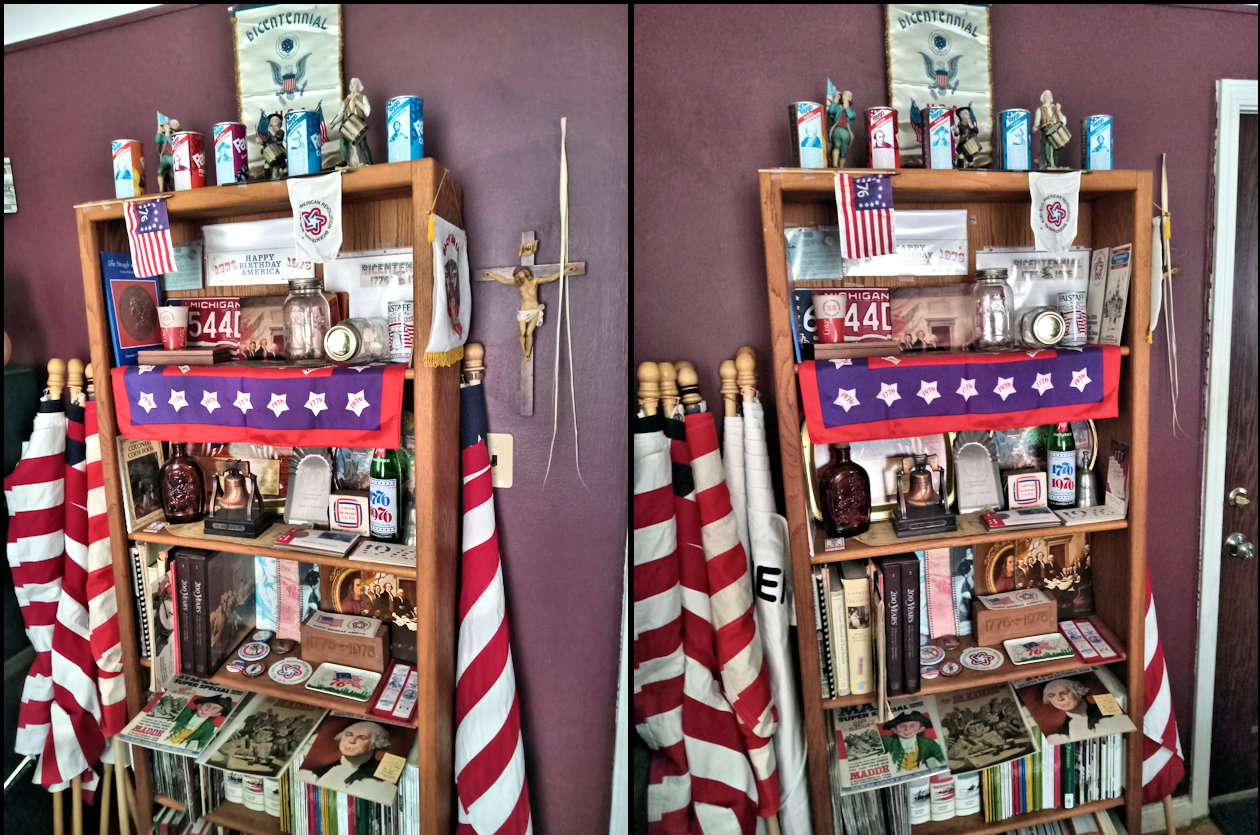 |
| I'm glad my wife enjoys things like this as well. Oh! The flags off to the side? Yeah...my various historical American flags. |
And that's a good way to end this portion of today's 4th of July post.
But wait---!!
Don't go yet!!
I have more to talk to you about ~ ~ ~ ~
Here is a recent bit of news about the planning for America's 250th birthday!
From a Boston site:
As Americans celebrate July 4, 2023, the 247th birthday of the nation, public and private preparations are already underway to mark the 250th anniversary of the independence of the United States of America, what will be officially known as the “Semiquincentennial,” on July 4, 2026.
 |
| The logo for America's Semiquincentennial in 2025~ And a link HERE |
Leading the planning is a special federal panel, known as the “United States Semiquincentennial Commission” – their work will be supplemented by a non-profit organization, the American Battlefield Trust, which works to preserve battlefields and historic sites from the Revolutionary War, the War of 1812, and the Civil War.
Philadelphia – home to Independence Hall and the Liberty Bell – is the unofficial center of the work on the Semiquincentennial, as the state of Pennsylvania has also established its own special panel to help with those 250th year celebrations.
It took a few years for the feds to figure out exactly what to call July 4, 2026 – the 250th anniversary didn’t have a convenient name like “Bicentennial” for the 200 year celebration of the United States, in 1976.
Some towns and groups have used names like Sestercentennial, Quarter Millennium, or Bicenquinquagenary (yikes!) to mark a 250th anniversary celebration – but the official designation of the Congress went for "Semiquincentennial," which technically means half (semi) of five (quin) of a century – so that gets you to 250 years.
(Ken's note: I always heard it would be called the "Sestercentennial" - I guess I was wrong)
“For many Americans, this July Fourth will look and feel very different,” said Daniel DiLella, Chairman, America 250. “These challenging times give us a unique opportunity to reflect on our shared history, and how each of our stories is woven together with the stories of all Americans. The National Park Service brings these stories to light through the deep cultural history of our National Park System, places where generations of Americans are reminded of our common ideals of life, liberty, and the pursuit of happiness.”
I absolutely hope that this celebration is done with patriotic pride. It doesn't take a ton of research to see that America has done much more good than bad and to see all of the wonderful changes that has occurred over the two and a half centuries.
How about 200 years of Music to accent your journey through America past?
 |
George Washington: "Music for the First President" by David and Ginger Hildebrand~ |
This recording contains music that George Washington knew or might have heard in his home or in the streets, in taverns and theaters, on the parade ground, the battlefield, or in ballrooms and concert halls.
Washington loved music and valued it for its practical as well as its emotional impact. When he arrived in Boston to take control of the Continental Army, among his first orders were directives ordering the fifers and drummers who played the camp duty music and the field signals. In Valley Forge in 1778 he gave 15 shillings to members of Proctor's band of music who trudged through the snow to serenade him on his birthday.
When he became an officer and a landowner, Washington had occasion to visit the colonial capitols of Williamsburg, Annapolis, Philadelphia, Boston, and New York to meet with governors and leading citizens. Balls, assemblies, private parties, and clubs were an important part of his social life. The flavor of these times is reflected in the music composed or or arranged to amuse members of the Tuesday Club in Annapolis, several of whom were acquaintances of Washington. This was a group of local gentlemen who met regularly between 1745 and 1756 to share a meal, sing rowdy songs, and tell stories.
When Washington went on trips, he brought home music books as gifts for his step-daughter, Patsy. Later in life he listened with joy as his step-granddaughter Nelly played his favorite songs on the harpsichord and pianoforte for her beloved grandpapa.
Kate VanWinkle Kelleris is the author of numerous books on colonial-era music and contra-dances.
David Hildebrande is a recognized scholar of early American music history, including colonial, Revolutionary War, Federal, and the War of 1812 periods.
 |
Dean Shostak - "Davy Crockett's Fiddle." |
This CD consisting of music from the late 18th and early 19th century as played on what is
believed to be the actual restored fiddle once belonging to Davy Crockett, which is very cool in itself. All other instruments used are roughly from around the same period of Davy Crockett's life - early 1800s.
 |
"American Folk Songbook" by Suzy Bogguss |
Here is a great CD that covers the mid-to-late 19th century, and since I purchased it in 2019 I've probably played it at least 50 times - no exaggeration. It's a collection of old American folk songs, a few of which I remember singing in music class at Deerfield Elementary (15 Miles on the Erie Canal and Old Dan Tucker), some that we had in the music books from our old Magnus organ (Sweet Betsy From Pike, Shenandoah, Beautiful Dreamer), plus other old-timey numbers (Swing Low Sweet Chariot, Banks of the Ohio, Rock Island Line, Shady Grove...) - - just a kaboodle of fun old tunes done in an old style with a contemporary fling.
 |
A Century of Ragtime - 1897 - 1997 |
Hearkening back to the turn of the 20th century, I have this wonderful collection of music that immediately brings to mind the big wheel bicycle, the trolley, the horse and carriage, and the early
automobile. Ragtime is a musical style that enjoyed its peak popularity between 1895 and 1919. Its cardinal trait is its syncopated or "ragged" rhythm.
As is written in the liner notes:
"All of the ragtime solos on this disc were published and are played in arrangements which adhere to the original sheet music in varying degrees."
The majority of these songs were published within the time-frame noted on the title of the disc.
 |
Nipper's Greatest Hits collections. |
In the 1990s, RCA released this collection of 90 years of popular music, beginning at the turn of the 20th century and going up to the 1980s (no '90s music collection, unfortunately), and all are
original recordings, including those from the earliest years. The biggest hits abound for each decade, so it's not like you are just listening to old and obscure records.
If I had one complaint it would be that from the 1920s through the 1980s, each decade gets two discs of music, while 1900 to 1919 only gets a total of 20 songs on one CD. I know there are plenty of original recordings from the first two decades of the 1900s that could have been included (I found them on other collections elsewhere), so they were a bit chincy here. As for the rest of the decades, however, they did an amazing job.
I love collecting the older original music that my parents, grandparents, great grandparents, and even great great grandparents heard back when these tunes were popular. I recall my grandpa having an old horn phonograph but I don't remember what had happened to it. Maybe my older siblings know more about that. I suppose I'll find out...if they read this (lol).
His Master's Voice indeed.
 |
| Time-Life's Sounds of the Seventies - 1976 |
And now to cover the Bicentennial year itself:
Here is the back of the CD so you can see the hit and hot music all over the the radio and on the record players/stereos everywhere in that Bicentennial year of 1976!
Though I knew all of these - and liked many of them - I was more of a fan of groups like Led Zeppelin, Bad Company, Aerosmith, Rolling Stones, and Pink Floyd during this time (mostly English groups - go figure!).
By the way, there is a part two to this set that I also have, but you get the gist of it.
This Bicentennial collecting really has been a lot of fun. It's not only a walk down memory lane for me, but a way to help to continue to fuel my patriotism, as well as being centered on history.
In the high school classroom where I work we have what's known as a "pencil tree," which would normally be used for Christmas. However, in our classroom we decorate it throughout the school year: for Autumn/Hallowe'en/Thanksgiving/Christmas/Valentines Day/St. Patrick's Day/Easter/Spring...and toward the end of the school year, patriotically to celebrate Memorial Day as well as for the 4th of July (though we're out for the summer by this last holiday). To decorate it as a patriot tree we use red, white, and blue lights, ribbons, and historic American flags.
 |
| Our patriotic classroom tree! |
The kids enjoy it immensely. In fact, they're usually the ones who get to decorate it.
So, in the picture below, you can see the classroom where I work. Or should I say "worked," for this photo was taken on the last day of school in June 2023; it was also my last day as well for I retired this year. As a gift I surprised each student with a small can of Pringles, a Hostess Ding Dong (my favorite snack), a copy of the Declaration of Independence (as you see rolled up on a few of the tables there), and an American flag. I was pleasantly surprised at how these high schoolers took to my patriotic gifts, and they all began to wave them, so we staff got in the fun and a picture was taken (you can see me in back directly below the canton of the large wall flag).
The future of America!
 |
| With the college kids being taught how not to be patriotic, I tried to teach the opposite to high schoolers in my class where I para at. So far, so good! I told them to wave the flag proudly on the 4th of July, and perhaps put it in a garden or flower pot the rest of the year. |
Something I have learned as I grow older is that youth is wasted on the young.
That's the truth.
When you're a 15 year old teen, there are many things you can't yet do or buy. At that time in my life any extra pennies that came my way went on buying albums of my favorite groups. 1976 saw the releases of Bad Company's Runnin' With the Pack, Aerosmith's Rocks, Steve Miller's Fly Like An Eagle, Rolling Stones' Black and Blue, and Led Zeppelin's Presence and double live The Song Remains the Same albums, and were added to my collection. Plus I had to have money to see Zeppelin on the big screen when they released their concert film. I saw it four times that year! Then there was keeping up my subscriptions to Circus and Creem Magazines. And that all cost me a nice chunk of change - even with the under-the-table $1.50 an-hour job of cleaning up at a local restaurant, money was very tight. Music was my main love at that time. History was there and was important - it was the bloody Bicentennial, for Pete's sake! - but at age 15 I wanted to be cool, and music is what made a zit-faced crooked teeth kid like me a bit cooler than a history nerd. So most of my Bicentennial collectibles that I coveted were what I could find for free.
Oh! To have the mindset I have today back in 1976!
But I am having such a good time finding and purchasing these things. And with the semiquincentennial at hand, I'll look for even more "cool"ectibles, though I have a feeling it won't even come close to the Bicentennial.
With that, until next time, see you in time.
Here are a few links you may be interested in checking out:
Celebrating the 4th of July 2012 - Before I began reenacting the 18th century - 1770s/Revolutionary War - I reenacted the 1860s/Civil War era (still do!), and on this 100+ degree July 4th, a few of us were very hot in all of our period clothing and celebrated at Greenfield Village. In fact, according to the Detroit News: "The hottest Fourth of July on record in Detroit was in 2012 with 102 degrees." And here's how it went for us that day.
Celebrating the 4th of July 2013 - A few of us returned to Greenfield Village in our 1860s clothing for this year's celebration. The temperature was much more reasonable than the previous year!
Celebrating the 4th of July 2014 - For my first time, I wore colonial clothes on the 4th of July, once again at Greenfield Village, and a few other colonials joined me. This, for me, felt perfect.
Celebrating the 4th of July 2015 - Celebrating similar to 2014, though we have a different set of colonials coming to the Village this year.
Celebrating the 4th of July 2016 - A few of us dressed colonial while others dressed Victorian, then we all found our way back to Greenfield Village. We were a sort of time-line.
Celebrating the 4th of July 2017 - We had a such a good time at Greenfield Village, then we went to Mill Race Village for our first time to check out their celebration! We even got a thank you in their newsletter: "Thank you to the Citizens of The American Colonies for bringing Ben Franklin and friends to remind us of where and how this country began."
Celebrating the 4th of July 2018 - Pretty much a repeat of last year, only we had different folks join us at Greenfield Village and we had a larger group - a much larger group! - join us at Mill Race Village, where we made quite a splash.
Celebrating the 4th of July 2019 - This was the best 4th of July yet! We had a very large group of colonials come out to Mill Race Village and celebrated America in a way it hadn't been done in over 40 years, I'm sure! What fun we all had!
Celebrating the 4th of July 2020 - 2020...the year of Corona Virus/Covid-19. Nothing - absolutely nothing - was going on, or so one would think. However, when Greenfield Village finally opened its gates on that July 2nd---just in time for the 4th!---I was ecstatic! And then a few of us decided to come out in our colonial-era clothing and celebrate the 4th of July as we've been doing, only as a smaller group.
But we did it!
Celebrating the 4th of July 2021 - The Covid fear was still reigning o'er the land, but it had much less of a grip, and our celebrations of Independence Day began to grow once again. We went back to Greenfield Village. We went "unofficially" back to Mill Race Village on July 5th, which was the Federal celebration, though with a smaller group than two years ago. There was nothing going on, though a number of visitors were enjoying the bright sunshiny day and strolled through the park.
And my wife and I even paid a visit to Crossroads Village.
Celebrating the 4th of July 2022 - This was a full weekend celebration! Beginning by watching the parade in Lexington, Michigan, traveling to Greenfield Village's Salute to America the next day, then having the largest 4th of July celebration since the Bicentennial in 1976 at Mill Race Village the following day!
Here is a sort of "part one" of today's post:
Celebrating America's Bicentennial - this is what I wrote in 2022 and shows my Bicentennial collection of Americana collectibles as well as has some fun stories from friends on how they celebrated that magical year back in 1976.
~~~~~~~~~
"Something special happened nearly two and a half centuries ago. But is that story being told and promoted? And to do that, you also have to be willing to promote what makes America special. That's not very PC/woke these days, but maybe it's time to start celebrating America again, especially in the run up to the 250th in 2026."
And here are links to help you to understand this holiday's history:
Declaring Independence: The Spirits of '76 - I had a conversation with Benjamin Franklin for this posting. Check it out and see! There is a lot of cool information about the writing of the Declaration and of those who signed it.
Unsung Patriots: The Printing of the Declaration of Independence - We have all heard on how those who signed the Declaration of Independence were putting their own lives on the line by signing such a treasonous document, right? But what about those who printed it? They were also putting their lives on the line as well. And just how did they spread the word and distribute this most important of all America's papers? How long did it take to get it from the printer's to other cities and towns?
Yep---you'll find the answers here!
The Great Declaration of July 4th, 1776: Reactions From Those Who Were There - So now we've learned about the Declaration of Independence and of its printing in the above posts. But how did the public respond when they first heard it??
Independence Day: A "Passion for the Past" History of This Grand Holiday - So, just what were the causes for the Founding Generation to want to claim Independence from Britain, and what were some of the events that occurred?
Here is a post of links to other postings I wrote on those issues.
August 2nd, 1776: The Signing of the Declaration of Independence - Contrary to popular belief, the Declaration was not signed on the 4th of July.
Wha---?
Yep--it's true. Here, click the link and see for yourself.
With Liberty and Justice For All - A pretty amazing collection of American history, many of the earlier items displayed here were a part of the The Struggle and the Glory exhibit from the Bicentennial.
I've also written on and about people and things from America's founding generation called Buried Treasure: Stories of the Founding Generation - there are some very cool stories and objects here I think you may be interested in.
~~~~~~~~~~~~~~~~~~~~~~~~~~~~~~~~